


Why The Medusa:
The shipwreck of the Medusa and its aftermath provides an insight into the corruption of the social class system in France in the 18th century. The French Frigate Medusa was a warship destined for Senegal with the hopes of recovering St. Louis from English control. This exhibit will take the reader through the story of the Medusa from the moment it launched to its tragic end and how it became immortalized through the painting “The Raft of The Medusa” by Theodore Gericault.
This particular shipwreck highlights the social hierarchy and corruption of France during the 18th century because it was those of lower status that were ultimately banished to the raft. Furthermore, not only were they forced to fit 400 people on a single raft they were also abandoned by the other boats. The Wreck of the Medusa also serves as an example of the corruption within the French government itself, as an incompetent captain was put in charge due to status and favor of the King, rather than skill.
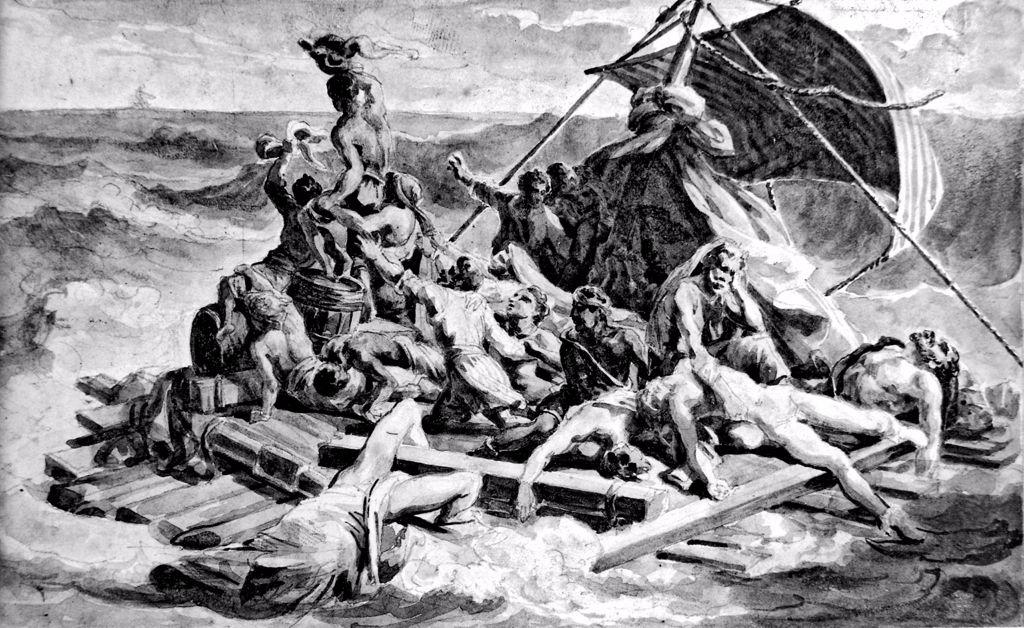
In the portion titled The Journey Towards Senegal there is an emphasis on the journey of the Medusa and the events that led up to the creation of the Raft of The Medusa. Within this section there is an in depth exploration of the landmarks the Medusa encountered on its journey towards Senegal which gives the viewer an idea of what the Medusa’s path towards Senegal looked like. To further explain the journey of the Medusa it is important to understand its end goal for embarking on the journey in the first place. The ship was attempting to reclaim St. Louis, a settlement in Senegal, from French control. The Medusa was a warship that contained several important people including the Governor of Senegal and army battalions. Along its journey towards Senegal the Medusa made many navigational errors due to the incompetence of their captain, who was only in charge of the Medusa due to his prior loyalty to the crown before the Napoleonic wars. All of these aspects caused the Medusa to get off course and run aground in the Bank of Arguin. The shipwreck of the Medusa is only the first part of the story of this ship due to the events that occurred aboard the Raft of The Medusa. The raft contained the lower class crew members and the black army battalion. The subsequent abandonment by the other boats caused the raft to be left to its own demise which is how they ended up struggling to survive for 13 days with minimal food and water. While the raft was drifting aimlessly in the sea mutiny, cannibalism, and death transpired. Nothing could end the cruel sufferings of those aboard the raft and out of the 150 people originally aboard the raft only 15 of them survived to see their rescue.4
The page “John Gericult: The Painting of the Shipwreck of the Medusa” explores the context behind Gericult’s fascination with the wreck of the Medusa, his painting process, and the intention behind his work. Furthermore, it examines the painting through an art history and visual analysis lens, as well as the painting’s reception at the time of its creation.
The page “The Medusa Now” delves into the relevance of this tragic shipwreck story today. Gericult’s painting, now displayed in the Louvre, has engendered an interest in the story. The shipwreck is referenced in modern art, literature, podcasts, and music. Along with this, historians and academics have referenced The Medusa as a metaphor for modern-day corruption and social class discrimination.
About The Authors:
Liv Wilson
Liv Wilson is a freshman at Carleton College from Dillon, Colorado and a prospective English major. In this project her research focused on the Medusa’s journey towards Senegal and the events that led up to the Raft of Medusa. She also focused on the specific events aboard the raft.
Nina Georgeson
Nina Georgeson is a freshman at Carleton College from Saint Paul, Minnesota. Nina’s research for this project focuses on the Medusa’s relevance today. She addresses pop culture references of the painting, social commentary regarding the painting, and what people are saying about the painting today.
Mia Melsted
Mia Melsted is a freshman at Carleton College from Los Angeles, California. Her research in the project focused on the painting The Raft of the Medusa, Gericault’s creative process, and the significance of the painting’s contents and reception.
Footnotes:
- Gericault, Theodore, 1791-1824, “Raft of the Medusa: figure study.” ↩︎
- GERICAULT Jean Louis André Théodore (1791-1824), “Drawing. Study for the “Raft of the Medusa.” ↩︎
- GERICAULT Jean Louis André Théodore (1791-1824), “Drawing. Second in a series of four watercolors illustrating Le naufrage de la frégate la Méduse.” ↩︎
- Savigny, Jean Baptiste Henri, and Alexandre Corréard, “Narrative of a Voyage to Senegal in 1816.” ↩︎