
“The American navy consists of about seventy vessels, embracing all from the ships-of-the-line to the smallest brig, schooner, and store-ship. Of these many ships-of-the-line, frigates, steamers, and sloops-of-war are not only unfit for service, but, I am advised by the Bureau of Construction, Equipment, and Repair, are not worth repairing. There are not now in the navy forty vessels which could be brought into service in ninety days, if needed.”
J. C. Dobbin, United States Secretary of the Navy, December 5, 18531
Dated December 5, 1853, the U.S. Navy Department’s annual report of 1853 was written by the then Secretary of the Navy J. C. Dobbin. It covered the state of the U.S. Navy at the time, its actions over the previous year, along with his observations and recommendations for the future for nearly 22 full pages—not including the 21 additional documents submitted. Placed roughly in the middle of the report—under a section titled ‘Increase of the Navy’—lay the plans that would result in the creation of the USS Merrimack, along with the USS Roanoke and USS Minnesota, which would both face off against the CSS Virginia in the Battle of Hampton Roads.2
As for the rationale behind his plans, Dobbin believed, or feared, that the United States was starting to fall behind. Overall, the U.S. Navy that Dobbin described wasn’t that different from the ones of previous years. However, it was this stagnation that was the issue, especially in a century characterized by technological advancements.
By the 1850s, times had changed. As J.C. Dobbin puts it, “A new empire has, as by magic, sprung into existence,” the burgeoning American one.3 With the signing of the Oregon Treaty of 1846, Treaty of Guadalupe Hidalgo in 1848, and the beginning of the California gold rush in 1848, the United States had massively expanded its territory. But now, it needed to protect its territory and people living there, despite increasing by nearly an entire third in size. Not only that, but the specter of Europe loomed over the United States. As the United States put in effort to be considered among the same league, increasing tensions in Europe had Britain and France increasing their own military might.4
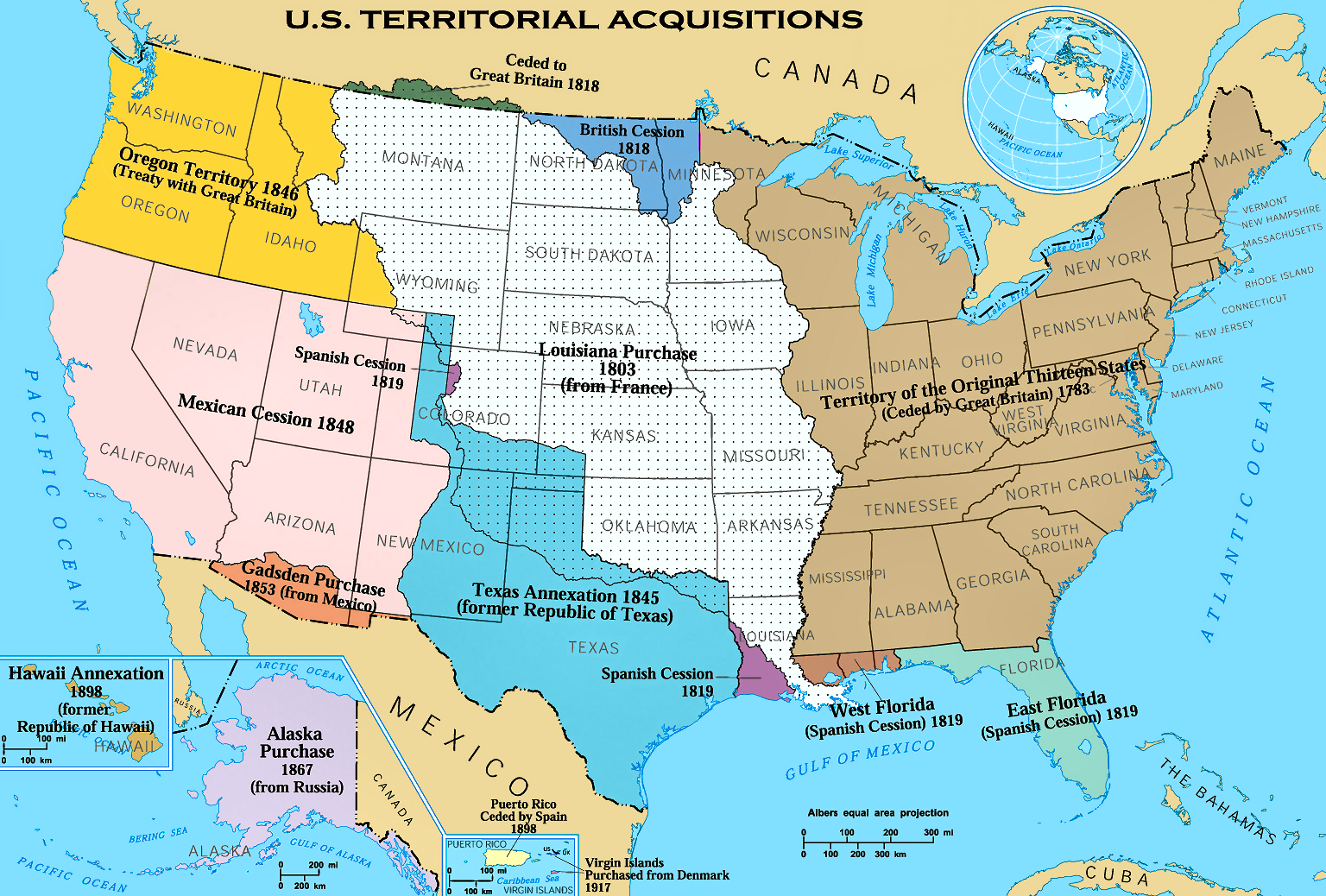
It was time for the United States to modernize its navy and the Secretary of the Navy had just the plan.
“I recommend, therefore, that the department be authorized to have constructed at least six first-class steam-frigate propellers.”
J. C. Dobbin, United States Secretary of the Navy, December 5, 18536
Creation of the USS Merrimack
On June 27, 1854, the design plans of the ship that would become the USS Merrimack were sent to Charlestown Navy Yard, in Boston, Massachusetts.7 As the largest ship to be built at the Charlestown Navy Yard at the time, special preparations had to be made for it to fit, before construction officially started in July of the same year.8 While many of the design elements of the USS Merrimack were influenced by the ships of the Royal Navy—including shape and propeller design—the sheer size of the ship was a staple of the U.S. Navy at the time.9 10 Lacking the ability to make a numerically superior navy, the United States decided that bigger was better, aiming to make ships large enough to completely dwarf any possible opponents.


Two engines, each with a diameter of 72 inches were installed in the ship, along with a screw propeller.15 Despite the importance the USS Merrimack’s engines would play for both its own service and for that of the CSS Virginia, the Navy did not intend its newest vessels to run primarily on steam power. Instead, they intended the USS Merrimack and the rest of its class to be primarily sailing vessels, which could tap into steam power for smoother or faster travel, along with during tactical maneuvering.16
The USS Merrimack was equipped with 40 guns total, notably all shell firing guns with the capacity to also fire solid shots, and it had the most advanced artillery available. Prior to this, large warships of both U.S. and European navies always carried a mixture of solid shot guns and shell firing guns, rather than cannons that could fire either or.17 It would be one of the most powerful ships afloat and was acclaimed as the pride of the U.S. Navy.18
The USS Merrimack was launched on June 14, 1855 in a ceremony witnessed by twenty thousand spectators, lining the shore and filling the nearby waters in hundreds of smaller vessels. At exactly 11am, a bottle containing water from the Merrimack River was smashed, christening the ship, before it slid into the water to a 31 gun salute, one for each U.S. State at the time.19 As one magazine announced,

“When the Merrimac and her sister steam frigates are once equipped and fairly afloat, bearing aloft the stars and stripes, we shall have no reason to be ashamed of our steam navy. This squadron will form a nucleus, at least, around which, in time of need, may be gathered, as circumstances warrant the addition, a formidable fleet of ships, independent of wind and tide. The time had really arrived for government to take hold of this matter, and redeem our credit. The English and French were, as, indeed, they still are, far ahead of us in their steam defences, but we can now overtake them when necessary.”
Ballou’s Pictorial, July 14, 185521

Service in the U.S. Navy
It would not be until February 20, 1856 that the USS Merrimack would be completed and formally commissioned, costing $685,842.19 total.23 On April 9, 1856, the USS Merrimack received its orders for its first commission.24 Rather than immediately begin military service, it was instead tasked to what was essentially a combination domestic and international parade, showing off the might of the United State’s newest and finest ship to thousands.
To start, the USS Merrimack left for Annapolis, Maryland on April 14, 1856, to be visited by the President of the United States. When the ship arrived five days later, both the Senate and House adjourned sessions “to allow members the opportunity to visit the new war steamer.”25
“The President and Secretary of the Navy expressed their high admiration of the strength and beauty of the Merrimac, and appeared to enjoy, with a great deal of pleasure, the ceremonies and exercises to which the visit gave occasion.”26
This was only the beginning of the 17 days the ship was at Annapolis, which were filled with frequent visits by members of Congress, local politicians, navy officials, and curious members of the public.
After the fanfare at Annapolis, the USS Merrimack sailed down to Havana, Cuba, arriving on June 2. An unfortunate failure of the propellers along the way temporarily paused the ship’s plans, forcing it to head back to Boston for repairs.


Fortunately, the repairs didn’t take long and the USS Merrimack left for New York Harbor on the 14th of August, 1856, before it set off for Southampton, England the 8th of September. Arriving on September 25, the ship spent the next 5 weeks in port, where it was visited by an eclectic mix of curious civilians, politicians, Royal Navy officers, technical journal correspondents, a few members of European royal families, along with both a Vice Admiral and an Admiral.29
The USS Merrimack would arrive in Brest, France on November 1, 1856, continuing its tour of various European ports. Notably, each port it visited was chosen for its proximity to major naval stations of their respective countries.
Arriving in Lisbon, Portugal on the 16th of November, the USS Merrimack was host to a number of diplomats before it set off again for Cadiz, Spain in early December. Staying until nearly the end of the year, the USS Merrimack left for Barbados in the Caribbean on December 29, 1856.30
Docking at Charlestown Navy Yard on the 6th of April 1857, it was put out of commission sixteen days later until its next orders.31
After four months of repair and modifications, the USS Merrimack was recommissioned for the second—and last—time to considerably less fanfare on September 1, 1857.32 Entering active military service, the USS Merrimack was granted the designation of flagship of the U.S. Pacific Squadron.33
On February 16, 1860, the USS Merrimack was put out of commission for a final time in Gosport Navy Yard, Virginia.34 It had spent more than 2 years as flagship and had travelled a total of 42,675 miles along the way, crossing the equator a total of 8 times.35
Footnotes:
- United States Navy Department, Annual Report of the Secretary of the Navy 1853, 307. ↩︎
- United States Navy Department, Annual Report of the Secretary of the Navy 1853, 297-319. ↩︎
- United States Navy Department, Annual Report of the Secretary of the Navy 1853, 308. ↩︎
- Kinnaman, “Merrimack, The Biography of a Steam Frigate,” 5. ↩︎
- Wikimedia Commons contributors, “File:U.S. Territorial Acquisitions.png,” Wikimedia Commons, https://commons.wikimedia.org/w/index.php?title=File:U.S._Territorial_Acquisitions.png&oldid=1179972275 (accessed March 16, 2026). ↩︎
- United States Navy Department, Annual Report of the Secretary of the Navy 1853, 310. ↩︎
- Kinnaman, “Merrimack, The Biography of a Steam Frigate,” 21. ↩︎
- Kinnaman, “Merrimack, The Biography of a Steam Frigate,” 22. ↩︎
- Kinnaman, “Merrimack, The Biography of a Steam Frigate,” 16. ↩︎
- Kinnaman, “Merrimack, The Biography of a Steam Frigate,” 69. ↩︎
- Dutton, Thomas Goldsworth, “United States “Auxiliary Screw” steam frigate “Merrimac” 60 guns. Off the entrance to New York harbour.” Lithograph. London: Published by W. Foster, 114, Fenchurch Street, [between 1856 and 1860]. From Library of Congress. https://www.loc.gov/pictures/item/2009633651/ (accessed March 15, 2026) ↩︎
- Kinnaman, “Merrimack, The Biography of a Steam Frigate,” 17. ↩︎
- U.S. Naval Institute. Proceedings. “The U.S.S. ‘Niagara.’” April 1, 1929. ↩︎
- Kinnaman, “Merrimack, The Biography of a Steam Frigate,” 141. ↩︎
- Quarstein, “The CSS Virginia: Sink Before Surrender,” 23. ↩︎
- Kinnaman, “Merrimack, The Biography of a Steam Frigate,” 18. ↩︎
- Kinnaman, “Merrimack, The Biography of a Steam Frigate,” 19. ↩︎
- Quarstein, “The CSS Virginia: Sink Before Surrender,” 26. ↩︎
- Ballou’s Pictorial, “Launch of the Steam Frigate Merrimac,” July 14, 1855. ↩︎
- “NH 86347-KN USS Merrimack (1856-1861).” ↩︎
- Ballou’s Pictorial, “Launch of the Steam Frigate Merrimac,” July 14, 1855. ↩︎
- Wikimedia Commons contributors, “File:USS Merrimack – NH 46248.jpg,” Wikimedia Commons, https://commons.wikimedia.org/w/index.php?title=File:USS_Merrimack_-_NH_46248.jpg&oldid=1010712148 (accessed March 16, 2026). ↩︎
- Quarstein, “The CSS Virginia: Sink Before Surrender,” 26. ↩︎
- Kinnaman, “Merrimack, The Biography of a Steam Frigate,” 50. ↩︎
- Kinnaman, “Merrimack, The Biography of a Steam Frigate,” 54. ↩︎
- Kinnaman, “Merrimack, The Biography of a Steam Frigate,” 54. ↩︎
- “NH 46250 USS Merrimack (1856-1861).” ↩︎
- Wikimedia Commons contributors, “File:”Port of Realejo — 1859″ – NH 116.jpeg,” Wikimedia Commons, https://commons.wikimedia.org/w/index.php?title=File:%22Port_of_Realejo_–_1859%22_-_NH_116.jpeg&oldid=909560308 (accessed March 16, 2026). ↩︎
- Kinnaman, “Merrimack, The Biography of a Steam Frigate,” 87-90. ↩︎
- Kinnaman, “Merrimack, The Biography of a Steam Frigate,” 97-102. ↩︎
- Kinnaman, “Merrimack, The Biography of a Steam Frigate,” 121. ↩︎
- Kinnaman, “Merrimack, The Biography of a Steam Frigate,” 151. ↩︎
- Quarstein, “The CSS Virginia: Sink Before Surrender,” 27. ↩︎
- Quarstein, “The CSS Virginia: Sink Before Surrender,” 30. ↩︎
- Kinnaman, “Merrimack, The Biography of a Steam Frigate,” 271. ↩︎