
The Story
The Essex, a Nantucket whale ship, set sail on August 12, 1819. The ship was captained by George Pollard, with Owen Chase and Mathew Joy as first and second mates, and with 21 crew members, 7 of whom were Black.1 The Essex had been on many successful journeys prior to setting sail in 1819, but this journey was unlucky from the start. Even before sinking, the ship had gathered only 800 of the 2,000 barrels of oil required to return to Nantucket after almost a year and a half at sea.2
On November 20, 1820, the ship’s luck seemed to be changing. The skies were clear, and the lookout yelled, “There she blows,” referencing the cluster of whales spotted in the distance. The crew lowered and filed the whale boats, leaving the Essex to chase the pod of whales. Captain Pollard, first mate Chase, and second mate Joy each captained a whale boat. Chase’s whaleboat was the first to harpoon a whale, and soon after, Pollard’s boat harpooned a second. While attacking a third whale, Chase’s boat was stoved in by the creature’s tail. Chase and his boat’s crew quickly returned to the Essex to repair their boat.4 While working on repairs, Thomas Nickerson, a cabin boy aboard Chase’s whale boat who was keeping lookout at the bow of the ship, saw a large spermaceti whale racing towards the Essex. He yelled to warn his mates, but the experienced crew members had never seen anything like it and had no way to stop the 85ft whale from attacking the ship. The whale rammed the Essex twice with its head. Whales have extremely reinforced skulls, so the two blows easily totaled the ship.5 Owen Chase described the whale’s attack as an act of revenge on the behalf of his dead companions:
“His aspect was most horrible, and such as indicated resentment and fury. He came directly from the shoal which we had just before entered, and in which we had struck three of his companions, as if fired with revenge for their sufferings.” 6

Quickly after the Essex was hit, Chase regained himself and ordered his crew to grab resources from the ship, fill their repaired whale boat with them, and escape the wreck. The crew grabbed compasses, the captain and Chase’s trunks, and two quadrants, a device used to measure the angle of the sun and moon to determine latitude. Chase’s whaleboat encountered the other two boats and relayed the unbelievable information of the attack.8 Chase describes Captain Pollard’s reaction to the news:
“I could scarcely recognise his countenance, he appeared to be so much altered, awed, and overcome, with the oppression of his feelings, and the dreadful reality that lay before him.” 9
It is important to note that the owners of the Essex severely under-stocked the ship with food to make a larger profit from the journey, not expecting the devastation that was to come.10 The first day after the attack, the crew rescued 600 pounds of bread, 195 gallons of water, a musket and powder, two pounds of boat nails, and several turtles. These resources were split among the three whale boats based on the number of men aboard them and the strength of the boats.11 They also attempted to strengthen the flimsy whaleboats by adding sails and building up their sides with wood from the Essex, in an effort to limit the amount of water splashing aboard.12
Two days after the attack, the whale boats left the sunken Essex. They were fairly close to the Marquesas Islands and the Society Islands, but the men feared the inhabitants were savages or cannibals, and they would be in more danger there than at sea. It was therefore decided to set their course to the coast of Chile.13
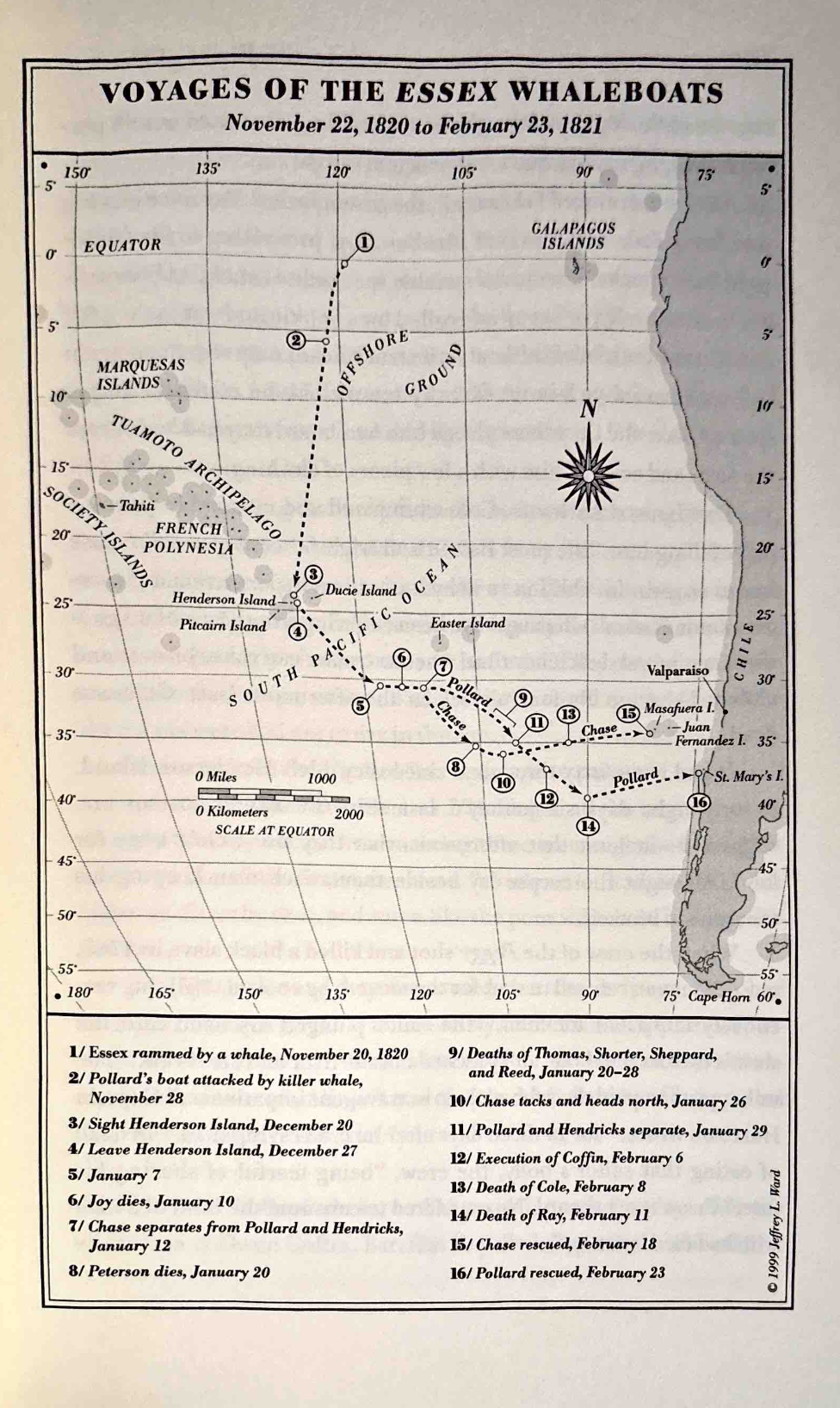
The three fragile whale boats continuously struggled with leaks that the men had to keep repairing to keep them afloat.15 The crews of the three whale boats worked hard to keep their vessels together. Chase admitted that they were losing time as they kept changing course and making light and noise to find lost boats, but staying together also provided irreplaceable companionship.16 The assigned food ration at this point in the journey was a little more than a pound of bread, one biscuit, and a half pint of water.17 Chase placed the limited rations in his chest and kept a part of his body on it at all times, while armed with his pistol to protect them. Extreme thirst and hunger began setting in. Crew members turned towards the turtle’s blood and their own urine to sustain them. 18
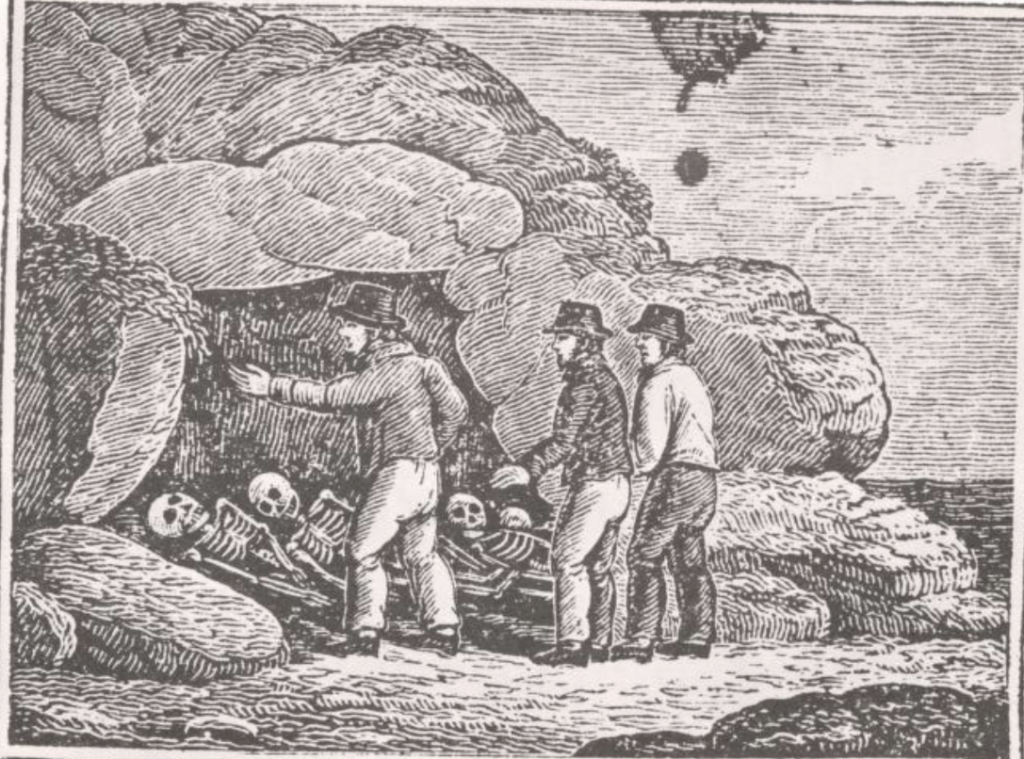
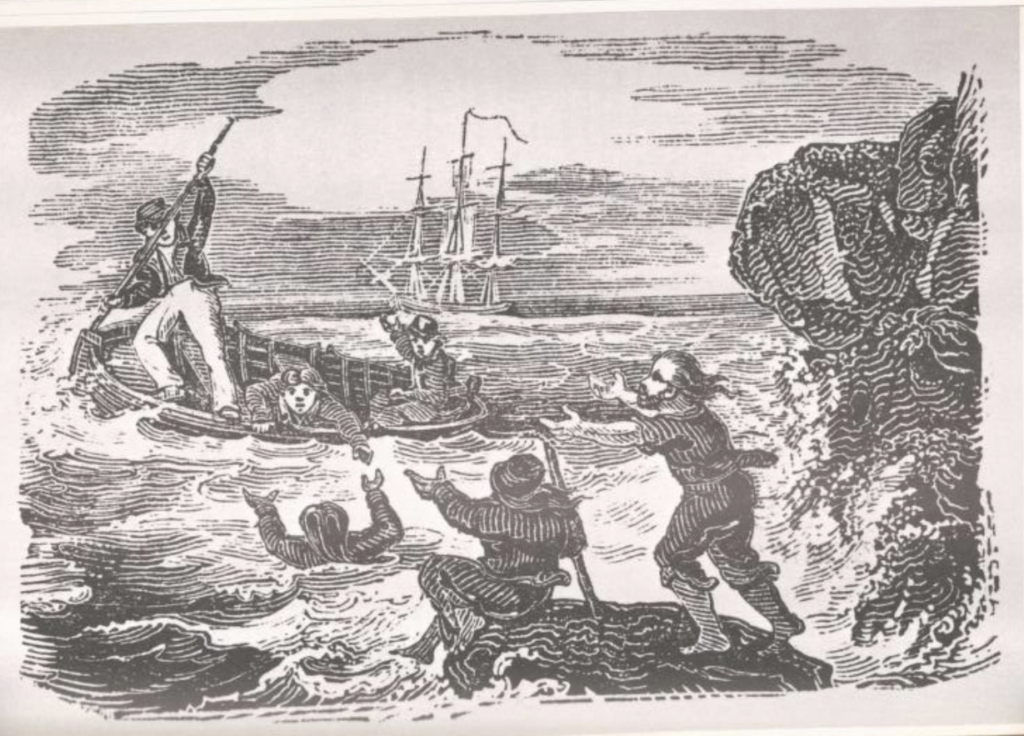
On December 20, 1820, exactly one month after the sinking of the Essex, the crew spotted land. The men believed they had landed on Ducie’s Island, but later studies have suggested it was more likely Henderson Island.20 The men enjoyed the fish, birds, and vegetation on the island for seven days before they severely diminished the ecosystem’s food supply. A spring was also found after several days, providing the crew with water and the ability to refill their boat’s kegs. The men decided to leave the island after about a week, as there was not enough food there to sustain them, and their chances of being rescued by another boat were much lower on land. Three men, William Wright, Thomas Chapple, and Seth Weeks, decided to separate from the others and take their chances on the island. 21
After leaving the island, the crew set course for East Island but quickly changed course to Juan Fernandez Island due to the wind patterns.22 The second mate, Matthew P. Joy, who had reported being sick during the whole journey, was the first man to die.23 Owen Chase’s boat was permanently separated from the others on January 12, 1821. Around this time, due to extreme starvation, Chase’s crew lost all strength and was no longer able to steer the ship, leaving their destiny up to Providence.24 The first man aboard Chase’s boat died on January 20, 1821, of starvation. He was a Black man named Richard Peterson. His body was cast into the water. The second man, Isaac Cole, died of starvation after going mad. The crew prepared to send his body into the ocean, but reassessed and kept it for food instead. They wrapped the man’s heart in his clothes and sent it into the sea before eating his body.25
Thomas Nickerson was about to give up hope and give in to death when the sail of a boat was spotted. The boat was the Indian from London and helped Chase along with his two remaining crew members, Thomas Nickerson and Benjamin Lawrence, recover and return home after their 93 treacherous days at sea.26

The Fates of The Other Men
Eight of the twenty men survived the sinking. The initial crew count was twenty one but one man jumped ship prior to the sinking. The survivors were George Pollard, Charles Ramsdale, Owen Chase, Benjamin Lawrence, Thomas Nickerson, William Wright, Thomas Chapple, and Seth Weeks.28
Captain Pollard’s boat was saved by an American Whaleship called the Dauphin. Brasilia Ray, Owen Coffin, and Samuel Reed all died on Pollard’s boat. The first four men to die and be eaten on Pollard and the second mate’s boats were Black this was likely because the Black men had been undernourished prior to the sinking and had less fat on their bodies to sustain them. Additionally, the Black sailors were also, in all likelihood, in poorer health prior to the journey as the life expectancy for Black people at the time was around 15 years younger than that of their White counterparts.30 After these men died, the remaining crew cast lots and Owen Coffin was chosen to be shot for food.
The survivors sent word about the three men on Henderson island and they were all rescued.
The third whale boat was never found.31
| Crew member name | Whale boat | Fate |
| Captain James Pollard | 1 | Survived |
| Obed Hendricks | 1 | Put on 3rd whale boat after the death of the second mate, lost at sea |
| Brazilla Ray | 1 | Died |
| Owen Coffin | 1 | Shot |
| Samuel Reed (Black) | 1 | Died |
| Charles Ramsdale | 1 | Survived |
| Seth Weeks | 1 | Left on island, survived |
| Owen Chase | 2 | Survived |
| Benjamin Lawrence | 2 | Survived |
| Thomas Nickerson | 2 | Survived |
| Isaac Cole | 2 | Died |
| Richard Peterson (Black) | 2 | Died |
| William Wright | 2 | Left on island, survived |
| Mathew Joy | 3 | Died |
| Thomas Chapple | 3 | Left on island, survived |
| Joseph West | 3 | Lost at sea |
| Lawson Thomas (Black) | 3 | Died |
| Charles Shorter (Black) | 3 | Died |
| Isaiah Shepherd (Black) | 3 | Died |
| William Bond (Black) | 3 | Died |
| Henry De Witt (Black) | N/A | Runaway |
The Authors of the Accounts
Owen Chase (written 1821 published 1821)
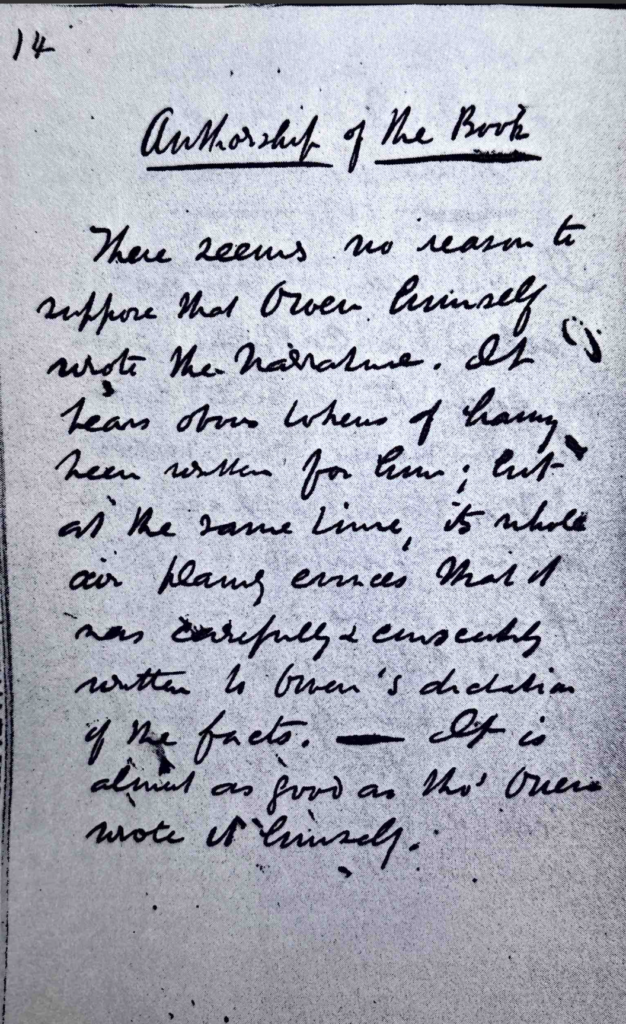
Owen Chase was the first mate of the whale ship Essex. His account of the events surrounding its sinking is recorded in his book Narrative of the Most Extraordinary and Distressing Shipwreck of the Whale-Ship Essex, of Nantucket. This account is the most studied because it offers a detailed and chronological history of the Essex from an authority figure on the boat.33
When the Essex set sail, Chase was twenty-two. He started his whaling career on the Essex when he was eighteen, working alongside Captain Pollard. The two remained together as Chase advanced from common sailor to boatsteerer to first mate. Chase was promised to be made a captain when the Essex returned to land from a successful voyage.34
The Essex was Captain Pollard’s first voyage as Captain. His father had been a captain, and he was respected on the island because of his family’s line of success in whaling. Chase’s father, on the other hand, was a farmer, which made it more difficult for Chase to move up the ranks. Chase was frustrated that he was not already a captain like Pollard, given his experience, and, as a result, became a sort of tyrant and a bully towards the younger crew members aboard the Essex.35
After the Essex, Chase continued working at sea. He was first mate for one more voyage before captaining three successful whaling voyages. Chase happily retired to his home in Nantucket with his wife and children but suffered mental illness later in life believed to be connected to the traumatic events on his whale boat.36
Thomas Nickerson (written 1876 published 1984)
On the island of Nantucket, being an “islander” or being born on the island was a sign of status especially if you could trace your lineage back to one of the original European families to settle on the island. As Nantucket was a fairly closed system with most people raising their families on the same island they grew up on, a large portion of the community was “islanders” and “off-islanders” were often shunned. Nickerson was an adopted islander. He was born in Cape Cod, but after both his parents died before he turned two he was adopted by a prominent Nantucket family. However, the fact that Nickerson was born in Cape Cod made him a “coof” and kept him at the bottom of Nantucket society.37
Thomas Nickerson was the youngest crew member aboard the Essex. He was just fourteen when the ship set sail and worked as the ship’s cabin boy. Nickerson was likely introduced to the Essex through his friend Owen Coffin who was Captain Pollard’s cousin.38 While Nickerson would earn a very long lay, which was a very small portion of the boat’s profit, the trip would set him up for a successful career of whaling and provide him with food and shelter for about two years. For these reasons, Nickerson excitedly anticipated his journey aboard the Essex before its unlucky days at sea.39
“One accustomed to the more modern built Ship would have turned in disgust. Such however was to be my home In all prob¬ ability for the coming three years. And black and ugly as She was I would not have exchanged her for a palace” (Thomas Nickerson)40
In 1876 many years after the tragedy of the Essex, Nickerson wrote a manuscript of his account of the event that was finally published in 1984 after being lost for more than a hundred years after his death. Besides his account of the events surrounding the sinking of the Essex, the manuscript includes illustrations of the Essex, a correspondence between Nickerson and Leon Lewis asking for his account to be published, and Nickerson’s account of the sinking of the Two Brothers. The Two Brothers was captained by George Pollard, the same captain who took charge of the Essex, and sank after hitting a coral reef. No one died aboard the Two Brothers, however Captain Pollard retired from his nautical life after leading two ships to the depths of the sea.41
Racial Dynamics Aboard the Essex
Aboard whale ships, Black men were paid the same as White men for the same tasks. While both groups were severely underpaid, Black men often turned to the sea because they knew they would be compensated the same as their White counterparts. The equality aboard whale ships, however, ended there. New White sailors were mistreated by captains but there was no comparison to the way captains mistreated their Black sailors. These sailors also had worse living quarters and food rations. Additionally, the African Americans were treated awfully on the island of Nantucket which did not appreciate outsiders.42
Aboard the open boat whale ships it is noted that the crew turned to the Black sailors for religious strength. The men relied on their evangelical worship to keep their spirits alive during their days at sea.43
Seven Black men were a part of the Essex crew and all of them died except for Henry De Witt, who jumped ship prior to the sinking. While it is theoretically believable that the Black men would die quicker because they had less body fat and were likely less healthy due to their living conditions on the boat and on land, it is important to note that there is no account from a Black man aboard the Essex. Therefore, there is no proof that the deaths of these men were purely natural and there is some speculation, considering the extreme disparity in the number of White and Black men who died, that the men on the whale boats might have contributed to the rapid deaths of their Black crew mates.44
- Owen Chase, Narrative of the most extraordinary and distressing shipwreck of the Whaleship
Essex: with supplementary accounts of survivors and Herman Melville’s memoranda on
Owen Chase (Pimlico, 2000), 19. ↩︎ - Ibid., 21. ↩︎
- Thomas Nickerson, The Loss of the Ship “Essex” Sunk by a Whale and the Ordeal of the Crew
in Open Boats (The Nantucket Historical Association, 1984), 79. ↩︎ - Owen Chase, Narrative of the most extraordinary and distressing shipwreck of the Whaleship
Essex: with supplementary accounts of survivors and Herman Melville’s memoranda on
Owen Chase, 24. ↩︎ - Thomas Nickerson, The Loss of the Ship “Essex” Sunk by a Whale and the Ordeal of the Crew
in Open Boats, 45. ↩︎ - Owen Chase, Narrative of the most extraordinary and distressing shipwreck of the Whaleship
Essex: with supplementary accounts of survivors and Herman Melville’s memoranda on
Owen Chase, 35. ↩︎ - Thomas Nickerson, The Loss of the Ship “Essex” Sunk by a Whale and the Ordeal of the Crew
in Open Boats, 47. ↩︎ - Ibid., 27. ↩︎
- Ibid., 29. ↩︎
- Nathaniel Philbrick, In the Heart of the Sea: The Tragedy of the Whaleship Essex (Viking, 2000), 60. ↩︎
- Owen Chase, Narrative of the most extraordinary and distressing shipwreck of the WhaleshipEssex: with supplementary accounts of survivors and Herman Melville’s memoranda on Owen Chase, 30. ↩︎
- Ibid., 33. ↩︎
- Ibid., 35. ↩︎
- Ibid., 186. ↩︎
- Ibid., 39. ↩︎
- Ibid., 45. ↩︎
- Ibid., 37. ↩︎
- Ibid., 49. ↩︎
- Thomas Nickerson, The Loss of the Ship “Essex” Sunk by a Whale and the Ordeal of the Crew
in Open Boats, 57. ↩︎ - Farel Heffernan, Stove by a Whale: Owen Chase and the Essex, 1st ed. (Wesleyan
University Press, 2012), 80. ↩︎ - Owen Chase, Narrative of the most extraordinary and distressing shipwreck of the Whaleship
Essex: with supplementary accounts of survivors and Herman Melville’s memoranda on
Owen Chase, 60. ↩︎ - Ibid., 62. ↩︎
- Ibid., 63. ↩︎
- Ibid., 65. ↩︎
- Ibid., 72. ↩︎
- Ibid., 74. ↩︎
- “The Whaleship Essex,” Nantucket Historical Association, accessed February 28, 2026, https://nha.org/research/nantucket-history/history-topic/the-whaleship-essex/. ↩︎
- Owen Chase, Narrative of the most extraordinary and distressing shipwreck of the Whaleship
Essex: with supplementary accounts of survivors and Herman Melville’s memoranda on
Owen Chase, 74. ↩︎ - Thomas Nickerson, The Loss of the Ship “Essex” Sunk by a Whale and the Ordeal of the Crew
in Open Boats, 60. ↩︎ - Philbrick, In the Heart of the Sea: The Tragedy of the Whaleship Essex, 146. ↩︎
- Owen Chase, Narrative of the most extraordinary and distressing shipwreck of the Whaleship
Essex: with supplementary accounts of survivors and Herman Melville’s memoranda on
Owen Chase, 75. ↩︎ - Farel Heffernan, Stove by a Whale: Owen Chase and the Essex, 1st ed, 192. ↩︎
- Philbrick, In the Heart of the Sea: The Tragedy of the Whaleship Essex, xiii. ↩︎
- Ibid., 30. ↩︎
- Ibid., 32. ↩︎
- Edouard Stackpole, “Aftermath,” in The Loss of the Ship “Essex” Sunk by a Whale and the
Ordeal of the Crew in Open Boats, ed. Helen Winslow Chase and Edouard A. Stackpole (Nantucket Historical Association, 1984), 80. ↩︎ - Philbrick, In the Heart of the Sea: The Tragedy of the Whaleship Essex, 10. ↩︎
- Ibid., 2. ↩︎
- Thomas Nickerson, The Loss of the Ship “Essex” Sunk by a Whale and the Ordeal of the Crew
in Open Boats, 12. ↩︎ - Ibid. ↩︎
- “The Whaleship Essex,” Nantucket Historical Association, accessed February 28, 2026, https://nha.org/research/nantucket-history/history-topic/the-whaleship-essex/. ↩︎
- Philbrick, In the Heart of the Sea: The Tragedy of the Whaleship Essex, 26. ↩︎
- Ibid., 132. ↩︎
- Ibid., 145. ↩︎