
Oceanographers and historians thought the wreck of the Endurance was lost for the better part of the 20th century. However, technological advancements helped boost the efficacy of shipwreck recovery missions, and has transformed the world of underwater exploration.1 Areas and wrecks once completely inaccessible to mankind have started coming into light–literally and metaphorically. Some of this new technology includes but is not limited to: high-resolution sonars, autonomous underwater vehicles, remotely operated vehicles, and high-resolution multibeam echosounders (MBES). This new technology made shipwreck recovery missions previously thought impossible, now within reach. The deep sea and thick pack ice encasing the Endurance made locating the shipwreck even more challenging. However, one group set out in 2018 to defy the odds, and locate the long lost Endurance. The Flotilla Foundation announced it would be funding the mission, with John Shears as the expedition leader, and Mensun Bound the director of exploration.2 The Flotilla Foundation is a Netherlands based foundation that has sought to promote the protection of the oceans since 2017. This initial expedition experienced numerous setbacks and proved a sharp learning curve for the expedition’s members, eventually ending in accepted defeat. They lost expensive autonomous equipment and endured continual mechanical failures that greatly hindered the mission’s success. It showed the difficulty of navigating the Weddell Sea pack ice, and technical skills needed for searching in the frigid waters at a depth of around 10,000 feet.
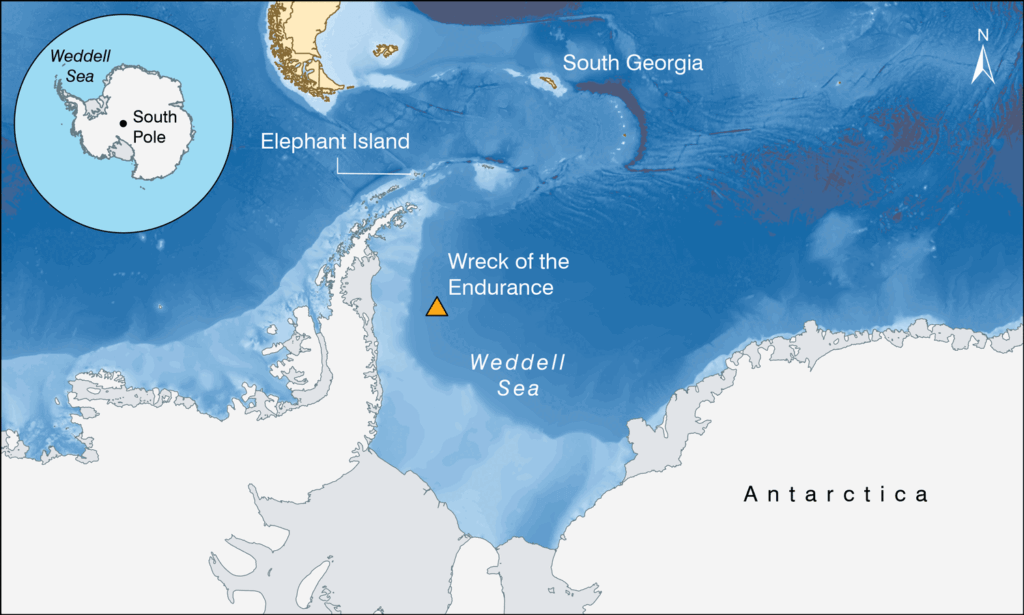
Figure 1: An aerial view of the Southern Ocean off the southern tip of the South American Continent. In focus is the Weddell Sea with a triangle representing the wreck site of Endurance, with Elephant Island and South Georgia Island also labelled. Relative seafloor depth and oceanography displayed through shading and blue coloration.
The Endurance22 Expedition
About a year later, Shears received a phone call from Donald Lamont, the then-chair of the Falklands Maritime Heritage Trust. Lamont and his Trust-management members wished to fund another expedition in partnership with the UK Antarctic Heritage Trust. The Trust believed Endurance held cultural significance and were representative of the tenacious South Atlantic Ocean + Drake Passage spirit. Funding another expedition to find Endurance could lead to an incredible trove of history and culture. Re-invigorated, Shears and Bound set to work on designing a new expedition plan.
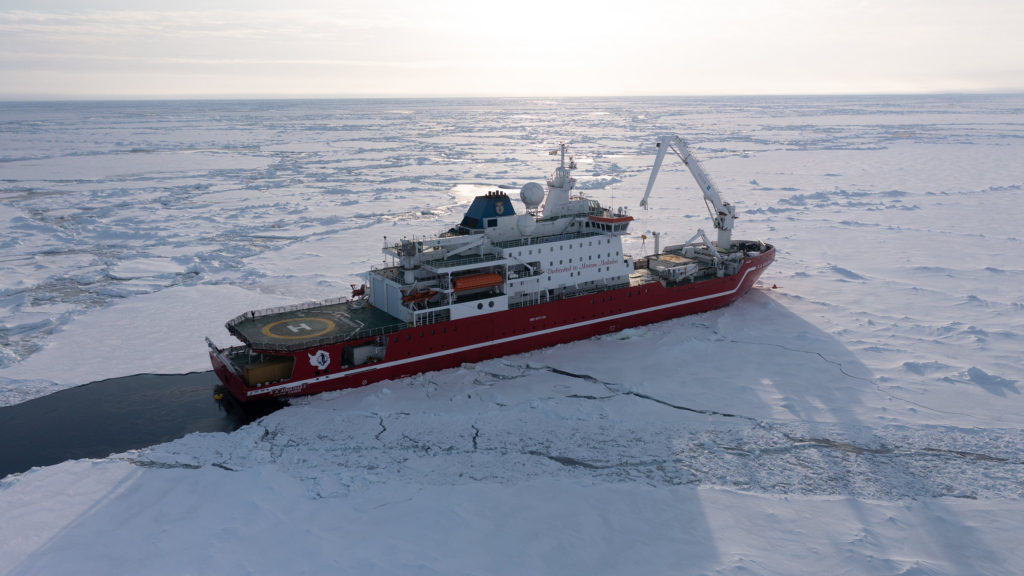
Figure 2: Above is a photo of the S.A. Agulhas II Antarctic icebreaker, which was used in both expeditions to locate Endurance. This ship was built in Finland as a predecessor to the first South African Antarctic exploration vessel. The cost to use the vessel was not disclosed in the budget report for the Endurance22 mission.3
The largest difference from the previous expedition would be their underwater vehicles. This time, the team would remotely man two high-tech Sabertooth AUVs (Autonomous Underwater Vehicles). Their search area also changed, made more accurate by a re-analysis of ship captain Frank Worsley’s estimated coordinates of where the Endurance sank. Right before the ship sank, Frank took extra time to measure and calculate their location despite degrading equipment and numerous cloudy night skies just before Endurance’s sinking. The explorers spent weeks combing the seafloor in a checkerboard pattern. Finally, the crew located the wreck on the afternoon of March 4th, 2022.
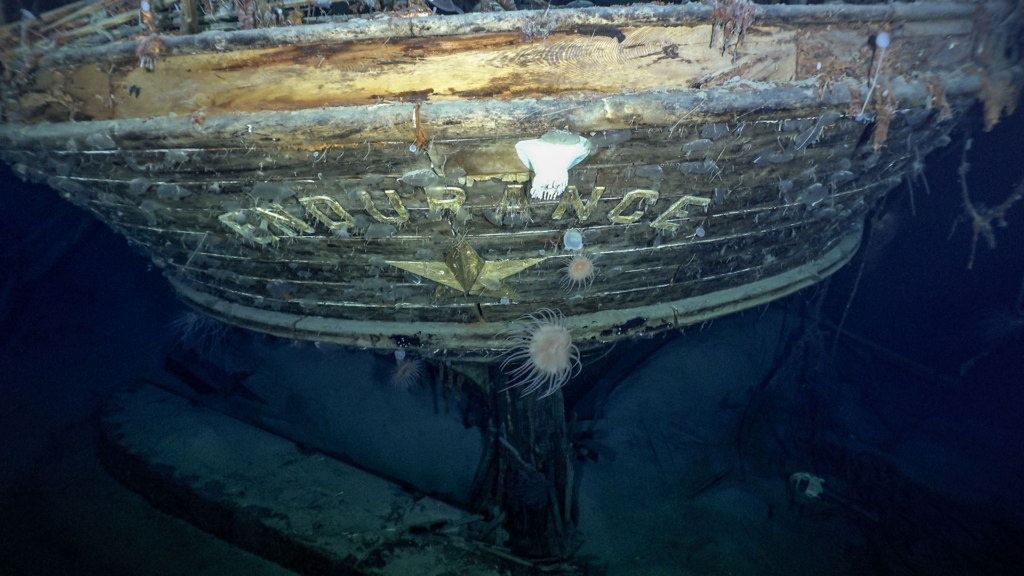
Celebration erupted on board the icebreaker as Endurance slowly came into view. Time and resources left the expedition with just a few days to explore the wreck site, so they paused celebration until their time at the wreck was up. The team explored and documented the sunken barkentine using True Color Technology from Voyis Imaging.4 This technology helped render accurate coloration images of the vessel otherwise unseen. The ship was sighted around 4pm on board the S.A. Agulhas II, and celebration was heard throughout the ship’s corridors. Photos were taken by one of the Sabertooth AUVs and processed on board shortly after. The image below shows the main masts, bow, and stern from above the wreck.
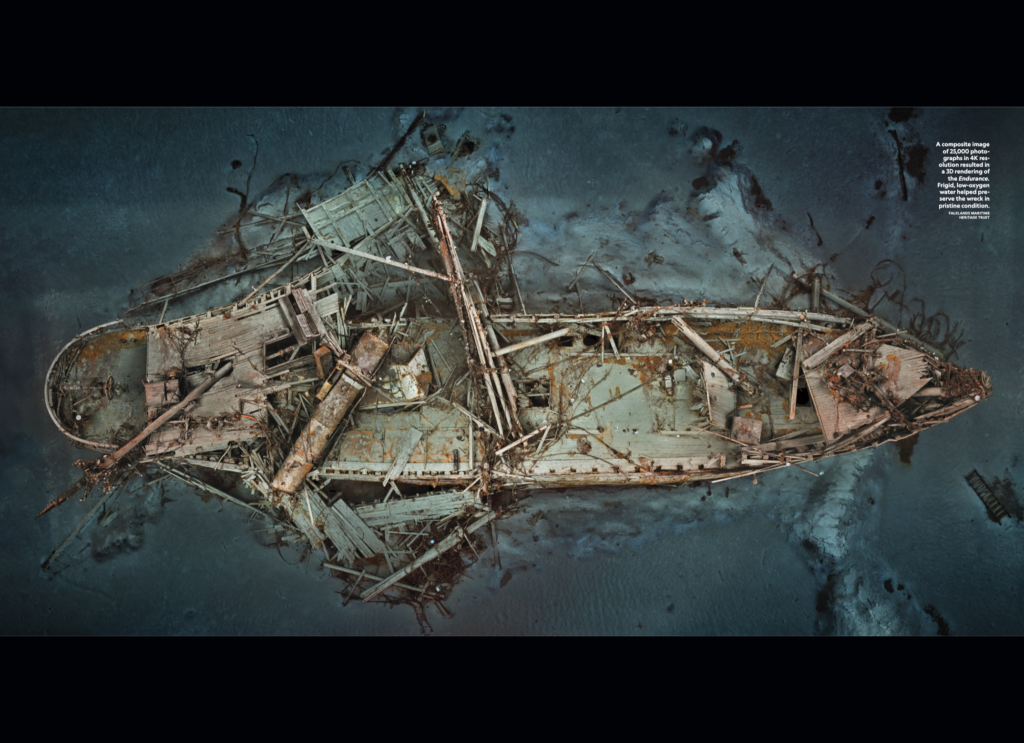
Figure 3: This image is the combination of thousands of images morphed together for a more accurate aerial view of the shipwreck. Visible in the image is the full ship, surrounding seafloor, and ship items like a ladder in the bottom right, masts, and coils of rope off the port side bow.
Endurance Conservation Plan
After locating the wreck, the UK Antarctic Heritage Wreck established a Conservation Management Plan (CMP) to prevent any unapproved human contact with the wreck.5 Ultimately, they hope to acquire ASPA (Antarctic Specially Protected Area) designation to preserve Endurance and her fragile marine ecosystem. Amongst other goals, CMP includes six key management policies.
- Management Policy 1: All activity relating to the site should be undertaken with the aim to preserve and/pr enhance the significance of the site. There will be a presumption in favour of non-destructive survey in preference to any recovery of the wreck structure or artefacts.
- Management Policy 2: The biodiversity, habitats and ecology of the wreck of Endurance will be studied, recorded, and conserved.
- Management Policy 3: Long term challenges to the significance of the wreck of Endurance should be identified, and mitigation methods explored with stakeholders and partner organisations.
- Management Policy 4: Access to the wreck site should be managed to ensure that activities directed at the wreck are not detrimental to the significance of the site.
- Management Policy 5: The significance of the site will be enhanced by maximising opportunities for knowledge enhancement and its public dissemination.
- Management Policy 6: The ongoing management of the wreck should be transparent and collaborative, and based on clear policies outlined in this Conservation Management Plan.
T
hese policies were established to promote and protect the purity of Endurances shipwreck. There are environments such as the Endurance shipwreck that allow the unique opportunity to study marine life’s adaptation to unnatural structural presence such as this shipwreck. Particularly interesting is the sheer quantity of life aboard Endurance, even 10,000 feet below the ocean’s surface.
Endurance‘s Deep Sea Nursery
The discovery of Endurance led to more scientific discoveries, including new deep sea animals. Many marine biologists have been interested in Endurance‘s marine ecosystem since its discovery. Initial images from the expedition show a plethora of sea stars, sponges, anemones, and a rare deep-sea squat lobser.6 “The ship is cool, but look at those things living on it” said Huw Griffiths, just days after Endurance’s discovery. Griffiths is a marine biogeographer at the British Antarctic Survey.
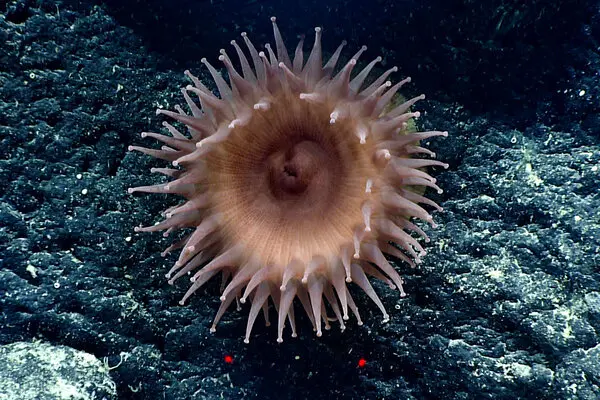
The seafloor life in the Weddell Sea is rarely observed, so this expedition gave biologists and others alike the opportunity to learn and observe more about these creatures. The marine life on and around the ship shows how sea creatures can adapt to changing resources and their environments. Furthermore, nearly all organism observation so far has been done on soft floor seabeds in the Weddell Sea. This is a strikingly unique opportunity to observe the creatures that call the Weddell Sea home, but on hard floor seabed surfaces. Encrusting organisms love to latch onto or grab ahold of hard surfaces, making a 100 year old shipwreck a perfect place to call home.7 This also proves to be a unique opportunity for studying deep sea adaptation to manmade material presence, such as wood. Any chemicals have most likely leeched out from the ship, but this discovery still opens the opportunity to observe life 3,008 meters below the ocean’s surface.
“Like a shipwreck or a jetty, almost anything that forms a structure in the ocean, whether it is natural or artificial, collects life”
Sylvia A. Earle
The finding of Endurance is a key milestone in shipwreck recovery work and oceanic exploration. It was a mission that furthers the narrative that humans have “conquered” the ocean and high seas. The ocean is a formidable force, but even that cannot stop explorers from braving its worst weather and conditions to succeed. The technical setbacks and hurdles they overcame to locate the wreck were incredibly impressive. The shipwreck recovery crew endured one of the harshest environments on the planet to even enter the Weddell Sea pack ice.8 They then went on to locate the precise location of one of the most inaccessible shipwrecks on Earth.
Broader Implications from the Endurance22 Expedition
In broader context, the discovery of Endurance and her protection shows the delicate balance humans must hold to ensure we don’t continue to harm ecosystems. Climate change, pollution, and warming oceans have impacted all but the most remote creature on earth, and hence leave us with a great burden: We must preserve the little remaining wild there is left. The waters of Antarctica are one of these few places where natural life hasn’t been greatly disturbed by human existence. Even deep within the Antarctic snow fields, the British Antarctic Survey Organization has found microplastics.9 This is yet another example of the spread of human impact and the difficulty to control how far our impact stretches. Protecting heritage sites rich in research opportunity like Endurance’s shipwreck site give us the opportunity to observe human presence in an otherwise truly wild environment. This kind of protection and regulated research can help scientists and researchers discover new ways to protect fragile ecosystems such as the deep sea benthic ecosystem that calls Endurance home.
The wreck of Endurance speaks to the continuation of broader oceanic exploration by helping show that little of the ocean is off-limits to human exploration. The true and wild human spirit has and will continue to fuel exploration and discovery in the ocean. Human fascination with the ocean hasn’t changed throughout centuries, and the S.A. Agulhas II expedition crew and all who aided in finding Endurance deserve the utmost respect and applause for their efforts in accomplishing this monumental discovery.
Works Cited
- The Technology of Discovery – NOAA Ocean Exploration. 2021. NOAA Ocean Exploration. https://oceanexplorer.noaa.gov/expedition-feature/21norlindo-features-technology/ ↩︎
- National Geographic, Jan 2025, Issue 1 Volume 247 ↩︎
- Brown C. 2022. Shackleton’s Endurance is Found in Antarctica. Good Nature Travel Blog | Stories are made on adventures. https://www.nathab.com/blog/endurance-found-in-antarctica#:~:text=The%20team%20had%20been%20searching,thank%20you%2C%20Anonymous%20Donor!).
↩︎ - 2026. Proquestcom. https://www.proquest.com/docview/3181917336?sourcetype=Trade%20Journals ↩︎
- CMP — Endurance Shipwreck. 2019. Endurance Shipwreck. Endurance Shipwreck. https://www.enduranceshipwreck.org/cmp
↩︎ - Wetzel C. 2022. Shackleton’s “Endurance” Shipwreck Is Teeming With Bizarre Ocean Life. Smithsonian Magazine. https://www.smithsonianmag.com/smart-news/shackletons-endurance-shipwreck-is-teeming-with-bizarre-ocean-life-180979719/#:~:text=Undersea%20footage%20reveals%20the%20ship’s,by%20a%20submersible%20camera%20Endurance22
↩︎ - Bozzano G, Cerredo ME, Remesal M, Steinmann L, Hanebuth TJJ, Schwenk T, Baqués M, Hebbeln D, Spoltore D, Silvestri O, Acevedo RD, Spiess V, Violante RA, Kasten S. 2021. Dropstones in the Mar del Plata Canyon Area (SW Atlantic): Evidence for Provenance, Transport, Distribution, and Oceanographic Implications. Geochemistry, Geophysics, Geosystems 22. doi:https://doi.org/10.1029/2020gc009333
↩︎ - Endurance Shipwreck – Falklands Maritime Heritage Trust. 2025. Falklands Maritime Heritage Trust. https://fmht.co.uk/wreckmap/endurance/
↩︎ - Microplastics discovered in Antarctica – British Antarctic Survey. 2026. British Antarctic Survey. https://www.bas.ac.uk/news/microplastics-discovered-in-antarctica/
↩︎