
Setting Sail
On May 19th, 1845, at 10:30 am, the HM Ships Erebus and Terror weighed anchor and were towed down the river Thames on their adventure to find the Northwest Passage. As the best prepared British expedition ever, the 134 men set off with confidence.1 Unbeknownst to them, this was the last time these vessels would be docked at a British port.
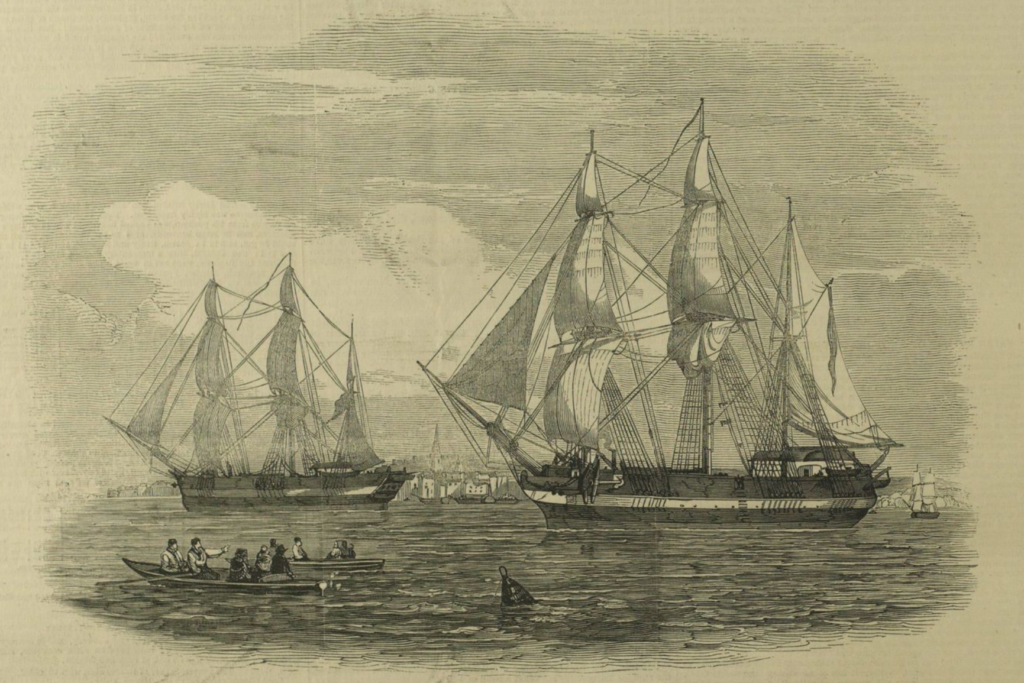
“H.M.S. “Erebus” and “Terror.”” The Illustrated London News. This image is in public domain.
On their path up the eastern coast of Great Britain, they encountered a rough storm which forced them to anchor in Aldeburgh for a day. The HMS Monkey, the towing vessels for the Barretto Junior, was replaced with the HMS Blazer due to the Monkey’s poor performance in this storm.3 This one day delay, along with the week long hold up before launching due to a late food shipment, were not going to be the only delays in this expedition.
Stromness
The first stop for the ships was a port city called Stromness on the ironically named island of “Mainland”, Scotland. When they arrived on Saturday, the 31st of May 1845, there was another delay here. Ten cattle had been taken on the Barretto Junior for slaughtering when they got to Greenland, however, on the trip to Stromness, four had died, which needed to be replaced. Despite the mission’s importance, the religious townspeople refused to trade on Sabbath, meaning they had to wait until after the weekend. Additionally, it is thought that Franklin would not “start on a Sunday” due to his religious fervor. When they got the cattle by Monday, bad weather meant that they had to sit at harbor an additional day.4
During this last night at Stromness, Thomas Work and three other sailors went into town and got drunk to the point that a typical officer would punish them severely and maybe even send them home. However, Fitzjames, being a forgiving man, let them off leniently and allowed them to stay on the mission to the men’s great happiness—a decision that ended up costing their lives.5 However, when it came time to sail out, one able bodied sailor was sent home (along with the escort vessels) because it was suspected that he had tuberculosis.6
Greenland
While there were some contrary winds when they passed the Southern tip of Greenland, the trip from Stromness was relatively uneventful.7 As they ventured further into the Arctic circle, freezing temperatures and constant daylight took over. Icebergs would occasionally float by, giving the crew a taste of what was to come.8
“While passing near one of these [icebergs], which I had just remarked was about the size of the North Foreland, it suddenly fell to pieces with an awful crash, sending the spray up to a great height, and leaving one field of sharp & broken ice.” – James Fitzjames in a letter to his father.9
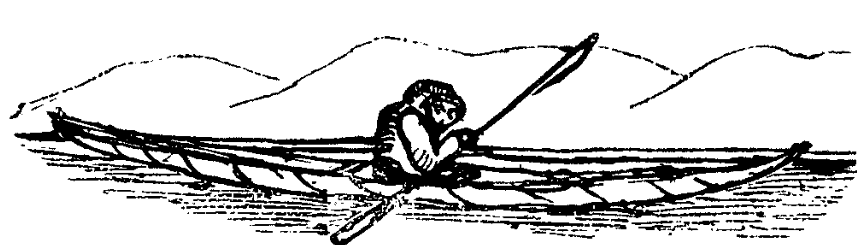
The Whalefish Islands, situated in Disko Bay (just below the ex-Danish colony on Disko Island), was both the chosen place for their transfer of materials from the Barretto to the HM Ships and to install an observation deck on the Erebus.10 They had some difficulties finding the islands, at first going the wrong direction before correcting their mistake. Eventually, they made it to the islands with only one day of delay and were led in to a narrow passage by “Esquimaux” in small canoes who were employed by the Danish government to kill seals for their oil.11
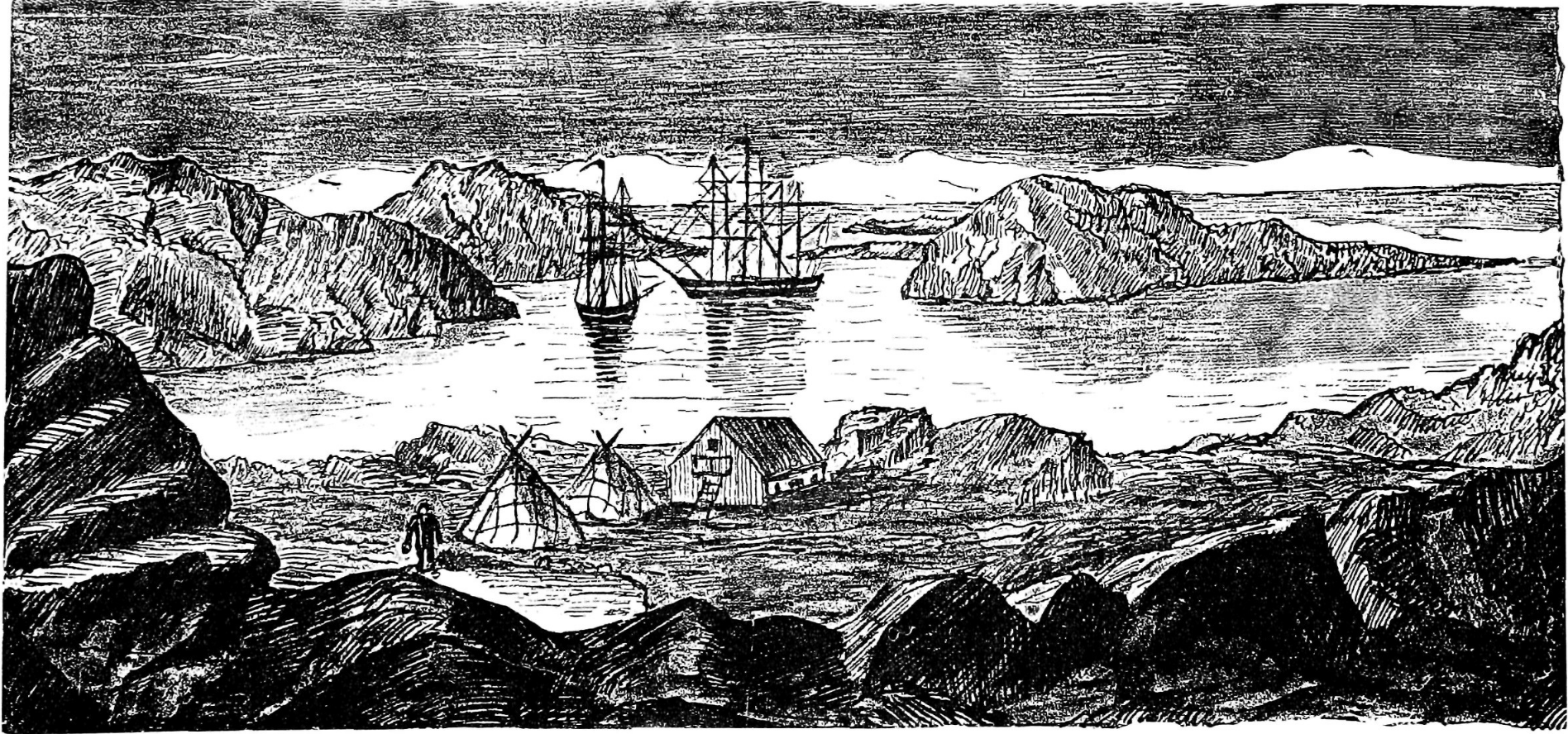
Drawing by Lieutenant John Irving, of the ships at Whalefish Islands transferring provisions.12
“‘ EREBUS ‘ and ‘ TERROR ‘ at Whalefish Island, July 1845.” by John Irving. Cambridge Library Collection. This image is in public domain.
Drawing by John Irving of a “Esquimaux” in a canoe.13
“Untitled” by John Irving. Cambridge Library Collection. This image is in public domain.
From Sunday July 4th to the 10th, the crews were busy transporting provisions from the Barretto to the Erebus and Terror.14 The boats became so laden with provisions that Crozier recorded the Erebus’s mean draught (the height difference between the bottom of the ship and the water line) at 16 feet when it normally was just over 11 feet. This led the Barretto being sent back with provisions deemed unnecessary.15 The Barretto Junior also left with four men from the HM Ships, two of whom were said to be sick by Crozier and two that were “perfectly useless either at their trade or anything else.”16
At six o’clock Sunday, the 13th of July, 1845, the Erebus and Terror alone set sail for Baffin Bay and Lancaster Sound.17
Last Sightings
There were various sightings and encounters between various whaling ships and the Erebus and Terror up to the end of July. The Captain of the Enterprise told the Admiralty that he had spoken to Franklin who spoke of their confidence to reach Lancaster Sound by mid-August despite the numerous icebergs and had provisions for 5-7 years. On July 26, the Captain of the Prince of Wales, another whaling ship, claimed that the crews Erebus and Terror and his crew interacted and that he was invited to have dinner aboard the Erebus but that he decided he should get back post-haste after the weather improved and therefore left. This seems to be the last sighting of the HM Ships by Europeans before their wrecks were uncovered over 150 years later.18
- Michael Palin, Erebus: One Ship, Two Epic Voyages, and the Greatest Naval Mystery of All Time (Greystone Books, 2018), 209. ↩︎
- “Departure of the “Erebus” and “Terror” on the Arctic Expedition,” The Illustrated London News, May 24, 1845, link.gale.com/apps/doc/HN3100440564/ILN?u=mnalmgl&sid=bookmark-ILN&pg=8&xid=c808feb3. ↩︎
- Palin, Erebus, 212. ↩︎
- Palin, Erebus, 214. ↩︎
- Palin, Erebus, 214-15. ↩︎
- Palin, Erebus, 217. ↩︎
- Palin, Erebus, 222. ↩︎
- Palin, Erebus, 223. ↩︎
- Russell A. Potter, Regina Koellner, Peter Carney and Mary Williamson, May We Be Spared to Meet on Earth : Letters of the Lost Franklin Arctic Expedition (McGill-Queen’s University Press, 2022), 222, https://ebookcentral.proquest.com/lib/carleton-ebooks/reader.action?docID=29342606&c=RVBVQg&ppg=1. ↩︎
- Palin, Erebus, 225. ↩︎
- Potter et al., May We Be Spared to Meet on Earth, 242. ↩︎
- Bell, Benjamin. “1844–1845.” Chapter. In Lieut. John Irving, R.N., of H.M.S. Terror, in Sir John Franklin’s Last Expedition to the Arctic Regions: A Memorial Sketch with Letters, 129. Cambridge Library Collection – Polar Exploration. Cambridge: Cambridge University Press, 2014. ↩︎
- Bell, “1844–1845,” 124. ↩︎
- Potter et al., May We Be Spared to Meet on Earth, 261-62. ↩︎
- Potter et al., May We Be Spared to Meet on Earth, 297. ↩︎
- Potter et al., May We Be Spared to Meet on Earth, 299. ↩︎
- Palin, Erebus, 233. ↩︎
- Palin, Erebus, 235-36. ↩︎
Published:
Last modified: