
Throughout the 19th century, Cunard Lines dominated the Trans-Atlantic passenger trade. However, they started to have competition in the 1850s and 60s.1 Cunard had many technical advancements that kept them on top of this trade; however, one of these lines, North German Lloyd, created the first ever superliner, called the SS Kaiser de Glossa.2 By this point, national pride had taken an interest in the Trans-Atlantic passenger trade, and it was a national interest to have the fastest and most luxurious ship. For Cunard lines to be the second best meant Britain was the second best, which they couldn’t come to terms with. The chairman of Cunard Lines, Lord Inverclyde, went and made an appeal to the British Admiralty to petition for funding and development. The Admiralty had a long-standing relationship with Cunard Lines and agreed, under one condition, that Cunard Lines’ new ships must be built so they could be converted into warships if needed.3 With war looming, the two parties agreed. The British Admiralty even added extra incentives. If the new ships could hold an average speed of 24.5 knots and a minimum of 23.5 knots, Cunard Lines would get a yearly subsidy.4
Cunard Lines began their construction of the RMS Lusitania on June 16th, 1904. The ship was so immense that they needed to make immediate accommodations at the shipyard where it was being built.5 The Lusitania was built with just one thing in mind: speed. The ship designs show this with the intricate design of the hull. However, the Lusitania would need more than just a hull to make its speed quota. Luckily for Cunard Lines, they had just the thing. They installed 4 Parsons turbines, giving the ship somewhere between 60,000 and 70,000 horsepower.6 To get enough steam to the engines, they used 25 fire tube boilers, which were fed by hand. When building a ship, workers would typically start from both ends and meet somewhere in the middle; however, in Lusitania’s case, all work began at the bow to give the engineers more time to figure out how to fit everything in the slim hull of this new beast. The design process took 2 years to complete.7 One of the biggest differences from the start of the process to the end was the additional smokestack added to the top of the ship. This smokestack was added due to a need to increase the number of boilers in the hull, meaning that the ship needed another smokestack to clear all the smoke.

In June 1906, the ship was at last ready for her launch. After her initial launch, she was guided by the help of 6 tug boats down the Clyde River to where she would be outfitted with all her interiors. After everything had been installed and carved, the Lusitznia was finally ready for her sea trials.8 On July 27th, 1906, the Lusitania surged ahead under her own power for the very first time. Ultimately, Lusitania’s trial was a major success; there was just one problem. In the hull, there was intense rattling that reverberated throughout the second and third classes. While engineers tried to fix this problem, it never fully went away, and was a problem that the ship had for her entire lifespan.9
On September 7th, 1907, the Lusitania arrived in Liverpool for the first time. On her maiden voyage, she was carrying 2,200 people and would stop in Ireland before making her way to the US. On Lusitania’s second voyage, she broke the record for the quickest trans-Atlantic trip by boat. However, she would later lose this title to her sister ship.
Lusitania made 101 round-trip voyages before tragically being sunk on May 7th,1915, by a German U-boat. The Lusitania was returning to Britain and was just off the coast of Ireland when she sank. The sailing conditions were less than ideal that day, as a thick fog hovered over the water, making visibility extremely low. Lusitania proceeded to make a 4 bearing maneuver,10 which used a coast line and to find where the ship was. This was important because if they came into port at the wrong time, they would be sitting ducks due to the shallow waters in Liverpool’s port. They were aware of German subs in the region; however, by their intel, they had passed the last known sighting under the cover of fog. What they didn’t know was that they had just doomed themselves by trying to get their bearings.11 When executing the first part of their maneuver, they turned right into the path of a German U-boat. The Germans fired and sank the Lusitania in 18 horrifying minutes.12
Before the Lusitania sinking, a German U-boat had never sunk a ship going faster than 14 knots. This normally wouldn’t be a problem with the Lusitania’s breakneck speed; however, due to wartime restrictions, the Lusitania only had so much coal and had to run at reduced speeds.13 It was also for this reason that the Lusitania never became a warship and stayed a passenger ship during the war. Due to the coal shortages, the Lusitania was running at 18 knots, and once it hit the fog, it had to reduce to 15 knots, just one knot above the previous fastest ship sunk by a U-boat.14 When performing her 4 bearing maneuver, she was going even slower.
Lusitania burst onto the scene as the fastest and most luxurious liner there was. But throughout the years, she started slowly slipping down the ranks in terms of speed. But why was she still so prevalent even though she was no longer the fastest liner? It was her posh interiors that kept the Lusitania popular among passengers. While new liners came out with increased speed, including her sister ships, the Lusitania was still revolutionary for her passenger accommodations. Throughout the Lusitania’s 101 round-trip voyages, no other liner came close to competing with her second and third class compartments. Ultimately, it was speed that made Lusitania famous, but it was the luxury interior that kept her prevalent among the top of the liner world for so long.
Lusitania Facts and Figures – The Lusitania Resource
Unrestricted Submarine Warfare:
German U-boats changed the name of the game in WWII. These U-boats were able to go undetected underwater before firing upon an enemy ship. The only way to spot one of these ships was to see the telescope peeking out from the surface of the water. Oftentimes, passenger ships and warships alike saw the U-boats too late and were ultimately sunk. Germany was able to control the Atlantic Ocean like never before with these submarines and wreaked havoc, especially when they didn’t follow the rules of seafare.15
German U-boat captains had orders to surface and announce their presence before sinking passenger ships. They did this for quite some time and even helped passengers load onto lifeboats before sinking the ship.16 However, as aforementioned, the Lusitania was made with the idea of being converted into a warship if needed. While she ultimately couldn’t be because of wartime restrictions on coal, other passenger ships were. When German U-boats surfaced to announce that they were going to sink a passenger ship, they were met with fire from newly installed guns on the ship.17 News of these incidents reached Germany, and new orders came out. They were to sink an enemy ship without warning, no matter the type of ship or cargo it had. Thus, the beginning of unrestricted submarine warfare in WWI.

The U-20 German submarine that sank the Lusitania was led by Captain Schweiger. He ordered a single G-6 torpedo to be armed and fired at the Lusitania. He later wrote in his journal that it would’ve been impossible for him to fire a second torpedo because there were too many people in the water. He later said, “that it was the most terrifying thing he had ever seen.”18 The U-20 watched, knowing there was nothing they could do to help the flailing passengers. They then descended back into the water and maneuvered away.
U-20 Specifications – The Lusitania Resource
Cash and Carry:
During the beginning of WWI, the US tried to remain neutral. They had allies in the war; however, they were trying to stay true to Washington’s farewell address and not get involved in foreign affairs. However, they did try to help their allies out. According to the US laws, they weren’t able to give weapons to their allies without entering the war, but there was nothing against selling the weapons. Thus, the beginning of Cash and Carry.19 Britain would buy weapons from the US, at discounted prices, and the US would transport them to Britain. These weapons were vital for fighting Germany and the Central Powers in WWI.20
How does this connect to the Lusitania? There were rumors that the Lusitania had weapons and ammunition on board as part of this Cash and Carry scheme.21 As it turns out, the rumors were true. The Lusitania had 173 tons of weapons, ammunition, and medical supplies in her hull.22 While it’s unclear if this played a role in her sinking, there was a second explosion heard throughout the Lusitania after the initial impact from the torpedo. Some suggest the secret cargo doomed the Lusitania to the bottom of the ocean along with most of her passengers. None of the passengers on board knew of the cargo they were carrying.
The Zimmerman Telegram:
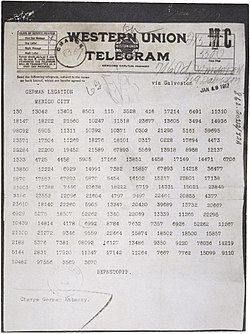
The Zimmerman Telegram was a telegram written by German Foreign Secretary Arthur Zimmerman. In his telegram was a coded message to Mexico about a military alliance against the US. This was a hugely impactful move if it were successful because it would stop the US from being able to aid Britain in the war and almost certainly lead to the Central Powers taking a firm grasp on the war. However, the telegram never made it to Mexico. It was intercepted by British forces and relayed back to the US.23 This ended up being the tipping point for the US entering WWI. Their official reasons for entering were continued aggression by Germany, both in this telegram and also in their use of unrestricted submarine warfare, which included the sinking of the RMS Lusitania. 24
References:
Newman, John, Schmalbach, John. United States History: Advanced Placement Edition. Perfection Learning, 2021.
Brady Michael, “The Terrifying Sinking of Lusitania,” Spring 2025, https://www.youtube.com/watch?v=9X0uxE2R_Uo. (Accessed February 1, 2026)
Chmielewski, K. “Sinking of the Lusitania Timeline.” Encyclopedia Britannica, July 10, 2025. https://www.britannica.com/story/sinking-of-the-lusitania-timeline.
Unknown, “The Lusitania Resource.” https://www.rmslusitania.info/lusitania/facts-and-figures. (Accessed February 10, 2026)
Footnotes:
- Ballard Robert & Archbold Rick, “Ocean Evolution: An excerpt from Lost Liners,” Fall 1997, https://www.pbs.org/lostliners/ocean.html. (Accessed February 1, 2026) ↩︎
- Brady Michael, “The Terrifying Sinking of Lusitania,” Spring 2025, https://www.youtube.com/watch?v=9X0uxE2R_Uo. (Accessed February 1, 2026) ↩︎
- Brady Michael, “The Terrifying Sinking of Lusitania,” Spring 2025, https://www.youtube.com/watch?v=9X0uxE2R_Uo. (Accessed February 1, 2026) ↩︎
- Brady Michael, “The Terrifying Sinking of Lusitania,” Spring 2025, https://www.youtube.com/watch?v=9X0uxE2R_Uo. (Accessed February 1, 2026) ↩︎
- Brady Michael, “The Terrifying Sinking of Lusitania,” Spring 2025, https://www.youtube.com/watch?v=9X0uxE2R_Uo. (Accessed February 1, 2026) ↩︎
- Brady Michael, “The Terrifying Sinking of Lusitania,” Spring 2025, https://www.youtube.com/watch?v=9X0uxE2R_Uo. (Accessed February 1, 2026) ↩︎
- Brady Michael, “The Terrifying Sinking of Lusitania,” Spring 2025, https://www.youtube.com/watch?v=9X0uxE2R_Uo. (Accessed February 1, 2026) ↩︎
- Brady Michael, “The Terrifying Sinking of Lusitania,” Spring 2025, https://www.youtube.com/watch?v=9X0uxE2R_Uo. (Accessed February 1, 2026) ↩︎
- Brady Michael, “The Terrifying Sinking of Lusitania,” Spring 2025, https://www.youtube.com/watch?v=9X0uxE2R_Uo. (Accessed February 1, 2026) ↩︎
- Brady Michael, “The Terrifying Sinking of Lusitania,” Spring 2025, https://www.youtube.com/watch?v=9X0uxE2R_Uo. (Accessed February 1, 2026) ↩︎
- Brady Michael, “The Terrifying Sinking of Lusitania,” Spring 2025, https://www.youtube.com/watch?v=9X0uxE2R_Uo. (Accessed February 1, 2026) ↩︎
- ↩︎
- Brady Michael, “The Terrifying Sinking of Lusitania,” Spring 2025, https://www.youtube.com/watch?v=9X0uxE2R_Uo. (Accessed February 1, 2026) ↩︎
- Brady Michael, “The Terrifying Sinking of Lusitania,” Spring 2025, https://www.youtube.com/watch?v=9X0uxE2R_Uo. (Accessed February 1, 2026) ↩︎
- Newman, John, Schmalbach, John. United States History: Advanced Placement Edition. Perfection Learning, 2021. ↩︎
- Brady Michael, “The Terrifying Sinking of Lusitania,” Spring 2025, https://www.youtube.com/watch?v=9X0uxE2R_Uo. (Accessed February 1, 2026) ↩︎
- Brady Michael, “The Terrifying Sinking of Lusitania,” Spring 2025, https://www.youtube.com/watch?v=9X0uxE2R_Uo. (Accessed February 1, 2026) ↩︎
- Brady Michael, “The Terrifying Sinking of Lusitania,” Spring 2025, https://www.youtube.com/watch?v=9X0uxE2R_Uo. (Accessed February 1, 2026) ↩︎
- Newman, John, Schmalbach, John. United States History: Advanced Placement Edition. Perfection Learning, 2021. ↩︎
- Newman, John, Schmalbach, John. United States History: Advanced Placement Edition. Perfection Learning, 2021. ↩︎
- Newman, John, Schmalbach, John. United States History: Advanced Placement Edition. Perfection Learning, 2021. ↩︎
- Chmielewski, K. “Sinking of the Lusitania Timeline.” Encyclopedia Britannica, July 10, 2025. https://www.britannica.com/story/sinking-of-the-lusitania-timeline. ↩︎
- Newman, John, Schmalbach, John. United States History: Advanced Placement Edition. Perfection Learning, 2021. ↩︎
- Newman, John, Schmalbach, John. United States History: Advanced Placement Edition. Perfection Learning, 2021. ↩︎