
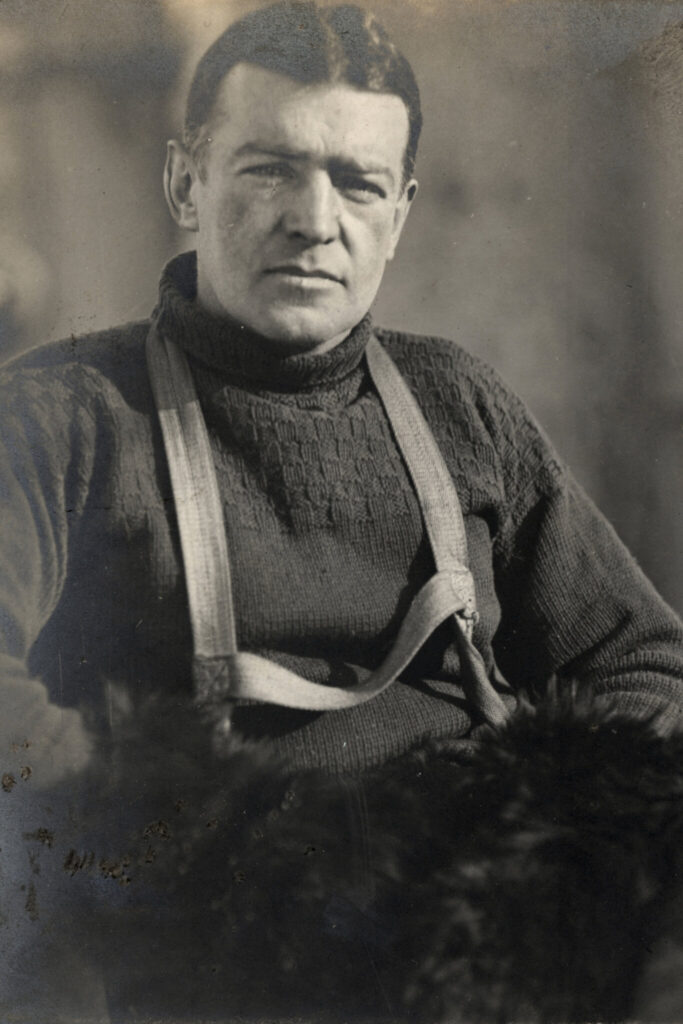
There is a Mount Shackleton, a Shackleton Range, a Shackleton Coast, and there is even a Shackleton Crater on the south pole of the moon. Furthermore, his exploits, personality, and leadership have been the subjects of countless books, articles, and theories. So what was it about Shackleton that has earned him such enduring fame and adoration?
Because Shackleton kept extensive journals and published several memoirs of his expeditions, much is known about his career and personal life. Shackleton was born on February 15, 1874, in Kilkea, Ireland. That same year, the HMS Challenger became the first steamship to reach Antarctic waters and is credited as the beginning of modern oceanography.2 He was always extremely curious and driven toward adventure, and at age 16, despite his father’s wishes, he signed up for his first voyage. It took him all the way to Valparaiso, Chile, and around Cape Horn – his first contact with the frigid Antarctic waters.3 He continued to sail and quickly worked his way up the chain of command, and in 1894, Shackleton became a third officer in the Merchant Navy and was qualified as a master mariner by 1898. In 1901, Shackleton embarked on the British National Antarctic Expedition, marking the beginning of his career as an explorer.4
Previous Expeditions:
The British National Antarctic Expedition:
Shackleton was appointed third officer aboard the RRS Discovery for the National Antarctic Expedition led by Robert Falcon Scott. The expedition planned to explore and map the Ross Sea, but more importantly to Shackleton, press into the Antarctic Continent to reach the South Pole by dog sledge.5 The expedition ended poorly for Shackleton, who, after sledging across Antarctica for 94 days, developed scurvy, as did many other crew members. Upon returning to the Discovery, much to his disappointment, Shackleton was invalided by the doctor and sent home. This was a very formative experience for the explorer, who felt that his case of scurvy was no more severe than the others on the expedition and that his treatment by Scott was unfair and embarrassing. His failure, as expounded in reports published by other crew members, galvanized his spirit, and he became resolute in leading another successful expedition to prove himself.6
The Nimrod Expedition
The British Antarctic Expedition, often referred to as the “Nimrod Expedition” after the ship Nimrod, embarked on new-years day of 1908. It was the first to be led by Shackleton. In the previous approximately six months, Shackleton scrambled to plan, fund, outfit, and staff the expedition. The expedition was short-funded, and so the ship selected was necessarily small, slow, and worn. Shackleton purchased the Nimrod in May of 1907, a forty-year-old sealing ship that stank of oil and had it retrofitted for the coming journey (109).7 The Nimrod was towed into the Antarctic Circle, as the ship would have struggled to make it there under its own power.8 Shackleton’s sledging team got closer to the South Pole than any previous expedition, making several discoveries, including the first sight of the Beardmore Glacier and the first discovery of coal on the continent.9 On January 9th, 1909, the sledging team was forced to turn back toward the Nimrod, a heartbreaking 97 miles from the pole, due to fatigue and low food.10 They had beaten all previous attempts to get to the pole. The trek back was treacherous, though each member narrowly made it to safety on the fourth of March.11
The Trans-Antarctic Expedition
Following the success of the Norwegian Andmunsen’s Antarctic expedition in 1911, which was the first to successfully reach the South Pole,12 Shackleton began planning for a “last great journey,” in the hopes that one of these successful expeditions could be claimed by Britain. This culminated in the Imperial Transantarctic Expedition, which departed from a whaling outpost on South Georgia Island on December 5, 1914, with the goal of being the first to complete an overland crossing of the entire Antarctic Continent.13
In December of 1913, after confirming that he would receive a large grant from a wealthy friend,14 Shackleton posted an ad for the expedition in a newspaper and soon received upwards of 5,000 crew member applications, from which only 56 men were selected.15 The advertisement was famously presented as follows, though it is debated whether or not this is a myth.
“Men wanted for hazardous journey. Low wages, bitter cold, long hours of complete darkness. Safe return doubtful. Honour and recognition in event of success.”16
The expedition would have two parties: one would be the first group in history to approach the continent from the Weddell Sea,17 while the other would approach from the Ross Sea on the other side of the continent. Aboard the Aurora, the Ross Sea party, an often overlooked component of the expedition, would lay supply depots along the second half of the route to aid the transcontinental party approaching from the Weddell Sea. The Weddell Sea party, aboard the Endurance, would land in November on the continent and split up into multiple groups: two people would stay by the Weddell Sea base, three people would go west to Graham Land, and another three people east to Enderby Land. The remaining six of the 14 total men would make up the transcontinental sledging party, along with 100 sled dogs and two motor sledges. The team would traverse over 1800 miles of snowy tundra, 800 of which were unknown ground, in an estimated 120 days.18 Both ships were outfitted with sounding, dredging, and meteorological equipment. The expedition would be the greatest journey and scientific endeavor ever attempted in the Antarctic.19
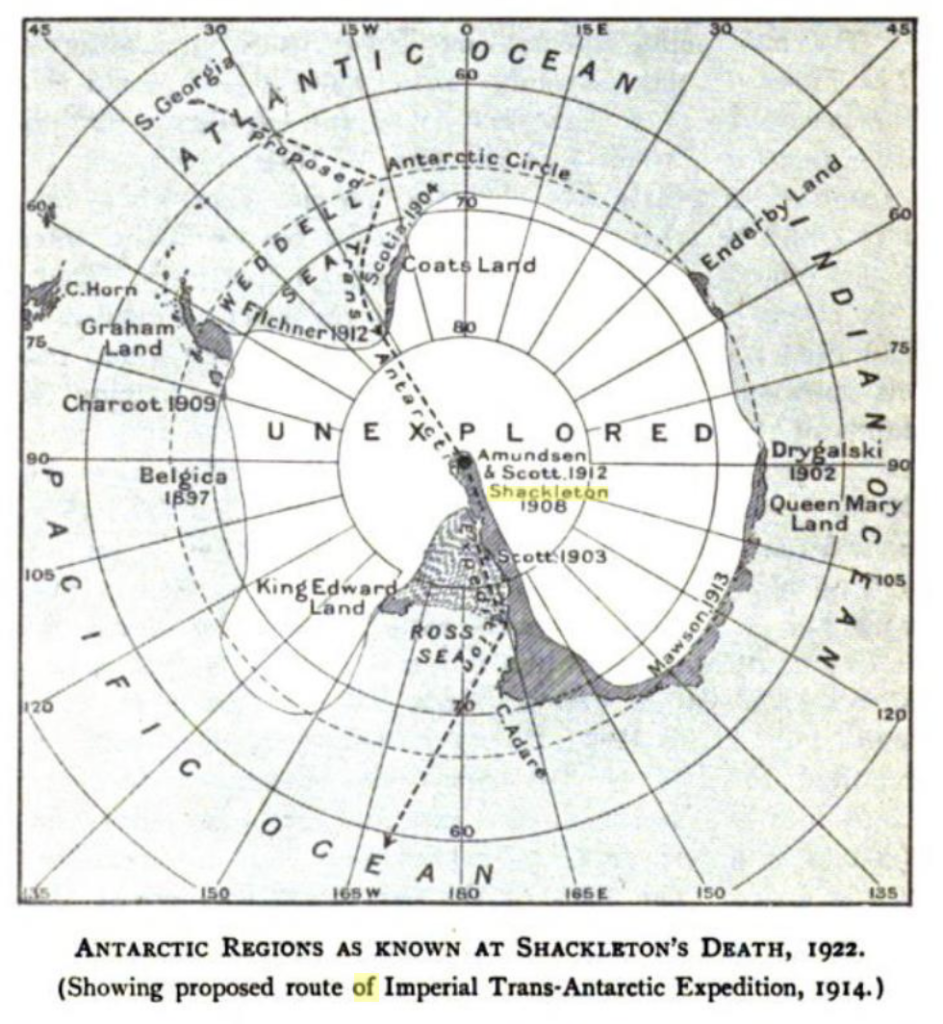
The ship set off from the Grytviken, a Norwegian whaling station on South Georgia Island, on the fifth of December, 1914 (page 2 Hurley Journal). They soon encountered pack ice and icebergs, which blocked their charted course. By February of 1915, the Endurance was “beset” by sea ice and drifted away from its destination with the floes of the Weddell Sea. With the realization that the Endurance would be stuck until the ice thawed, the crew planned to spend the winter on the ship.

Map of the drift of the Endurance
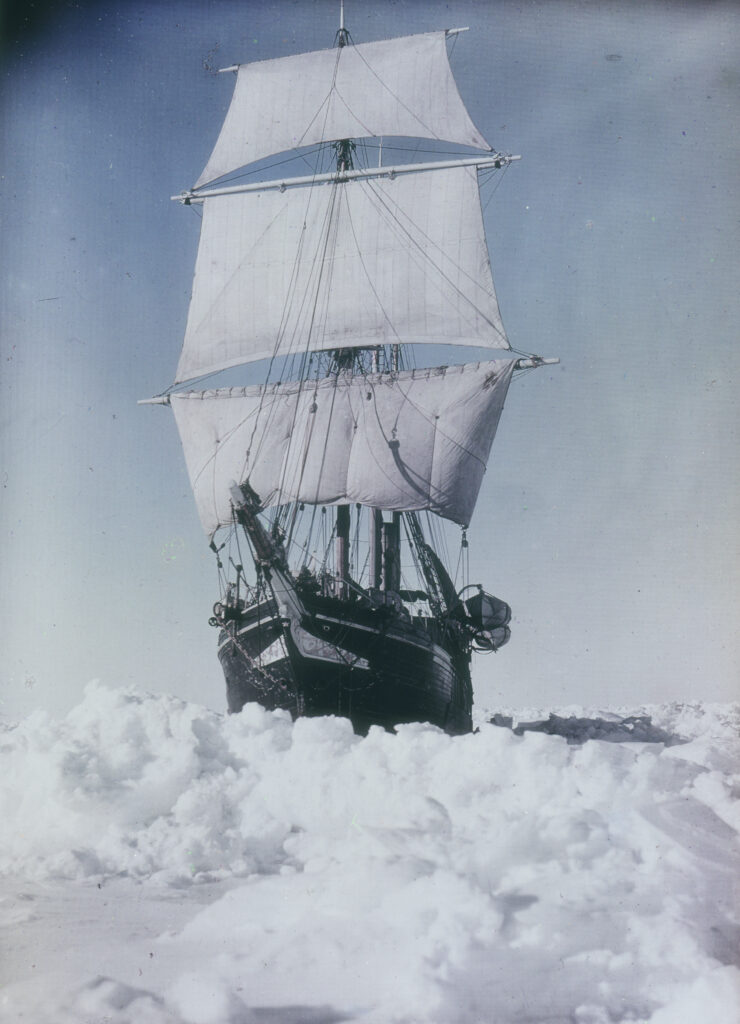
Over the next few months, the sea ice surrounding the Endurance repeatedly squeezed the ship’s hull, and by October, the ship began to yield to the pressure.20 On the 22nd of October, the pressure finally became too great. The ice tore apart the rudder and stern-post and created gaps in the planks large enough for water to flow into the hull. The crew desperately tried to save the ship for four days, but by the 27th of October, the ship and expedition had to be abandoned. All of the food, sledges, dogs, tents, lifeboats, and other equipment were loaded onto the ice.21 The crew attempted to drag the lifeboats and gear across the ice with the dogs and sledges, but progress was too slow and difficult, and the crew resigned themselves to camp on the ice. About one mile from the wreck, the crew made what Shackleton called “Ocean Camp.”22
The endurance stuck in ice
Ocean Camp lasted for about two months. During this time, frequent trips were made to salvage materials from the half-sunk Endurance, a make-shift stove was constructed, and several structures were improvised on the floe. The crew, to conserve their rations, ate as much seal, penguin, and dog pemmican as they could.23 Shackleton had the remainder of the luxury rations, like jelly, fish paste, and tinned herrings, distributed to each meal in an attempt to improve morale, which succeeded remarkably.24 On the 21st of November, nearly a year after the expedition set off from South Georgia Island, the Endurance sank beneath the ice. This was a welcome development for the crew, who found the wrecked ship depressing and dangerous to visitors.25 In December, another attempt was made to drag the lifeboats over the ice. Only nine miles of progress was made in five days, and further efforts were abondoned.26 There, they established a “patience camp.”
Patience Camp lasted for roughly three and a half months. Due to limited rations, all the dogs except two teams had to be shot and eaten. They drifted northward due to the wind and ocean currents, and as the weather warmed and the ice melted, the floe became unstable, and life became miserable. Soon, seals stopped appearing, and the remaining dogs had to be killed. The crew began to fracture in the poor conditions.27 Finally, however, on April 7th, 1916, the crew of the Endurance spotted land.
On April 8th, 1916, the crew took to their lifeboats as the floe they had camped on began to break up.28 They left with the intention of reaching Deception Island, which had supplies and a church whose timbers they planned to construct a ship with. On the second day of their journey, a measurment of their position revealed that they had traveled 30 miles further East than planned, and had to set their sights on Elephant Island which was over 100 miles away.29 The last of the six day journey met with high seas and sub-zero termeratures which froze the seawater to the lifeboats in such think layers that it had to be chisseled off to prevent the extra weight from sinking the vessels. The tired and starving men faced frostbite and seasickness, and Shackleton expected that the weakest among them wouldn’t survive the night. By the morning of April 15, 1916, the three lifeboats made the first-ever landing on Elephant Island, and the crew set foot on solid ground for the first time in 17 months.30
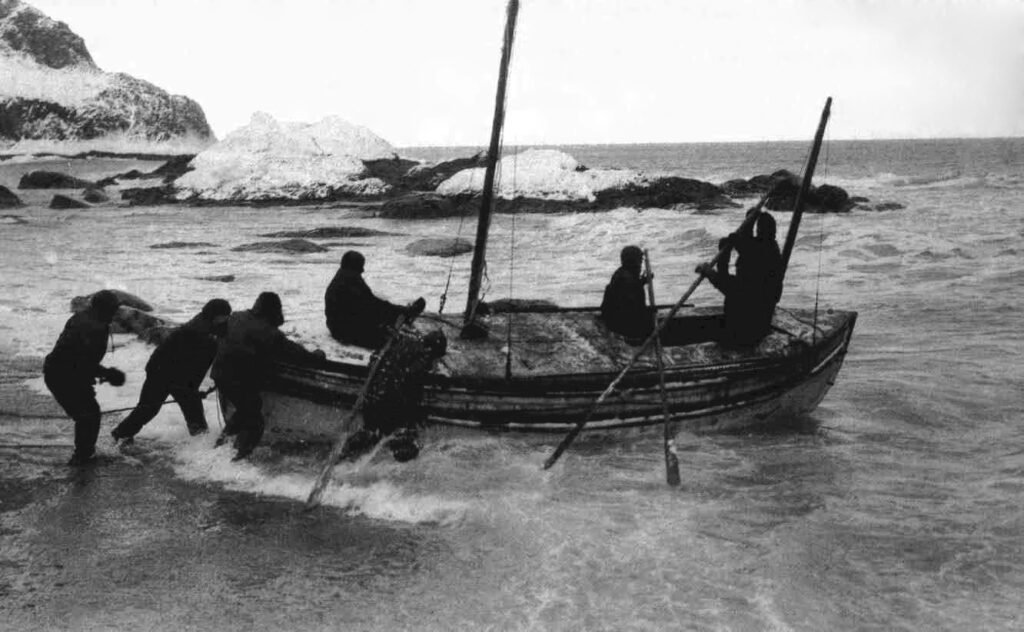
On Elephant Island, the crew constructed a shelter made of the lifeboats and prepared for a long-duration stay. Shackleton planned to sail the largest of the lifeboats, the James Caird, to South Georgia Island with a party of six to secure a rescue for the remaining crew. With the coming winter, the crew wasted no time in preparing the James Caird for the 800-mile journey over open ocean. The carpenter reinforced its hull, attached another mast from another of the lifeboats, and fitted a canvas cover to provide some kind of shelter.31
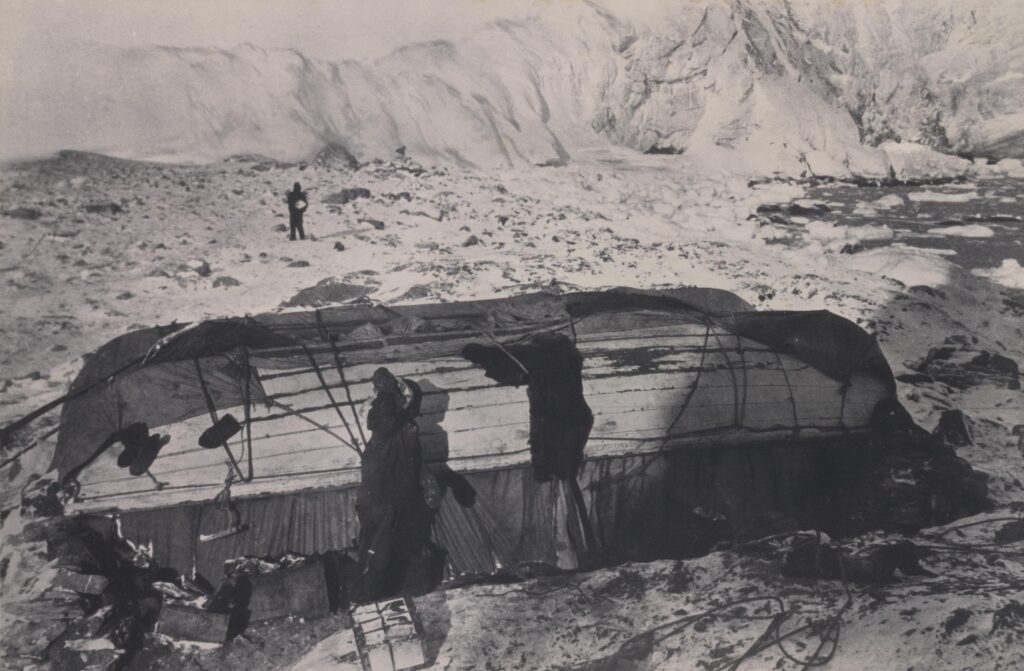
Shelter on Elephant Island
The voyage aboard the Caird lasted for 17 days. A tiny, 22-foot lifeboat, the Caird was incredibly cramped and unstable in the swells of the southern ocean. Standing up was nearly impossible; there was nowhere to sit other than the helm, where each member took two-hour turns steering the boat, and there was nowhere to lie down. The conditions were so poor, and the crew was so exposed, that after spending their two hours at the helm, the crew members needed assistance unbending their knees.34
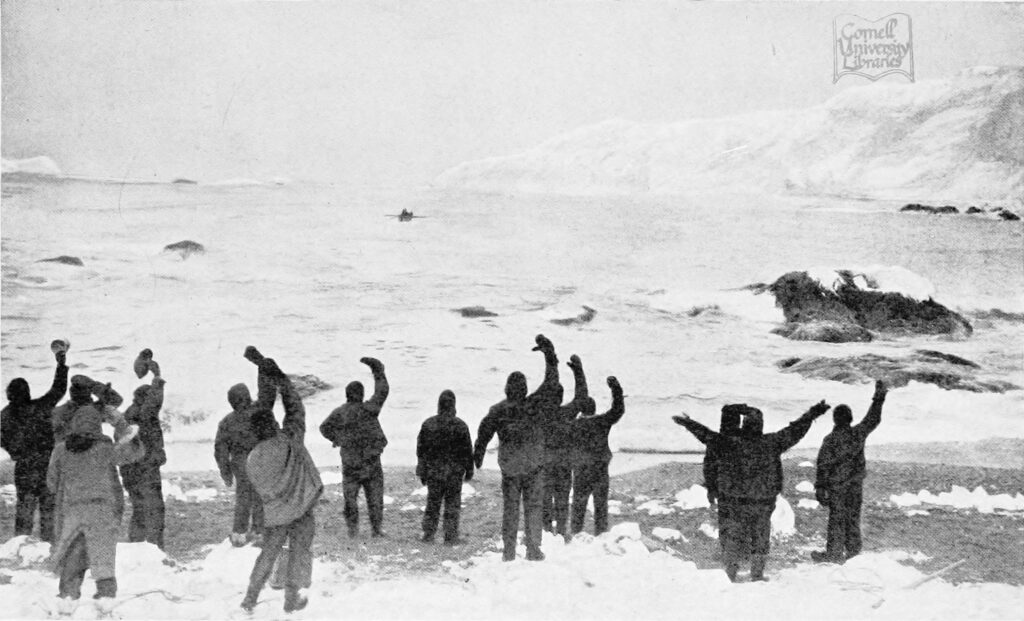
The James Caird finally reached South Georgia Island on May 10th, after almost sinking in a storm the night before, and made a landing on the side of the island opposite the whaling station. The six men burnt parts of the boat to dry their clothes and to cook the seabird they caught on the island. After recuperating, Shackleton and two other men left the three remaining comrades back at their camp on May 15th in an attempt to hike over the island to reach the whaling station. According to their charts, the hike would be about 17 miles, so they decided to make the trip in one shot. They left at three in the morning and hiked for 36 hours straight across the snowy mountains of the Island until, on the 20th of May, 1916, the three men arrived at the Grytviken whaling station. They were the first group to ever cross the interior of South Georgia Island. They soon arranged for a steamship to pick up the remaining crew on Elephant Island, and on August 30th, after nearly two years, they were rescued. The entire 28-man crew survived.
Shackleton, though he never succeeded on any of his expeditions, is remebered as the greater polar explorer of the time. His leadership, optimisim, and endurance are reguarded societal benchmarks for the best that people can be.35
Works Cited:
-
↩︎ - Hugh Robert Mill, “Family and the Future Field,” The Life of Sir Ernest Henry Shackleton (William Heinemann, Ltd., London), 3. ↩︎
- ↩︎
- Mill, “The Discovery,” 34-37 ↩︎
- Mill, “The Discovery,” 59-63 ↩︎
- Mill, “The Discovery,” 78-79 ↩︎
- Mill, “The Nimrod,” 108 ↩︎
- Mill, “The Nimrod,” 114 ↩︎
- Mill, “The Nimrod,” 139-141 ↩︎
- Mill, “The Nimrod,” 143-144 ↩︎
- Mill, “The Nimrod,” 151 ↩︎
- Ernest Henry Shackleton. 1920. South; the Story of Shackleton’s Last Expedition, 1914-1917, “Preface” (London: W. Heinemann), vii ↩︎
- Mill, Hugh Robert. “The Return of Sir Ernest Shackleton.” The Geographical Journal 48, no. 1
(1916): 68 ↩︎ - Mill, “The Endurance,” 195 ↩︎
- Shackleton, “Preface” in South!, xi ↩︎
- NIELSEN, HANNE ELLIOT FØNSS. “Heroic Antarctica: Sponsorship and Selling a Narrative in the Age of Heroes.” In Brand Antarctica: How Global Consumer Culture Shapes Our Perceptions of the Ice Continent. University of Nebraska Press, 2023. https://doi.org/10.2307/jj.8500748.7. ↩︎
- Shackleton, South!, ix ↩︎
- Shackleton, South!, x ↩︎
- Shackleton, South!, ix ↩︎
- Shackleton, South!, 66 ↩︎
- Mill, “The return of Sir Ernest Shackleton,” 68-69 ↩︎
- Shackleton, South!, 68 ↩︎
- Shackelton, South!, 88-89 ↩︎
- Shackleton, South!, 90 ↩︎
- Dixon, Robert, and Christopher Lee, eds. “The Imperial Trans-Antarctic Expedition Diary: (November 1914–April 1917).” In The Diaries of Frank Hurley 1912-1941. Anthem Press, 2011. http://www.jstor.org/stable/j.ctt1gxp8hb.7. ↩︎
- Mill, “The return of Sir Ernest Shackleton,” 69 ↩︎
- Mill, “The James Caird,” 216-218 ↩︎
- Shackleton, South!, 120-123 ↩︎
- Mill, “The James Caird,” 216-218 ↩︎
- Mill, “The James Caird,” 222 ↩︎
- Shackleton, South!, 160 ↩︎
- Hurley, The Diaries of Frank Hurley 1912-1941, 46 ↩︎
- Hurley, The Diaries of Frank Hurley 1912-1941, 49 ↩︎
- Mill, “Across South Georgia” 225 ↩︎
- Tallmadge, John. “Shackleton in the Antarctic: Tragedy, Initiation, and the Epic of Endurance.” Interdisciplinary Literary Studies 10, no. 2 (2009): 55. http://www.jstor.org/stable/41210018. ↩︎