
“It is painful to us, to have to recount such events : we have to shew to what a degree the imagination of man is susceptible of being struck by the presence of danger, so as to make him even forget the duties which honor imposes on him. We, doubtless admit that in forsaking the raft, the minds of those who did so, were greatly agitated, and that the desire of withdrawing themselves from danger, made them forget that a hundred and fifty unfortunate men were going to be abound end to the most cruel sufferings.”1
—J. B. Henry Savigny and Alexander Corréard


Where The Medusa Was Going

The French Frigate Medusa was a 44 gun frigate war ship that set sail with the goal of reclaiming St. Louis from British control. The British and the French had been fighting over territory off the Western coast of Africa, and The Medusa’s job was to resume France’s possession and enjoyment of her rights over St. Louis. The ship carried the future Governor of Senegal and his family as well as army battalions. Four vessels were sent on this journey: The Medusa, Echo, Loire, and Argus but it was only the Medusa that shipwrecked along this journey.4
Image depicts the French Frigate Medusa and its accompanying ships: The Echo, The Loire, and The Argus.5
Landmarks Along The Way:
The Medusa set sail on June 17th, 1816, at seven in the morning from l’Île d’Aix along with the Argus, Loire, and Echo. After 4-5 days, on the 21st or 22nd of June, they reached Cape Finisterre, which is where the Loire and Argus parted company from the frigate as they were sailing poorly. The Medusa was meant for long and perilous journeys so it was much easier for the ship to cut thorough water compared to the Loire and Argus. The Medusa then set sail towards Madeira, but the crew did not see the island when they were supposed to and once realizing this mistake the crew took a solar observation. Their observation led them to believe they were actually east and west of Porto Santo. This mistake was attributed to the currents of the Straits of Gibraltar. In the morning of the 28th, the Medusa saw the islands of Madeira and Porto Santo which marked another landmark along their journey towards Senegal. The next landmark the crew encountered was the Salvages Islands, followed by Pico de Tenerife. Then they saw Cape Bayados, where there was the immense desert of Zaara, now the modern-day Western Sahara. Throughout their route they apparently saw the mouth of the St. John River and also crossed the equator. However when looking at modern maps, both of these landmarks seem unlikely given the location of Senegal.6
It was the 28th of June when the first mistake of the Medusa’s navigation occurred. A member of the Philanthropic Society of Cape Verd was aboard the Medusa and claimed that staying where they were in the Peak of Tenerife was extremely dangerous. This man claimed to be well acquainted with the country and had experience navigating in this area. To the anger of the crew Captain Lachaumareys believed this man and gave him command of the frigate. Various officers told the captain that this was a bad idea but the captain refused to acknowledge the officers concerns and ordered everyone to obey Richefort; saying he was king therefore everyone should obey him. Richefort immediately changed the route for no reason and the Medusa set sail in a southerly direction.7


On the 2nd of July the captain was convinced that a large cloud was Cape Blanco and after this pretended discovery the frigate steered west in order to supposedly miss the Arguin Bank. The danger of this route was presented to the captain but once again he ignored these warnings and by noon on the 2nd of July the frigate was at the edge of the Arguin Bank. Again the captain was told of this and he ignored the warning signs and told the crew there was no cause of alarm. Thus when the frigate hit a sandbank along the Bank of Arguin it was no surprise to majority of the crew. They were only 100 miles from Senegal when the Medusa ran aground in shallow water, only 5 meters deep.10
The Making of The Raft of Medusa

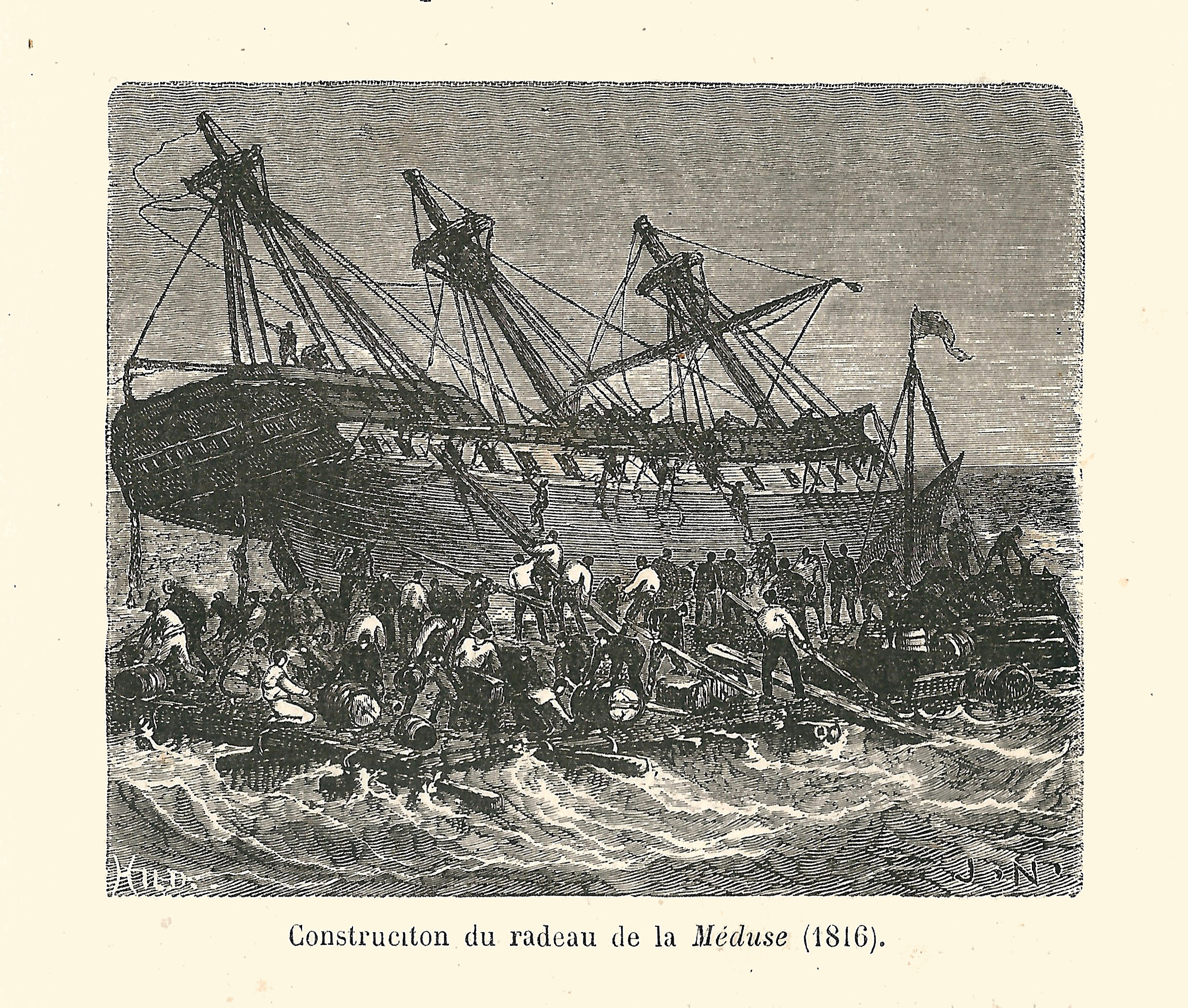
This image is a detailed version of the plan of the Raft of Medusa. This raft was to hold one hundred and fifty people, and it was mostly composed of the top-masts of the frigate, yards, fish, boom, etc. Very strong ropes joined every piece together, and there were masts connected side by side throughout the entirety of the raft. Boards were nailed to the first foundation of the raft, which formed a parapet; however, as the individuals on this raft later learned, they should have made the foundation higher. To make the raft more solid, they placed long pieces of wood across the raft. There was a kind of railing, but it was no more than forty centimeters in height. Therefore, it was not as effective as it could have been. The fore part of the raft, which was at least two meters long and had very little strength, therefore it got submerged quite frequently. The only strong part of the raft was its center, but it was not enough to hold 150 people. The raft was 20 meters long and 7 meters wide. It had no sails or mast, which would later be a mistake. On board the raft, there were also certain provisions. For example, there was a great quantity of barrels of flour, as well as six barrels of wine and two casks of water. It only took fifty men to board the raft for it to sink at least seventy centimeters underwater. When all one hundred and fifty boarded the raft, it sank one meter underwater. These conditions were less than ideal for those aboard the Raft of Medusa.12
The Raft of Medusa
After The Medusa hit a sandbank along the Bank of Arguin the crew knew that the loss of the vessel was certain. A plan was needed in order to ensure the escape of the crew therefore a council was called. It was at this council that the governor of Senegal gave the plan of a raft that could carry 200 men and provisions. They knew that their four other row-boats could not carry all 400 crew members therefore this raft was necessary. The plan was to form a caravan, and proceed to the Island of St.Louis however this plan was never carried out fully. The ship was far too heavy which is what led to its inevitable end. There were flour barrels that the Governor of Senegal objected to having thrown overboard and if the frigate had been lightened as soon as they struck the sandbank then perhaps the ship could have been saved. The raft was also damaged during the demise of The Medusa.13
“It was now that we had need of all our courage, which, however, forsook us more than once: we really believed that we were sacrificed, and with one accord, we cried that this desertion was premeditated. We all swore to revenge ourselves if we had the good fortune to reach the shore, and there is no doubt but that, if we could have overtaken, the next day, those who had fled in the boats, an obstinate combat would have taken place between, them and us.”14
—Jean Baptiste Henri Savigny
Alexandre Corréard.
Those on board The Raft of Medusa were soon abandoned by the other rafts. The cries of Vive le Roí were shouted between the raft and the boats as the raft was left to its demise. The raft was being towed by 2-3 boats when the officers and the Governor of Senegal decided to abandon the rope towing them. The cowardice and inhumanity among the officers of the other boats was evident, for even as they saw the cries of those aboard the raft they continued to cut the rope connecting the boat to the raft. Some aboard the raft like Mr. Dangles attempted to take their own life in fear that death was imminent.16
Everyone aboard the raft saw the inevitable destruction that was soon to occur. One of their small feats was that they had a little compass that could potentially tell the raft where they were, however an accident caused them to lose the compass in the sea. Hunger was soon severely felt and they decided to mix biscuit paste with wine and distribute it to the 150 people aboard the raft. Even after one night 10-12 people lost their lives either by the violence of the sea or by openings between the pieces of the raft. The ocean was not kind to those on the raft and they were continuously hit with huge waves that threatened to throw them overboard. The fumes of wine plus the need for food caused some men to go insane and commit mutiny.17
“The raft already appeared to be buried under the waves, and its unfortunate passengers immersed. The fatal machine was drifted by currents far behind the wreck of the frigate; without cable, anchor, mast, sail or oars; in a word, without the smallest means of enabling them to save themselves.”18
— Madame Dard, one of the sufferers

“When we recall to our minds those terrible scenes, they present themselves to our imagination like those frightful dreams which sometimes make a profound impression on us; so that, when we awake, we remember the different circumstances which rendered our sleep so agitated. All these horrible events, from which we have escaped by a miracle, appear to us like a point in our existence: we compare them with the fits of a burning fever, which has been accompanied by a delirium…We were really seized with a fever on the brain, the consequence of a mental exaltation carried to the extreme.”20
—Jean Baptiste Henri Savigny
Alexandre Corréard.
Surviving The Raft of Medusa

As the horrible conditions of the raft caught up with the survivors extreme measures were taken in order to survive. What makes the raft of the Medusa so famous was not just the abandonment by the French officers but the extreme lengths those on board the raft went to.22 Worn out with fatigue, hunger and lack of sleep a great number of individuals on the raft had thrown themselves into the sea as they had deemed drowning the better fate. About a fourth of the raft had drowned themselves in despair. In an attempt of finding food many of the soldiers tried to fish for sharks however this proved to be unsuccessful. It was in this moment that the men aboard the raft started to do what they needed in order to survive. Those whom death had spared fell upon the dead bodies and began to cut off pieces, which were instantly devoured. The officers refused to touch the dead bodies however, as they saw the cannibalists grow in strength they changed their mind.23
After more deaths either by sea, hunger, or mutiny there were only 27 men remaining from the 150. Only fifteen of the 27 seemed likely to live the entirety of the journey. Once the men fell to the necessity of cannibalism there was scarcely sufficient food on the raft to last for about 6 days. However having food does not make the experience any less painful. It was when the final 15 men aboard the raft hoped for death when an out of the ordinary event occurred. A white butterfly, a species common in France, appeared fluttering over the heads of those aboard the raft. To some this white butterfly was an harbinger that brought news of land. Others thought this butterfly to be a messenger of heaven. Either way the butterfly brought hope with it as it stayed with the raft for days just fluttering around the sail. It was only a couple of days later that the Argus found the raft. The men on the raft were in an awful state after being at sea for 13 days. They were almost naked, their bodies disfigured by the sun and ten of the fifteen were hardly able to move. Their eyes were hallow and wild and their appearance frightful. They were nothing but shadows of their original selves.24

“We tremble with horror at being obliged to mention that which we made use of! we feel our pen drop from our hand; a deathlike chill pervades all our limbs; our hair stands erect on our heads!—Reader, we beseech you, do not feel indignation towards men who are already too unfortunate; but have compassion on them, and shed some tears of pity on their unhappy fate.”25
—Jean Baptiste Henri Savigny
Alexandre Corréard.
Alive when we were saved. Notice of their subsequent fate.
- Messrs.
- Dupont, Captain of Foot; In Senegal.
- L’Heureux, Lieutenant; In Senegal.
- Lozach, Sub-Lieutenant; Dead.
- Clairet, Sub-Lieutenant; Dead.
- Griffon du Bellay, Ex-Clerk of the Navy; Out of employment.
- Coudin, élève de marine; Midshipman.
- Charlot, Sergeant Major (of Toulon); In Senegal
- Courtade, Master Gunner; Dead.
- Lavillette. In France
- Coste, Sailor; In France
- Thomas, Pilot; In France
- François, Hospital Keeper; In the Indies.
- Jean Charles, black Soldier; Dead.
- Corréard, Engineer Geographer; Without employment.
- Savigny, Surgeon. Resigned.
Of those that were saved by the Argus only 12 remained alive. After the surviving the raft some became unemployed or resigned while the rest lived out their days in various places. Some of 12 even lived in Senegal which was the final destination of the Medusa. The story of abandonment and cowardice is a window into the social class distinctions occurring during this time period in France. Majority of those aboard the raft were lower class or black while those of higher status were on the boats. The division of people between the raft and boats provides an insight into the social hierarchy of the 18th century. Furthermore the cruelty those aboard the raft experienced was so severe that one cannot help but read this story and feel as though they themselves had to undergo the trauma of the raft of the Medusa.
—Jean Baptiste Henri Savigny and Alexandre Corréard.26
Footnotes:
- Savigny, Jean Baptiste Henri, and Alexandre Corréard, “Narrative of a Voyage to Senegal in 1816,” 69. ↩︎
- GÉRICAULT Jean Louis André Théodore, “La Radeau de La Méduse.” ↩︎
- GÉRICAULT Jean Louis André Théodore, “Shipwreck of the Medusa.” ↩︎
- Savigny, Jean Baptiste Henri, and Alexandre Corréard, “Narrative of a Voyage to Senegal in 1816,” 34. ↩︎
- Jean-Jerome Baugean, “Relation complète du naufrage de la frégate La Méduse faisant partie de l’expédition du Sénégal en 1816.” ↩︎
- Savigny, Jean Baptiste Henri, and Alexandre Corréard. n.d, “Narrative of a Voyage to Senegal in 1816.” ↩︎
- Anonymous. n.d, “Thrilling Narratives of Mutiny, Murder and Piracy,” 80-82. ↩︎
- Claude Ferrere, “French Frigate Meduse wrecked on the Bank of Arguin.” ↩︎
- Gericault, Theodore 1791-1824, “The Raft of The Medusa.” ↩︎
- Anonymous. n.d, “Thrilling Narratives of Mutiny, Murder and Piracy,” 85. ↩︎
- Savigny, Jean Baptiste Henri, and Alexandre Corréard, “Narrative of a Voyage to Senegal in 1816,” 20. ↩︎
- Savigny, Jean Baptiste Henri, and Alexandre Corréard. n.d, “Narrative of a Voyage to Senegal in 1816.” ↩︎
- Savigny, Jean Baptiste Henri, and Alexandre Corréard, “Narrative of a Voyage to Senegal in 1816,” 74. ↩︎
- Savigny, Jean Baptiste Henri, and Alexandre Corréard. n.d, “Narrative of a Voyage to Senegal in 1816.” ↩︎
- Zurcher & Margollé, Les Naufrages célèbres, Paris, “Construction du radeau de la Méduse, en 1816.” ↩︎
- Anonymous. n.d, “Thrilling Narratives of Mutiny, Murder and Piracy,” 90-95. ↩︎
- Anonymous. n.d, “Thrilling Narratives of Mutiny, Murder and Piracy,” 95. ↩︎
- Anonymous. n.d, “Thrilling Narratives of Mutiny, Murder and Piracy,” 100. ↩︎
- Jean de Bonnot, “Relation complète du naufrage de la frégate La Méduse faisant partie de l’expédition du Sénégal en 1816.” ↩︎
- Savigny, Jean Baptiste Henri, and Alexandre Corréard. n.d, “Narrative of a Voyage to Senegal in 1816.” ↩︎
- C. Motte, “The Raft of Medusa.” ↩︎
- Anonymous. n.d, “Thrilling Narratives of Mutiny, Murder and Piracy,” 101. ↩︎
- Savigny, Jean Baptiste Henri, and Alexandre Corréard, “Narrative of a Voyage to Senegal in 1816,” 87. ↩︎
- Savigny, Jean Baptiste Henri, and Alexandre Corréard. n.d, “Narrative of a Voyage to Senegal in 1816.” ↩︎
- Savigny, Jean Baptiste Henri, and Alexandre Corréard. n.d, “Narrative of a Voyage to Senegal in 1816.” ↩︎
- Savigny, Jean Baptiste Henri, and Alexandre Corréard. n.d, “Narrative of a Voyage to Senegal in 1816.” ↩︎