
History of the Terror and Erebus Modifications
Before getting into the modifications of these ships, it is worthwhile learning a little about their history serving Britain. Both the Terror and Erebus were launched as bomb ships in the British Royal Navy, in 1813 and 1826 respectively. Bomb vessels had an advantage compared to conventional ships because they could launch motors over fortifications. This type of ship was used intermittently in times of war until they became obsolete in warfare in the early 19th century due to advances in long range artillery. Therefore, the Erebus and Terror were put into service for navigation for their strength and copious amounts of storage.1
Before their last and fatal voyage, the hulls of HMS Terror and HMS Erebus had already been strengthened and their heating systems installed for a polar rescue mission. However, only the Terror went to the Hudson bay on the mission, barely surviving being beset (stuck) in the polar ice for the winter of 1836-37. The newly installed water heating system failed due to its pipes routinely leaking or being clogged. After the both ships’ heating systems were replaced with the Sylvester hot air system, they were used on the famous and successful James Clark Ross Antarctic voyage in 1839.2
Auxiliary Power
For the 3rd Franklin Expedition, one main and controversial modification was made: the addition of steam engines. The HMS Erebus and Terror were the first Royal Navy wooden warships to be fitted as steam-driven screw ships.3 Since these ships were not made with steam engines in mind, the addition of such could’ve proven to be difficult to operate. The engines, the newest technology on ships at the time, would’ve infused the crew with a sense of confidence in the ships’ capabilities, and, at the same time, adding more complexity to ships that was already executing a complex mission. The drawing below shows how out of place the engines looked in the ships, with the smoke stack cutting through the deck vertically.
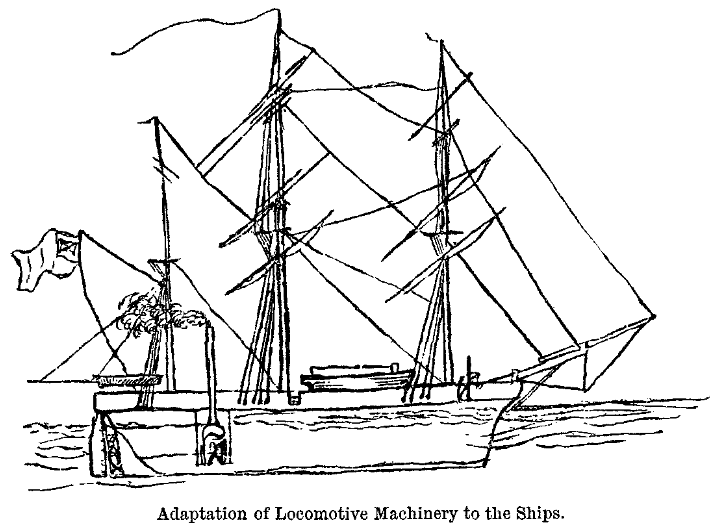
Drawing by John Irving showing the steam engine installation. The smoke stack pictured would only be put up when in use.
“Adaptation of Locomotive Machinery to the Ships” by John Irving. Cambridge Library Collection. This image is in public domain.4
The fuel for the steam-engine was ‘patent fuel’—”a mixture of coal dust and coal tar formed into bricks under hydraulic pressure”.5 It was considered to be more efficient and to take up less space than traditional coal. Despite this, the fuel still took up valuable space, so they loaded the minimum amount thought necessary (possibly up to 12 days worth). As a result, they wouldn’t have run the engines unless every other means of moving was exhausted. 6
The train engines they used were lightweight and relatively efficient compared to the maritime steam engines at the time which were bulky and wholly impracticable for these ships. The engines were cited as being 30 horsepower by Murray’s Navy List but these figures were in Nominal Horsepower, which describes the engines’ size rather than their actual power—a number that could’ve been up to 3 times as much (for reference a modern icebreaker has 40,000 horse power7).8 When tested, the Terror went 3.6 knots or 4.1 miles per hour.9 This is likely comparable to the Erebus as Parry, who oversaw the outfitting of the ships, insisted that both engines be identical so parts could be interchangeable. 10
This auxiliary power addition raised some criticism. Sir James Clark Ross and his uncle, Sir John Ross, both notable Arctic navigators, expressed concerns about the steam engine additions due to the fuel’s heavy weight. The lifting gear, which permitted the lifting of the propeller to protect it from ice damage and to reduce drag, Ross thought weakened the sternposts.11 In the image below, the modification of the sterns can be seen which shows a break in the sternposts to make room for the propeller (likely weakening the sterns). He also believed that the vessels were too heavy and bulky to make it through the narrow ice passages and that they would get stuck. He pleaded to Franklin to leave supplies and spare boats along the way in case he needed to retreat. Ross also advised him to leave a notice in a cairn of where they were going if they were stuck so that they could more easily be found. Franklin dismissed his worries as he would not consider failure.12
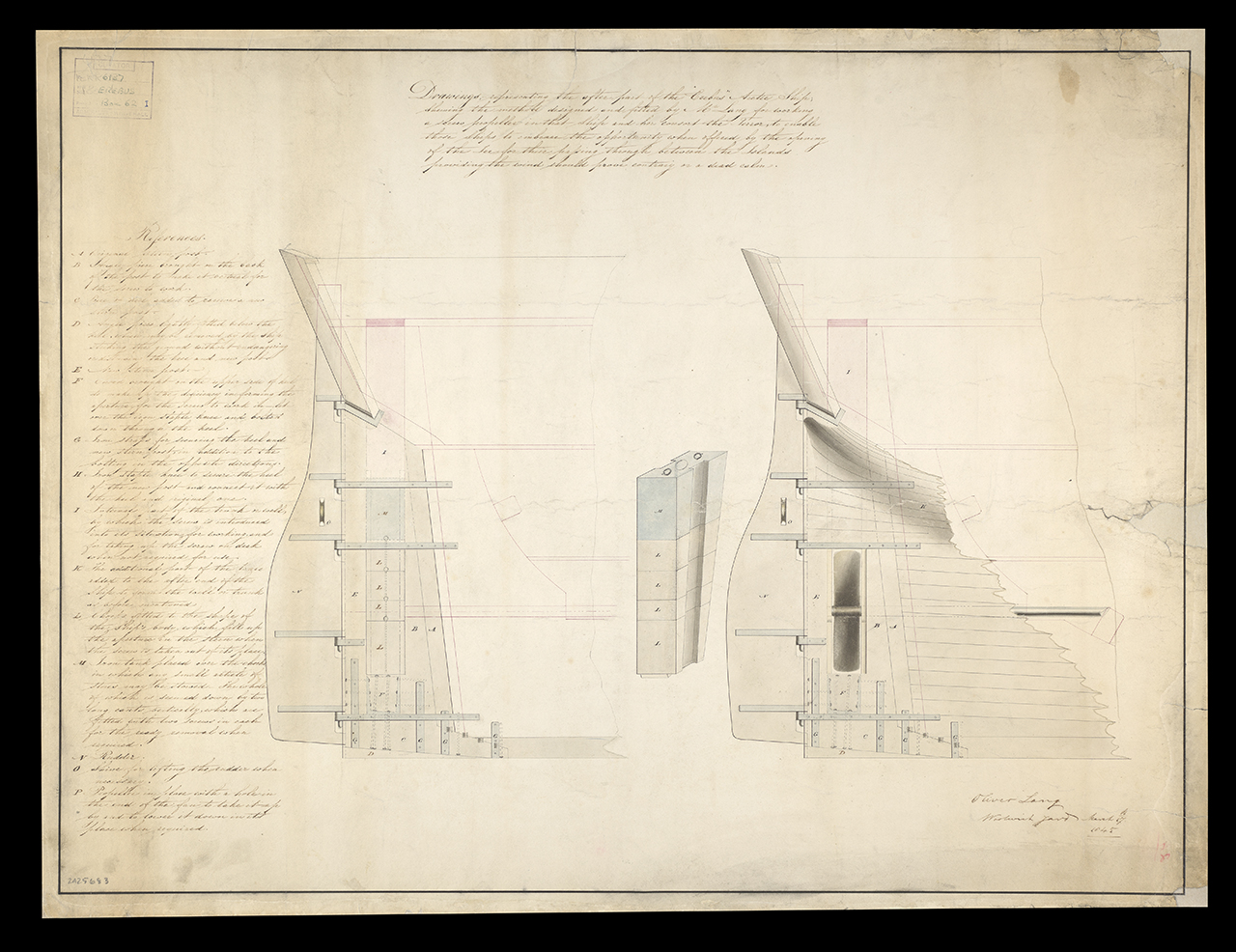
Technical drawing of the stern modifications to the HM Ships Erebus and Terror. The left stern is pre-modification the right stern is post-modification. The propeller addition can be seen with the axle extending to the engine to the right. This modification was one of the many concerns John Ross had for this expedition.13
“[Sterns of HMS Erebus (1826) and Terror (1813)]” by Oliver Lang. Royal Museums Greenwhich. This image is in public domain.
![“[Sterns of HMS Erebus (1826) and Terror (1813)]”](https://commons.wikimedia.org/wiki/File:Erebus_(1826);_Terror_(1813)_RMG_S0807.jpg)
The presumptuous belief that steam engines (an unproven technology in maritime transportation) wouldn’t lead to any issues and Franklin’s arrogance in the face of the unknown would ultimately lead to the expedition’s demise. If Franklin took his friend John Ross’s advice, he and his crew might’ve come home as arctic tested heroes and not in coffins.
Final Plans
Just 14 days before they would set sail, on May 5th 1845, the British Admiralty gave Franklin sailing instructions leading up to the expedition that comprised of 23 clauses (see the attached file below for the full instructions). The first two clauses describe how a transport ship, called the Barretto Junior, would carry supplies that would later be transferred when the ships got up to Greenland. The third clause describes how they should go through Lancaster Sound with “as little delay as possible”.14 In the fifth clause, the Admiralty expresses its optimism that the rest of the trip through the Arctic will be as unobstructed as Lancaster Sound, and instructs Franklin to travel through to the Bering Straight. However, in the sixth clause, the Admiralty understood that the Barrow straight might not be open and thus instructs Franklin to continue south.15
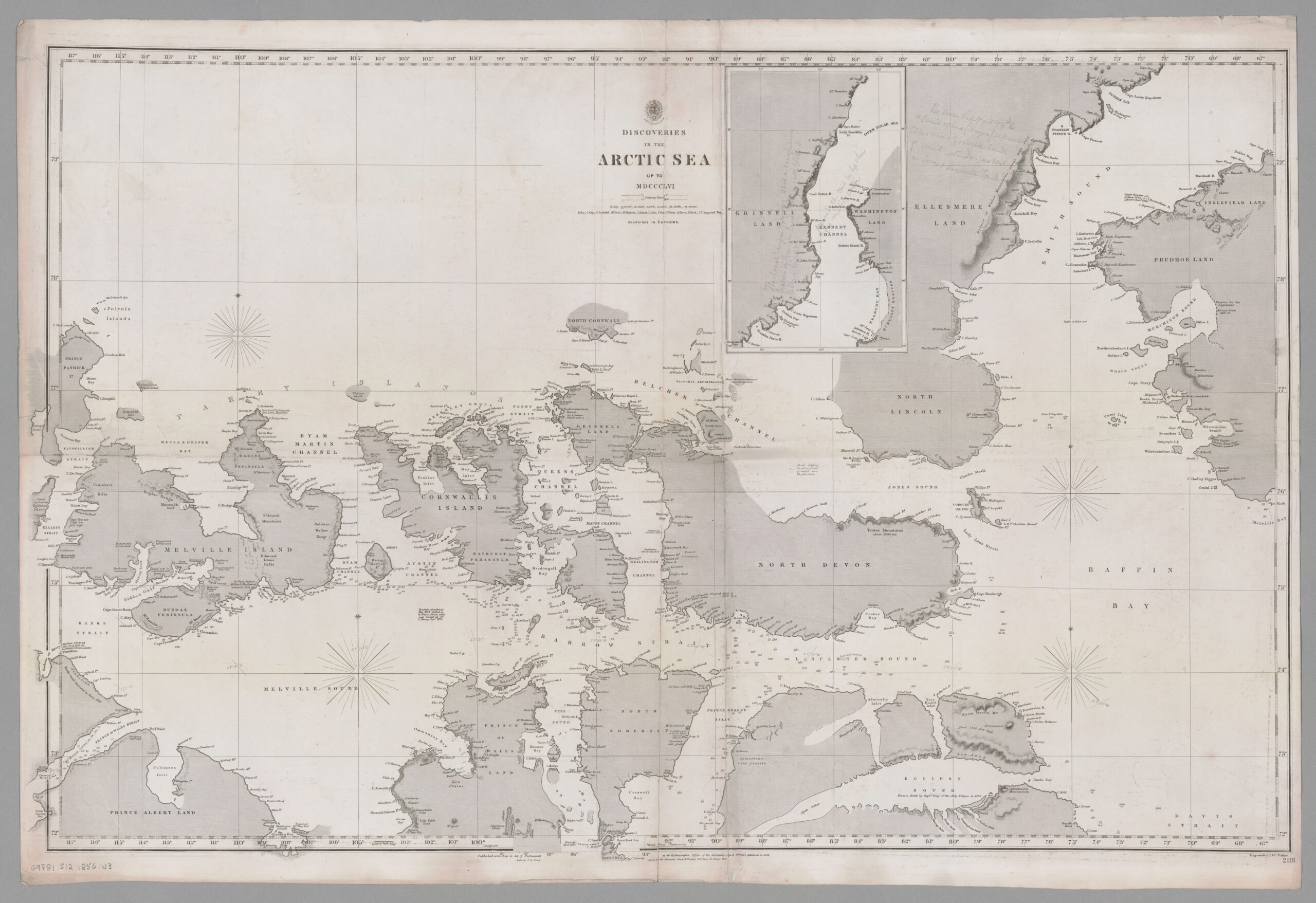
However certain these route instructions seem, the way was anything but known. Before the Franklin expedition to the Arctic, little was known about the location of islands, weather, and ice patterns. It was only after the expedition, with the rescue attempts that the Western world started to map out, to any significant degree, the Northwest. Below, there are three maps: one before the 1845 Franklin expedition that shows the extent to British geographic knowledge of the Northwest, one after the searches for the Franklin expedition which shows the numerous new islands that became known, and one of the geography as we know it today. The discrepancies in knowledge that these images display show how blind Franklin was sailing into the Arctic. He had no knowledge of what path to take or where they would get stuck.
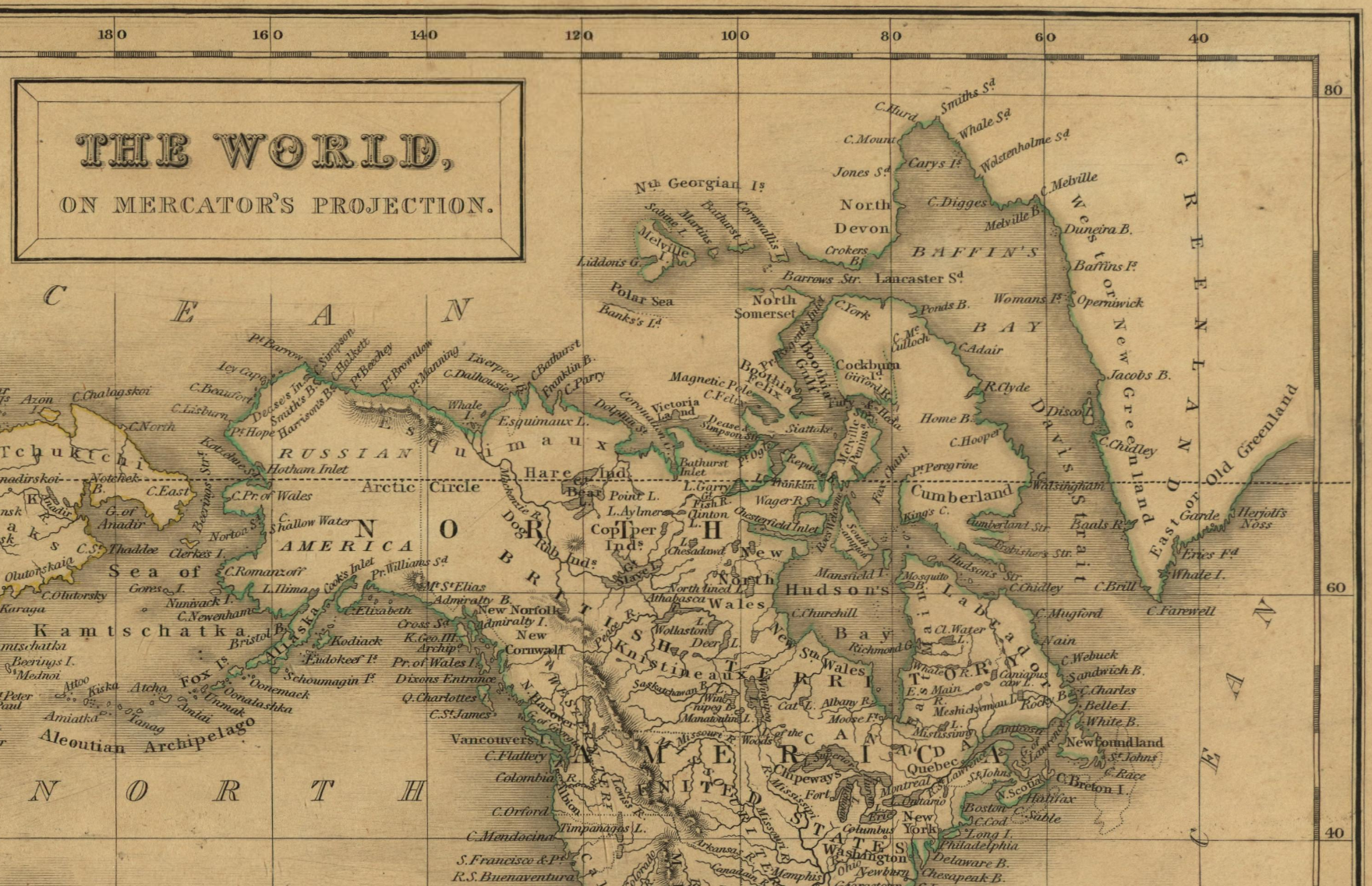
Section of a map of the Arctic Sea in the General Atlas of the World published in 1840 by Adam Black showing the lack of geographic knowledge past Somerset Island.16
“The World, on Mercator’s Projection” by Adam Black. Library of Congress. This image is in public domain.
Map of the Arctic Sea created in 1852 and added to in 1856 which shows the additions to geographic knowledge that the search missions for Franklin created.17
“Discoveries in the Arctic Sea up to MDCCCLVI (1856).” United Kingdom Hydrographic Office. This image is in public domain.

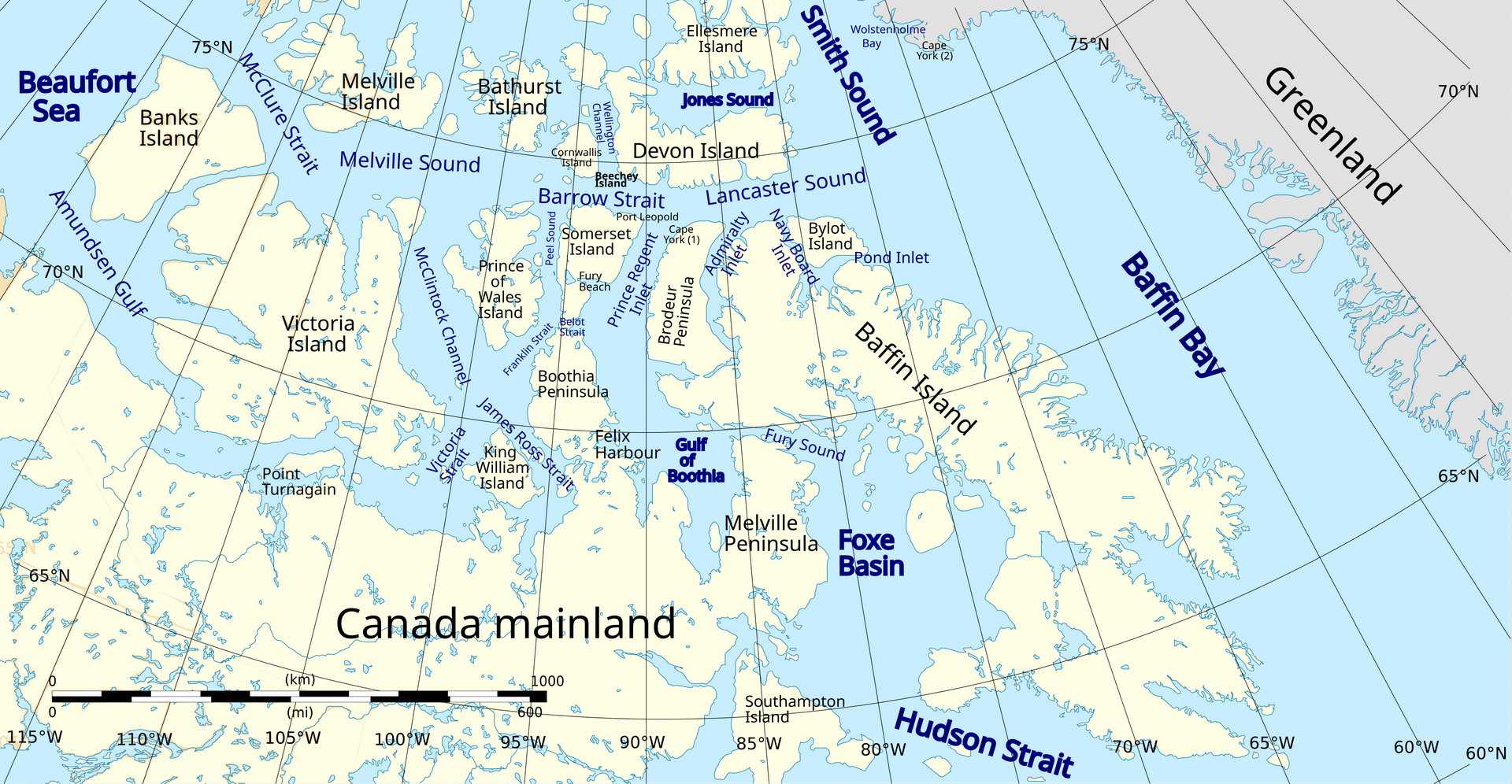
“Canadian Arctic Archipelago” by Thincat. Wikimedia Foundation. This image is in public domain.

Franklin would only get to 100 degrees west, but the Admiralty stated what he was to do if successful in clause 8: travel to “The Sandwich Islands” (what is now Hawaii) to recuperate, send word by Panama of their proceedings and discoveries, and then sail around Cape Horn back to Britain.19
However, the Admiralty was not blind to the possibility of hardship. It advised, in case of wintering, “by every means in your power to cultivate a friendship with [Inuits]”.20 However, this instruction seemed to be solely utilitarian, as the Admiralty recognized the Inuit’s knowledge of the land and their capacity to help if stuck by alerting Hudson Bay outposts of the wintered ships. It even states later in clause nine to be on guard against any hostility by the Inuits.21
The Admiralty goes on to caution Franklin against separating the Erebus and the Terror and to maintain regular communication with Crozier so that the crews could be stronger together.22 The 21st clause describes the succession of power if Franklin or Crozier were to pass or become unavailable, due to sickness or otherwise.23 Additionally, in clause 12, any scientific discovery made by one ship was to be relayed and recorded on the other ship to increase the odds that the findings from both vessels survive—an indication that the Admiralty believed in the chance that one of the ships might be abandoned or sink.24
The majority of the rest of the instructions from clause 13-20 refer to these scientific findings that were of interest to the crown: the true geographical position of islands; the currents in the Arctic Seas; specimens of flora, fauna, and geologic origin; meteorological observations; and most importantly, magnetic observations.25
Due to a late food delivery, the ships were already a week behind schedule by the time they would launch. Because of this delay, the Admiralty did not want the ships to rely on variable winds, so it had the ships towed by the HMS Rattler, a steamship driven by a screw propeller. While the Barretto Junior was to be towed by the HMS Monkey, a small tugboat.26
With everything ready, on May 19th, 1845, at 10:30 am, the HM Ships Erebus and Terror weighed anchor and were towed down the river Thames on their journey to the Arctic.27
Footnotes
- William Battersby and Peter Carney, “Equipping HM Ships Erebus and Terror, 1845,” The International Journal for the History of Engineering & Technology 81, no. 2 (2013): 193-194, https://doi.org/10.1179/175812111X13033852943147. ↩︎
- Battersby and Carney, “Equipping HM Ships Erebus and Terror, 1845,” 194. ↩︎
- Battersby and Carney, “Equipping HM Ships Erebus and Terror, 1845,” 200. ↩︎
- Bell, Benjamin. “1844–1845.” Chapter. In Lieut. John Irving, R.N., of H.M.S. Terror, in Sir John Franklin’s Last Expedition to the Arctic Regions: A Memorial Sketch with Letters, 119. Cambridge Library Collection – Polar Exploration. Cambridge: Cambridge University Press, 2014. ↩︎
- Battersby and Carney, “Equipping HM Ships Erebus and Terror, 1845,” 207. ↩︎
- Cockburn, Haddington, and Gage, “Instructions addressed to Captain Sir John Franklin, K. C. H., Her Majesty’s Ship [Erebus],” 3-4. ↩︎
- Michael Palin, Erebus: One Ship, Two Epic Voyages, and the Greatest Naval Mystery of All Time (Greystone Books, 2018), 196. ↩︎
- Battersby and Carney, “Equipping HM Ships Erebus and Terror, 1845,” 201. ↩︎
- Battersby and Carney, “Equipping HM Ships Erebus and Terror, 1845,” 201. ↩︎
- Battersby and Carney, “Equipping HM Ships Erebus and Terror, 1845,” 203. ↩︎
- Palin, Erebus, 196. ↩︎
- Palin, Erebus, 206. ↩︎
- Lang, Oliver. Erebus (1826); Terror (1813), paper ship plan, Wikimedia Foundation, March 17, 1845, https://commons.wikimedia.org/wiki/File:Erebus_(1826);_Terror_(1813)_RMG_S0807.jpg. ↩︎
- Cockburn, Haddington, and Gage, “Instructions addressed to Captain Sir John Franklin, K. C. H., Her Majesty’s Ship [Erebus],” 3. ↩︎
- Cockburn, Haddington, and Gage, “Instructions addressed to Captain Sir John Franklin, K. C. H., Her Majesty’s Ship [Erebus],” 4. ↩︎
- Aikman, George, Engraver. The World, on Mercator’s Projection. Edinburgh: Adam and Charles Black, 1840. Map. https://www.loc.gov/item/2021668708/. ↩︎
- Admiralty, Discoveries in the Arctic Sea up to MDCCCLVI (1856), Paper map, Wikimedia Foundation, April 8, 1852, https://commons.wikimedia.org/wiki/File:Admiralty_Chart_No_2118_Discoveries_in_the_Arctic_bk103wt7572,_Published_1852,_Additions_to_1856.jpg.
↩︎ - Thincat, Canadian Arctic Archipelago, digital svg image, Wikimedia Foundation, August 4, 2017, https://commons.wikimedia.org/wiki/File:Northwest_Passage,_exploration.svg. ↩︎
- Cockburn, Haddington, and Gage, “Instructions addressed to Captain Sir John Franklin, K. C. H., Her Majesty’s Ship [Erebus],” 4. ↩︎
- Cockburn, Haddington, and Gage, “Instructions addressed to Captain Sir John Franklin, K. C. H., Her Majesty’s Ship [Erebus],” 5.
Many people considered Inuits to be savages and primitive at the time including the likes of Fitzjames on this voyage. ↩︎ - Cockburn, Haddington, and Gage, “Instructions addressed to Captain Sir John Franklin, K. C. H., Her Majesty’s Ship [Erebus],” 5 ↩︎
- Cockburn, Haddington, and Gage, “Instructions addressed to Captain Sir John Franklin, K. C. H., Her Majesty’s Ship [Erebus],” 5. ↩︎
- Cockburn, Haddington, and Gage, “Instructions addressed to Captain Sir John Franklin, K. C. H., Her Majesty’s Ship [Erebus],” 6-7. ↩︎
- Cockburn, Haddington, and Gage, “Instructions addressed to Captain Sir John Franklin, K. C. H., Her Majesty’s Ship [Erebus],” 5. ↩︎
- Cockburn, Haddington, and Gage, “Instructions addressed to Captain Sir John Franklin, K. C. H., Her Majesty’s Ship [Erebus],” 5-6. ↩︎
- Palin, Erebus, 211-212. ↩︎
- Palin, Erebus, 209. ↩︎
Published:
Last modified: