An online exhibit curated by students at Carleton College in HIST111: Uncharted Waters
Discovery, Exploration, and Archeology of RMS Lusitania Shipwreck
Introduction
The RMS Lusitania’s shipwreck was first identified on October 6th, 1935. It was located around 11 miles off of Old Head of Kinsale and around 300 feet deep into the Celtic Sea by the crew of the salvage steamer Orphir. 1 They used echo sounding technology to discover the wreck which works as sound waves identifying varying depths to illustrate the shape of a shipwreck on the ocean floor. What is interesting about this technology, and others like it during this time, is that it wasn’t developed for the purpose of scientific research and exploration. Echo sounding was initially used during the war to identify German submarines under the water, but postwar it was repurposed to help discover shipwrecks.
“Collecting Multibeam Sonar Data” by NOAA’s National Ocean Service is licensed by CC 2.0“Lusitania coming into port” by George Grantham Bain is licensed by United States Library of Congress
The sinking of the RMS Lusitania was experienced by people all over the world. The ship was filled with people from many different countries, so the lives lost impacted many nations during the war. Of the 1,198 lives who were lost aboard the ship, 128 were Americans, 63 were Irish, and many others from different countries.2 The multiculturalism aboard the ship contributed to the desires to preserve and research this wreck because it impacted so many nations around the world. Additionally, of these 1,198 people who died, only 289 bodies were recovered, so the wreck site acted, and continues to act, as a grave or memorial for the approximately 900 people whose remains were at the bottom of the Celtic Sea with the shipwreck.3 The number of lives lost, the internationalism, and the influence this ship had on WW1 have all added to the long lasting importance of RMS Lusitania and its wreck.
Ownership of RMS Lusitania Shipwreck
After the shipwreck was first discovered in 1935, it was automatically owned by the British War Risks Association. They allowed many different diving expeditions to do exploration and research on the wreck. The first person to dive to the wreck was a man named Jim Jarrat. He was lowered 300 feet down to the wreck wearing the 1-atmosphere JS Peress Tritonia diving suit, which helped resist pressure at the site of the wreck. Jarrat reported that the RMS Lusitania wreck was laying on her port side, exposing the point of torpedo impact.4 This claim is refuted by a later round of divers in 1953 who said the wreck is actually laying on her starboard side, concealing the point of torpedo impact.5 In the early 1960s, the wreck was still owned by the British War Risks Association. During this time, a U.S. Navy diver named John Light makes 42 dives to the RMS Lusitania wreck, working to draw conclusions about the damage he observed on the wreck. He claims that the bow of the ship was severed by some sort of internal explosion.6
“Torpedoed Lusitania” by unknown author is licensed by U.S. Copyright Office“Tritonia Lusitania 1935” by National Undersea Research Program (NURP) is licensed under National Oceanic and Atmospheric Administration
In 1967, John Light bought rights to the wreck from the British War Risks Association for 1,000 British pounds. This purchase of the wreck at such a low price indicated to the public that there was likely little to no gold to be salvaged.7 However, after more dives, Light ran into some financial issues that eventually led one of the financial backers, Gregg Bemis, to purchase the wreck and become the sole owner.8
Gregg Bemis purchased ownership of the wreck from John Light in January of 1968. He sponsored many expeditions to the wreck by other groups and companies who wanted to salvage artifacts or do research on the site. In 1982, Bemis partnered with Oceaneering International. Oceaneering International is an organization that is looking to “solve the unsolvable.” They develop new, advanced technology to do underwater expeditions and investigations.9 During the expeditions led by Oceaneering International, they had worked on saturation diving, which they used to explore the RMS Lusitania wreck. The goal of the Oceaneering International expeditions was to recover artifacts, and hopefully sell them for a profit. They were able to recover three of the four bronze propellers, two of the ship’s anchors, the ship’s whistle, and more.10 With the many artifacts recovered came some challenges. For Gregg Bemis, he was in and out of many court disputes with the country of Ireland to decide who should have ownership of these recovered items. The Irish government felt protective over the wreck, as it still acts as a grave site to the many lost, unrecovered bodies who still lie at the bottom of the Celtic Sea. They wanted more control over Bemis, his expeditions, and the salvaged artifacts.11
“Dr. Ballard Visit 2023” by unknown author is licensed under CC 2.0“Propeller of RMS Lusitania” by Richard Hoare is licensed under CC 2.0
After Oceaneering International stopped doing expeditions down the shipwreck, Robert D. Ballard made history with his famous 1993 expedition, exploring the RMS Lusitania. This will be covered in greater detail later on this page. But, the overarching goal of this expedition was to determine the cause of the second explosion, which is hypothesized to have been the reason for the inevitable sinking of the Lusitania.
Gregg Bemis owned the rights to the RMS Lusitania wreck from 1968 all the way up to 2019. Before his death in 2020, he signed over the rights of the wreck to The Old Head of Kinsale Museum, also known as Lusitania Museum. He wanted to ensure its preservation, research, and accessibility to everyone.
Artifacts from the RMS Lusitania
There were many artifacts salvaged from the Lusitania wreck, many of which were sold at auctions or are currently displayed at the Old Head of Kinsale Museum in Ireland. These include three bronze propellers, two of the ship’s anchors, the ship’s whistle, the bell, the telegraph, china, ammunition, personal possessions of the passengers, and more.12 In this section, there is going to be a more in depth examination of a few of the most important artifacts.
Propellers
On the RMS Lusitania, there were a total of four propellers. The role of propellers is to accelerate the ship forward or backward using rotational energy. Of the four propellers on the RMS Lusitania, only three of them were recovered from the wreck. The fourth was stuck underneath the wreck, and was therefore unretrievable. However, the three propellers that were recovered were used or located in various places. The first propeller is on display in Liverpool in front of the Maritime Museum as a Lusitania memorial. The second propeller (which is pictured to the below) is currently on display in the Sculpture Garden of the Hilton Anatole Hotel in Dallas, Texas.13 The third and final recovered propeller’s location is currently unknown. However, there is speculation that the propeller was melted down and converted into 3,500 golf clubs that were sold for a set of $900,000.14 The propellers of the RMS Lusitania are some of the most prized artifacts recovered from the wreck, representing the memory of this tragedy and the lost lives that went with it.
“One of the Salvaged Propellers of RMS Lusitania at the Hilton Anatole Hotel in Dallas, Texas” by unknown author is licensed under CC 4.0
Telegraph
Another monumental artifact recovered from the RMS Lusitania was the telegraph. There were multiple on the ship, but in this section, the focus will be on the main one. It was recovered from the wreck site on July 25th, 2017. Before this successful recovery of the main telegraph, there were actually many failed attempts. In 2016, on an expedition to recover the telegraph, while they were in the process of lifting it to the surface, they dropped it and it fell 270 feet down back to the seabed.15 Despite this fall, when they eventually were able to secure the telegraph the following year, it was in very good condition. The telegraph was a very important part of the ship. It was used to send signals/commands down to the engine room that would adjust the course of the ship. They sent things like, “full ahead” or “half astern.”16 An example of a ship telegraph is pictured below. Today, the main telegraph is located at a local museum in Ireland devoted to the remembrance of the RMS Lusitania.
“Engine room engine-order telegraph instrument” by unknown author is licensed by CC 4.0
Ammunition
There have been ongoing debates on a couple things related to the RMS Lusitania. For one, there is the question of why the Lusitania was a target of the German U-boat. If it was a passenger ship, why did the Germans torpedo it and kill over a thousand innocent people? Well, archeologists have been using recovered artifacts to answer this question, specifically the recovered ammunition. The British government has been evasive about the presence of ammunition aboard the Lusitania, but in 2008, Eoin McGarry and his team took on an expedition to visit the wreck site. They discovered large amounts of cargo in the form of Remington .303 caliber bullets.17 They only brought 10 bullets to the surface, but were able to confirm that the RMS Lusitania was in fact carrying military ammunition for the British for World War 1. Exploring and studying these wreck sites is super important in that it can help historians create an accurate picture of historical events.
“Lusitania’s Secret Cargo” by Eoin McGarry is licensed by CC 2.0
The Bell
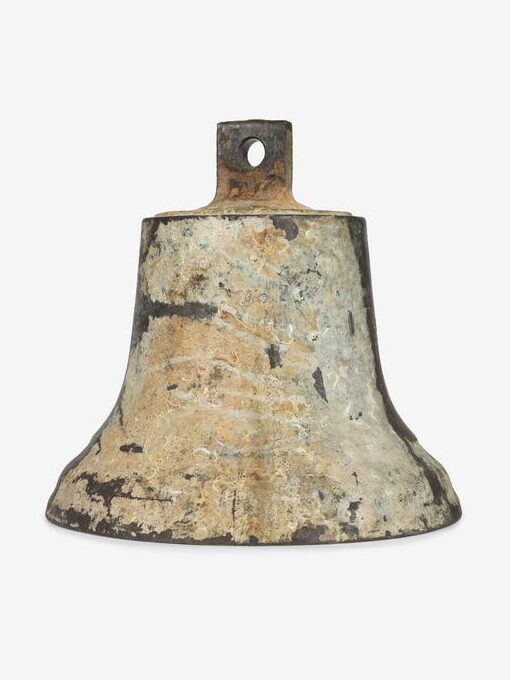
The bell is one of the most symbolic parts of a ship. The uniqueness of each ship’s bell identifies the vessel, so for the RMS Lusitania, it was a valuable artifact to salvage from the wreck. The role of the bell on a ship is to warn other vessels of their presence, signal for crew watches, ring for emergencies aboard, and more. The bell of the Lusitania was recovered by divers in 1982.18 It is a large metal bell with a square-shaped crown, and it is severely cracked and tarnished from its extensive period of time on the seafloor.19 After the bell was salvaged from the wreck in 1982, it was placed in the Imperial War Museum’s collection (IWM). Currently, it is said to be held in a private collection, and not for the public to view on display. The bell was a significant symbolic artifact from the RMS Lusitania, as it defines the ship and its remembrance.
“Ship’s Bell, RMS Lusitania” by IWM Non Commercial License
Ballard Expedition of 1993
In 1993, Robert D. Ballard and his team went on one of the most widely known expeditions to the RMS Lusitania. Already famous for his expeditions and research on the Titanic and Bismarck shipwrecks, Gregg Bemis permitted Ballard to conduct his expedition for deeper archeological and historical insight on the wreck of the RMS Lusitania.20 They explored the site from July through August of 1993 and returned with significant hypotheses.
One of the biggest mysteries from the RMS Lusitania was the so-called “second explosion.” After the German U-boat torpedoed the Lusitania, it was reported by many individuals, aboard the ship and from the nearest coast, that there was a second explosion. What people wanted to know was the cause of this second explosion. Did the German U-boat fire another torpedo? Did something occur inside of the RMS Lusitania? Is it even true there was a second explosion?21 With these questions in mind, Ballard and his team set out to explore the wreck and seek answers.
“1915 Lusitania Sunk By a Submarine” by The New York Times is licensed under United States
Ballard’s team had a powerful combination of manned and unmanned vehicles that enhanced their analysis of the wreck site. This included:
Delta: their manned minisubmarine, this was the submarine Ballard himself first saw the wreck from22
Jason: a 3,000 pound unmanned remotely operated vehicle used for screening images of the wreck23
Medea: a small robot vehicle which allowed them to look into tighter spaces inside the wreck24
Homer: a small manned microsub, it was borrowed from the Harbor Branch Oceanographic Institution25
“Gustavia (Saint-Barthélemy) — Yellow Submarine” by unknown author is licensed under CC 2.0 Germany
With the images taken by the various vehicles, Ballard’s team was able to compile a then and now analysis of the ship. They placed images they had taken from the wreck side by side with images of the ship before it sank. They analyzed:
The Bow: was bent upward after hitting the ocean floor26
The Foredeck: covered in fishing nets and decay, but can still make out the wheel and a small crane27
The Water Tanks: immediately behind the first funnel, readily recognizable on the wreck and in the same place28
Aft Docking Bridge: had its own controls to help guide the ship into a port, it currently lays to the side, having been torn off the ship29
Engine Room: can look right into the engine room, badly battered but features still recognizable like the metal girder30
After a long and significant expedition of the Lusitania shipwreck, Ballard came to some conclusions about the second explosion. There were previously two theories about the second explosion that had taken the most popularity. The first was that the “contraband” aboard the ship was set off by the torpedo. This was quickly shut down by Ballard because the contraband would have been stored in the magazine, which Ballard reported was an undamaged area of the ship. The second theory was that a boiler exploded. However, none of the three survivors who operated the boiler room heard an explosion.31 What Ballard noticed was that chunks of coal lay all around the wreck. The RMS Lusitania required immense amounts of coal, up to a thousand tons a day, to operate. Ballard’s famous cold dust theory is that when the torpedo struck, it sent coal dust flying up, which then was ignited and created a second explosion that led to the eventual sinking of the RMS Lusitania.32
“RMS Lusitania While Sinking” by Tackney OS is licensed under CC 4.0 International
Underwater Heritage Order (UHO)
Another reason why the RMS Lusitania wreck is such an important one to study is because it sheds light on protection rights and how a famous wreck, like this one, is allowed to be studied and explored. In 1995, the Underwater Heritage Order (UHO) was placed on the wreck of the RMS Lusitania by Michael D. Higgins, the Minister for Arts, Culture, and the Gaeltacht at the time.33 This order is under section 3 of the 1987 National Monuments Amendment Act which works to protect wrecks over a hundred years old.34 In the case of the RMS Lusitania, it means anyone seeking to undertake diving or other investigations of the wreck must apply and receive a license from the minister. It is so important to protect historical sites, like the wreck of the Lusitania. They are not only places to conduct groundbreaking archeological research, but also places of historical memory. There were 1,198 lives lost, and the site of this shipwreck honors them.
Footnotes
“Finding and Diving the Lusitania,” Lusitania Museum, https://lusitania.org/finding-and-diving-the-lusitania/ ↩︎
Fionnbarr Moore, “One Hundred Years Since The Sinking of RMS Lusitania, Twenty Years Since it was Protected by Underwater Heritage Order,” Archeology Ireland 129, no. 1 (2015). ↩︎
Fionnbarr Moore, “One Hundred Years Since The Sinking of RMS Lusitania, Twenty Years Since it was Protected by Underwater Heritage Order,” Archeology Ireland 129, no. 1 (2015). ↩︎
“Finding and Diving the Lusitania,” Lusitania Museum, https://lusitania.org/finding-and-diving-the-lusitania/ ↩︎
Robert D. Ballard, Exploring the Lusitania: probing the mysteries of the sinking that changed history (Madison Press Books, 1995), 14. ↩︎
Robert D. Ballard, Exploring the Lusitania: probing the mysteries of the sinking that changed history (Madison Press Books, 1995), 18. ↩︎
“Finding and Diving the Lusitania,” Lusitania Museum, https://lusitania.org/finding-and-diving-the-lusitania/ ↩︎
“Finding and Diving the Lusitania,” Lusitania Museum, https://lusitania.org/finding-and-diving-the-lusitania/ ↩︎
“Our Mission, Vision, and Values,” Oceaneering International, 2026, https://www.oceaneering.com/about/mission-vision-and-values/ ↩︎
Fionnbarr Moore, “One Hundred Years Since The Sinking of RMS Lusitania, Twenty Years Since it was Protected by Underwater Heritage Order,” Archeology Ireland 129, no. 1 (2015). ↩︎
Patricia Tennison, “Buried At Sea,” Chicago Tribune, August 5, 1996. ↩︎
Fionnbarr Moore, “One Hundred Years Since The Sinking of RMS Lusitania, Twenty Years Since it was Protected by Underwater Heritage Order,” Archeology Ireland 129, no. 1 (2015). ↩︎
“Finding and Diving the Lusitania,” Lusitania Museum, https://lusitania.org/finding-and-diving-the-lusitania/ ↩︎
Fionnbarr Moore, “One Hundred Years Since The Sinking of RMS Lusitania, Twenty Years Since it was Protected by Underwater Heritage Order,” Archeology Ireland 129, no. 1 (2015). ↩︎
Jason Daley, “Telegraph Recovered from the Wreck of the ‘Lusitania,'” Smithsonian Magazine, July 31, 2017, https://www.smithsonianmag.com/smart-news/telegraph-recovered-wreck-lusitania-180964267/ ↩︎
Jason Daley, “Telegraph Recovered from the Wreck of the ‘Lusitania,'” Smithsonian Magazine, July 31, 2017, https://www.smithsonianmag.com/smart-news/telegraph-recovered-wreck-lusitania-180964267/ ↩︎
“Ship’s Bell, RMS Lusitania,” Imperial War Museums, 2026, https://www.iwm.org.uk/collections/item/object/30003992 ↩︎
“Ship’s Bell, RMS Lusitania,” Imperial War Museums, 2026, https://www.iwm.org.uk/collections/item/object/30003992 ↩︎
Robert D. Ballard, Exploring the Lusitania: probing the mysteries of the sinking that changed history (Madison Press Books, 1995), 18. ↩︎
“Did the U-boat fire twice?” The News, November 11, 1935. ↩︎
Robert D. Ballard, Exploring the Lusitania: probing the mysteries of the sinking that changed history (Madison Press Books, 1995), 144. ↩︎
Robert D. Ballard, Exploring the Lusitania: probing the mysteries of the sinking that changed history (Madison Press Books, 1995), 144. ↩︎
Robert D. Ballard, Exploring the Lusitania: probing the mysteries of the sinking that changed history (Madison Press Books, 1995), 144. ↩︎
Robert D. Ballard, Exploring the Lusitania: probing the mysteries of the sinking that changed history (Madison Press Books, 1995), 144-146. ↩︎
Robert D. Ballard, Exploring the Lusitania: probing the mysteries of the sinking that changed history (Madison Press Books, 1995), 156-157. ↩︎
Robert D. Ballard, Exploring the Lusitania: probing the mysteries of the sinking that changed history (Madison Press Books, 1995), 166-167. ↩︎
Robert D. Ballard, Exploring the Lusitania: probing the mysteries of the sinking that changed history (Madison Press Books, 1995), 170-171. ↩︎
Robert D. Ballard, Exploring the Lusitania: probing the mysteries of the sinking that changed history (Madison Press Books, 1995), 182-183. ↩︎
Robert D. Ballard, Exploring the Lusitania: probing the mysteries of the sinking that changed history (Madison Press Books, 1995), 186-187. ↩︎
Robert D. Ballard, Exploring the Lusitania: probing the mysteries of the sinking that changed history (Madison Press Books, 1995), 194. ↩︎
Robert D. Ballard, Exploring the Lusitania: probing the mysteries of the sinking that changed history (Madison Press Books, 1995), 194-195. ↩︎
Fionnbarr Moore, “One Hundred Years Since The Sinking of RMS Lusitania, Twenty Years Since it was Protected by Underwater Heritage Order,” Archeology Ireland 129, no. 1 (2015). ↩︎
Fionnbarr Moore, “One Hundred Years Since The Sinking of RMS Lusitania, Twenty Years Since it was Protected by Underwater Heritage Order,” Archeology Ireland 129, no. 1 (2015). ↩︎
References for Timeline
Robert D. Ballard, Exploring the Lusitania: probing the mysteries of the sinking that changed history (Madison Press Books, 1995).
“Our Mission, Vision, and Values,” Oceaneering International, 2026, https://www.oceaneering.com/about/mission-vision-and-values/
Fionnbarr Moore, “One Hundred Years Since The Sinking of RMS Lusitania, Twenty Years Since it was Protected by Underwater Heritage Order,” Archeology Ireland 129, no. 1 (2015).