
Introduction
The sinking of the RMS Titanic has had relevant cultural impacts, both at sea and well beyond. The impacts of the shipwreck on broader society have taken many forms, from art and media to political propaganda and more. By examining societal and cultural reactions to the sinking of the Titanic, we can better understand the role the ship plays in the world both past and present.
The Shock of the Shipwreck
Before it sank, the Titanic was considered to be invincible to the powers of the ocean. This view reflects the hubris and arrogance that came with the shift from sailboats, which were more susceptible to the forces of wind and waves, to larger, more powerful steamships.1 Built and equipped with all the latest and best technology, the RMS Titanic represented new innovations and was seen as the technological marvel of its day.2 The fate of the seemingly unsinkable ship shocked mariners and landlubbers alike; it served as a reminder of the power of the ocean and shook society’s faith in newly developing technology.
Art and Media
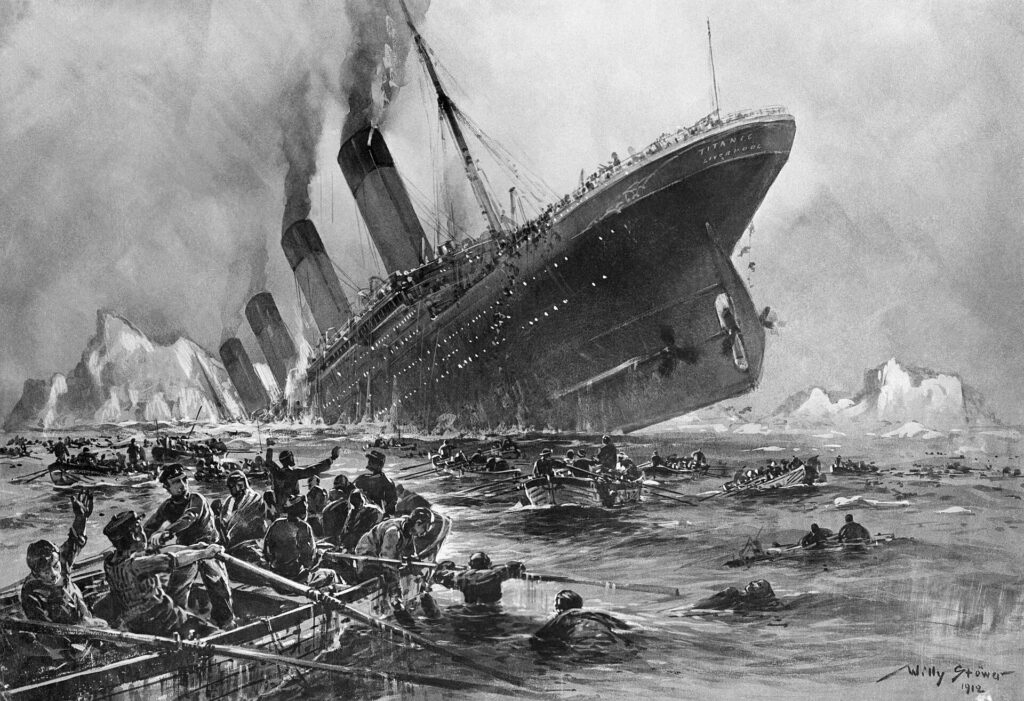
The cultural impacts of the sinking of the RMS Titanic are well represented by the art and media that the shipwreck inspired, both immediately after the tragedy and decades later. Soon after it sank, the Titanic became the subject of poetry, films, books, and plays. Some art was made in memory of the lives lost in the disaster, while some was primarily created for entertainment. Most famously, James Cameron’s 1997 movie Titanic combines the story of the shipwreck with tales of romance and adventure, leading the RMS Titanic to become perhaps the most widely known shipwreck in the world. Much of the public’s knowledge of the Titanic is drawn from this movie. However, so much art and media on the shipwreck was created before this film—art and media that shaped the way we tell its story today.
Film
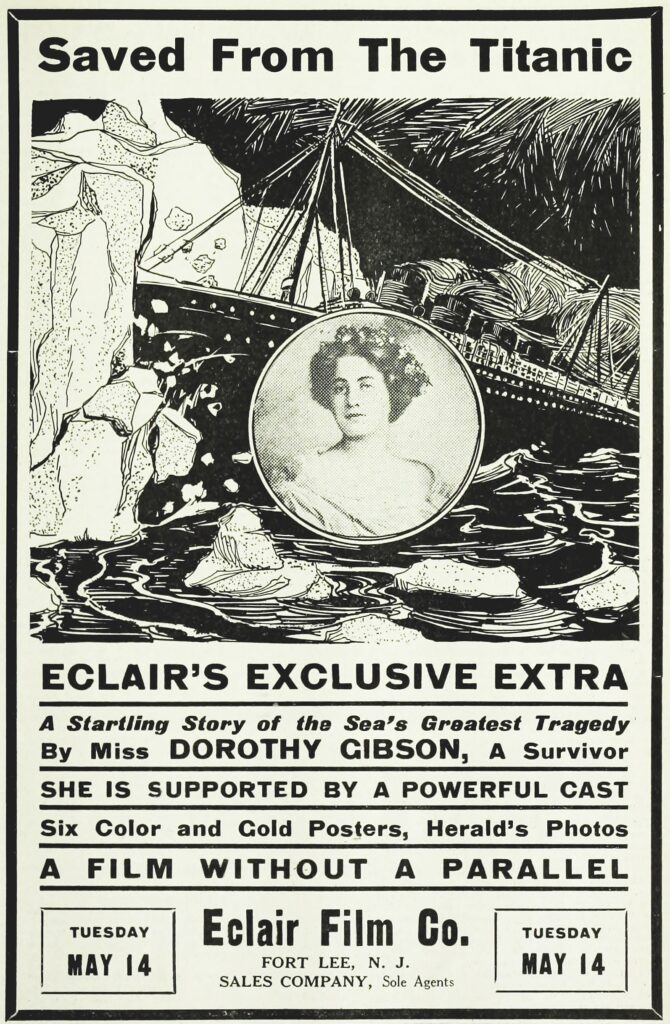
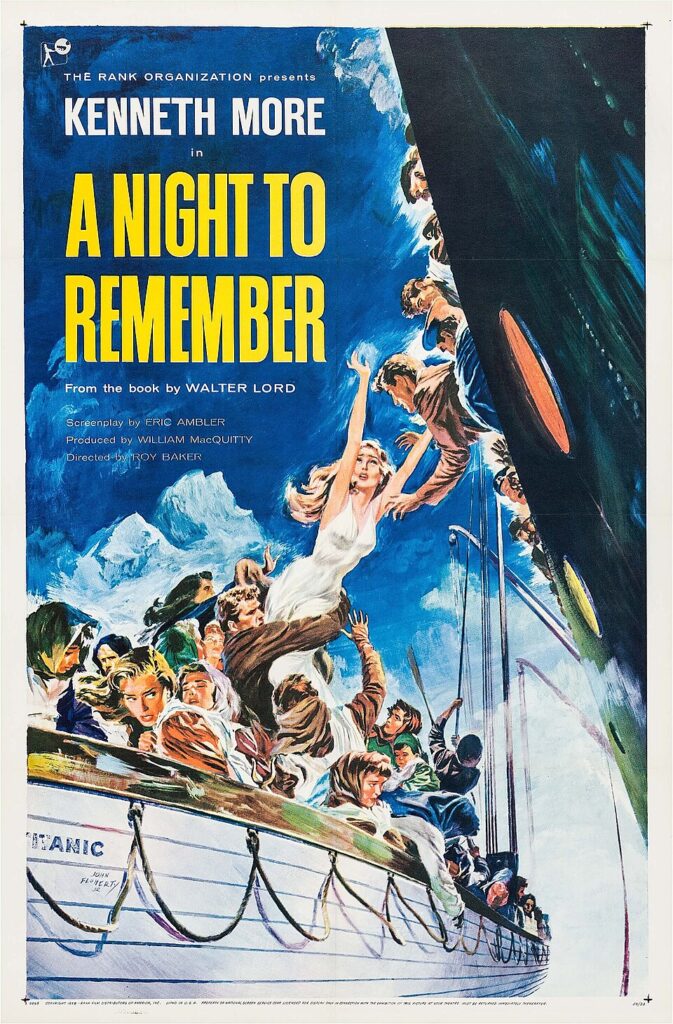
The earliest film inspired by the Titanic appeared only a month after the ship sank. Starring American actress and Titanic survivor Dorothy Gibson, Saved from the Titanic incorporated romance into the tale of the shipwreck—a theme that reappears countless times in later tellings of the story. Since this very first film, many more versions of the Titanic’s story have appeared on screen. Some of the more notable examples include Titanic, Hollywood’s first covering of the shipwreck (1953); A Night to Remember, a British production known for being very historically accurate (1958); and Raise the Titanic, a movie about exploration of the shipwreck set in the 1980s that focuses on themes of the Cold War era (1980).5
Visual Art
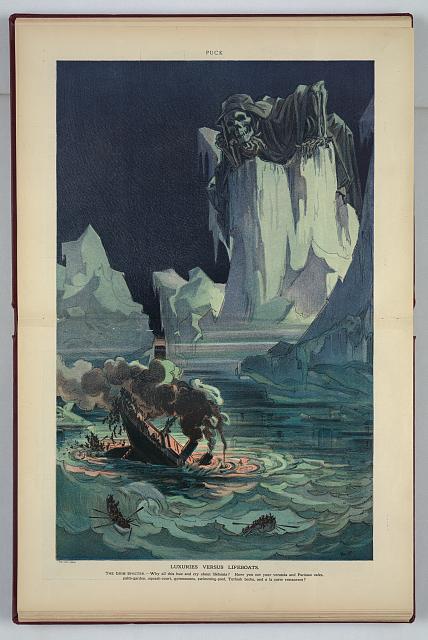
This rendition of the Titanic sinking appeared in a 1912 issue of Puck, an American magazine of political satire and humor. The image emphasizes the terror and tragedy of the event, depicting the iceberg as death itself. It also highlights the contrast between the fate of those left on the luxurious Titanic and the survivors on tiny lifeboats.
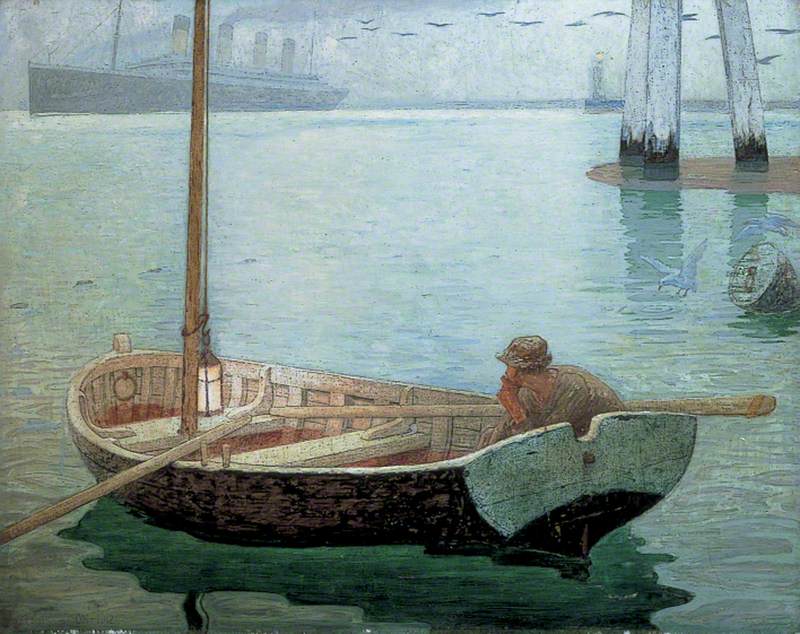
This painting, The Outward Bound, was commissioned in memory of the leader of the Titanic’s band, Wallace Hartley. Painted by Frederick Cayley Robinson, it shows a man on a small boat looking out on the ocean as the RMS Titanic leaves the harbor. The painting shows the calm, innocent time before the tragedy and demonstrates how art was a way that society grieved for the lives lost in the shipwreck.
Literature
Perhaps the strongest example of early media on the Titanic influencing modern day thought on the shipwreck is found in Philip Gibbs’s 1912 article The Deathless Story of the Titanic. This account of the Titanic, based primarily on news stories and telegraph reports, sets up many themes that today have a strong association with the Titanic in the public mind. His work includes topics such as the tragic lack of lifeboats or help from a nearby ship, the rescuing of women and children first, and the band playing “Nearer my God to Thee” in the ship’s final moments.8 Though it’s easy to imagine that these ideas only exist in the 1977 film that brought them such popularity, in reality they have been part of our collective cultural thought for much longer.
Conclusion
The way that society views and reacts to the story of the Titanic greatly depends on the way its story is told. The story changes based on when it is told, who is telling it, and what their purposes are. Art and media inspired by the Titanic is the vessel through which most people get to know the story, and tells us a lot about the impacts the shipwreck has had on different people in different places and times.
Politics and Propaganda
The Titanic made its impact on global politics in the hands of the Nazis during World War II. In 1940, a film titled Titanic was commissioned by the German Propaganda Ministry. Led by politician and chief propagandist for the Nazi party Joseph Goebbels, the film used the story of the Titanic as anti-British and American propaganda. 9
The Nazi’s sought to take advantage of all that was wrong with the sinking of the Titanic in order to highlight the faults of the British, most prominently the rigid British Class divides that became all too obvious in the ship’s final moments. German newspapers of 1912 reveal that directly after the shipwreck, many were in shock about how many first class-passengers made it off the ship and comparatively how few first-class passengers survived.
Still, the film goes to great lengths to emphasize this point and specifically blame the British for the inequality; Titanic included scenes showing German passengers aboard the ship saving people who the British left to die. In addition to the focus on the inhumanity caused by British class divide, Titanic played on the “profit before safety” aspect of the shipwreck—the film shames the British for choosing to install insufficient lifeboats on the ship in order to maximize their profits. Overall, the film paints the Titanic as a picture of British failure and villainy—where many cultural representations of the Titanic romantically depict the ship’s band playing “Nearer my God to Thee” as it sinks, the Nazi ‘Titanic’ instead chooses scenes of mass panic, terror, and chaos.
Themes of British greed, capitalism, and failure, are summarized in the movies end title:
“’Der Tod von 1500 Menschen blieb ungesühnt: eine ewige Anklage gegen Englands Gewinnsucht.’”10
The above translates to:
“The deaths of 1500 people remained unatoned for: an eternal condemnation of England’s desire to profit.”11
Titanic never actually made it to the public—for unknown reasons, Goebbels withdrew the film’s license before it ever went to theaters. Still, the Nazi Titanic remains important, as it both reflects the political aspects of the shipwreck and demonstrates the wide reach of its impacts on German thought and culture.
Conclusion
The sinking of the seemingly unsinkable ship shook society to its core. Beyond the immediate grief and outrage of the tragedy, the cultural impacts of the shipwreck continued throughout the next century and beyond. Through art and media, the story of the Titanic has been told countless times, constantly being reshaped to fit the needs of the storyteller. These stories are the way the Titanic impacts us today, and are the foundation that our collective understanding of the shipwreck is built upon.
Footnotes
- Bell, Karl. The Perilous Deep. Reaktion Books LTD, 2025. ↩︎
- Brown, Kevin. Titanic: Ship of Lost Illusions: A Floating Microcosm of Edwardian Society. Pen & Sword History, 2025. ↩︎
- Eclair Film. Saved from the Titanic. 1912. Wikimedia Commons. https://commons.wikimedia.org/wiki/File:Saved_from_the_Titanic_advert_1912.jpg. ↩︎
- Floherty, John. A Night to Remember. 1958. Linnen. https://commons.wikimedia.org/wiki/File:A_Night_To_Remember_(1958)_-_US_Poster.jpg. ↩︎
- Howells, Richard. “One Hundred Years of the Titanic on Film.” Historical Journal of Film, Radio and Television 32, no. 1 (March 2012): 73–93. https://doi.org/10.1080/01439685.2012.648054. ↩︎
- Keppler, Udo. Luxuries versus Lifeboats. May 8, 1912. 1 Photomechanical Print : offset, color. Washington, D.C. 20540. Library of Congress Prints and Photographs Division. https://www.loc.gov/pictures/item/2011649145/. ↩︎
- Cayley Robinson, Frederick. The Outward Bound. 1912. Oil on Canvas. Leeds Art Gallery. https://artuk.org/discover/artworks/the-outward-bound-37729. ↩︎
- Kerby, Martin, and Margaret Baguley. “When Death Gave Way to Glory: Philip Gibbs, RMS Titanic and the Western Front.” International Journal of Maritime History 34, no. 1 (February 2022): 46–62. https://doi.org/10.1177/08438714221075995. ↩︎
- Strobl, Gerwin. “‘Zum Ruhme Englands’: The ‘Vorgeschichte’ of the Nazi Film Titanic.” German Life and Letters 60, no. 2 (April 2007): 196–211. https://doi.org/10.1111/j.1468-0483.2007.00382.x. ↩︎
- Strobl, Gerwin 2007 ↩︎
- Strobl, Gerwin 2007, translated by Carleton Student Anna Blaich ↩︎