
The Age of Steamboats
Steamboat technology emerged in the late 18th century, however it did not reach its peak until the mid 19th century.1 Steamboat technology cut the travel time along the Mississippi river down drastically. Before the presence of steamboats a trip from New Orleans to Louisville upstream could take months, compared to 10 to 25 days, depending on the steamboat technology. Its ability to drastically cut down on transport time upstream was what drove the large-scale adoption of the steamboat. However as the railroad system in the United States became more widespread they became a better option for long distance transport in the central United States, leading to the steamboats decline. Compared to steamboats, railroads were faster, cheaper, and safer, making them the better option in almost every way.2
Steamboat Technology
Steamships were based around the concept of turning heat into mechanical energy that would be used to propel the ship forward. This process would start in the boiler, where a fuel, often coal, would be burned. This heat would transfer to water and cause it to boil, releasing steam. The steam would power a piston engine which would convert the steam to the mechanical energy required to propel the ship, either with paddle wheels or a screw propeller.3 The core of a steamship is the boiler. There were a few different types of boiler that were commonly used on steamships, each with their respective pros and cons. The two main types of boiler were the Lancashire boiler and high-pressure tubular boilers.4
Lancashire Boilers
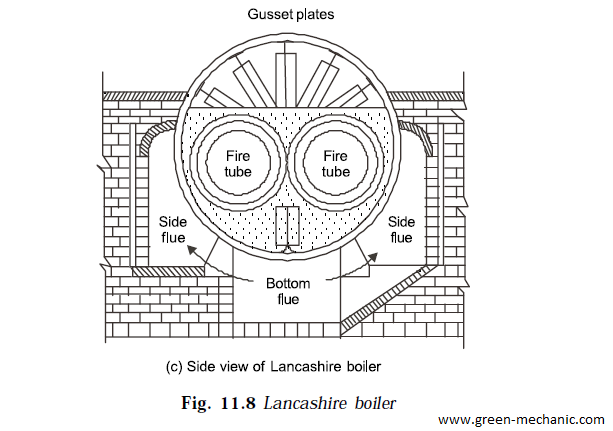
This type of boiler was often constructed with the furnace on one end connected to two main tubes (called flues). The flues are surrounded by water so when the hot gasses from the furnace flow through the flues they transfer heat to the water and create steam.5 The simpler construction of the flue boiler system enabled easier maintenance and cleaning, making them much more tolerant of all types of water sediment. However the decreased surface area to water volume ratio caused them to be much less efficient than other options. This resulted in the flue boiler being used for many large steamboats on the Mississippi that didn’t move very fast.6
High-Pressure Tubular Boilers
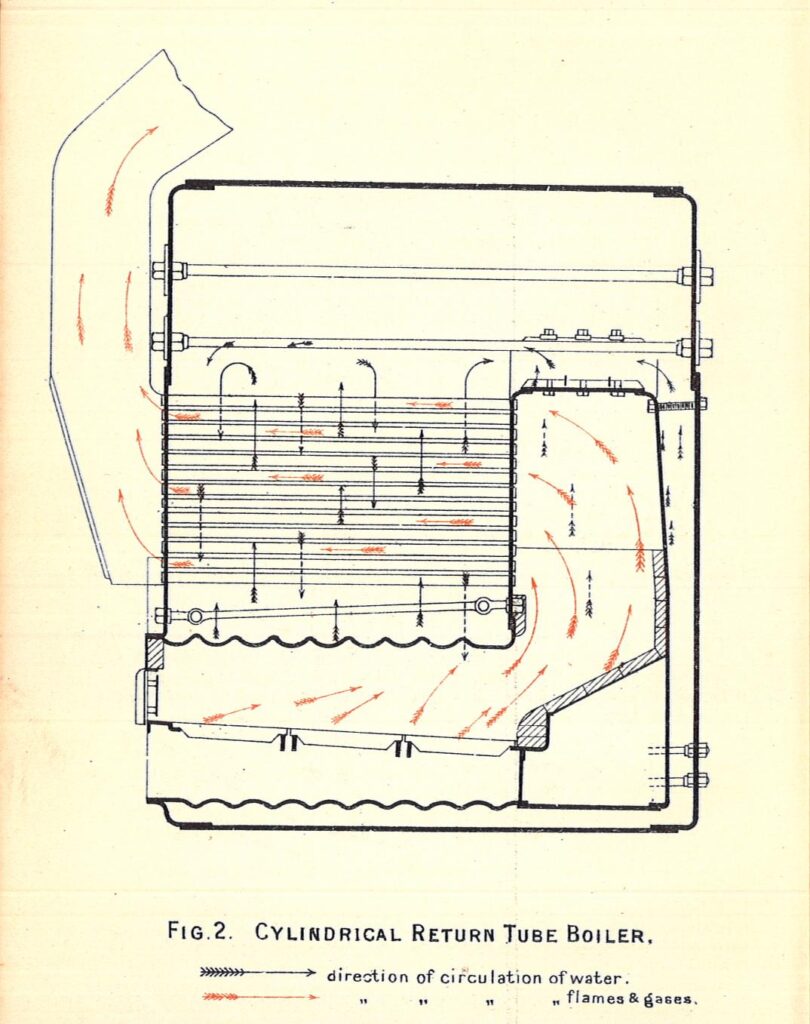
These tubes were similar in concept to the common Lancashire boilers, but they were adapted for increased efficiency. They did this by having a greater number of flues for the hot gas to flow through, this increased the surface area in contact with the water, and the efficiency of the steam output.9 However this more complex construction complicated the maintenance and cleaning of the boiler, this meant that reducing the water sediment as much as possible was very important.10
The Steamboat Act of 1852
Because steamboat explosions were growing too common on the Mississippi, in 1852, Congress passed a bill to introduce more safety regulations. This bill set standards for the equipment on steamboats as well as created inspectors to ensure that these standards were being followed.11 Although this did reduce steamboat explosions overall, many other problems stopped it from being fully successful.
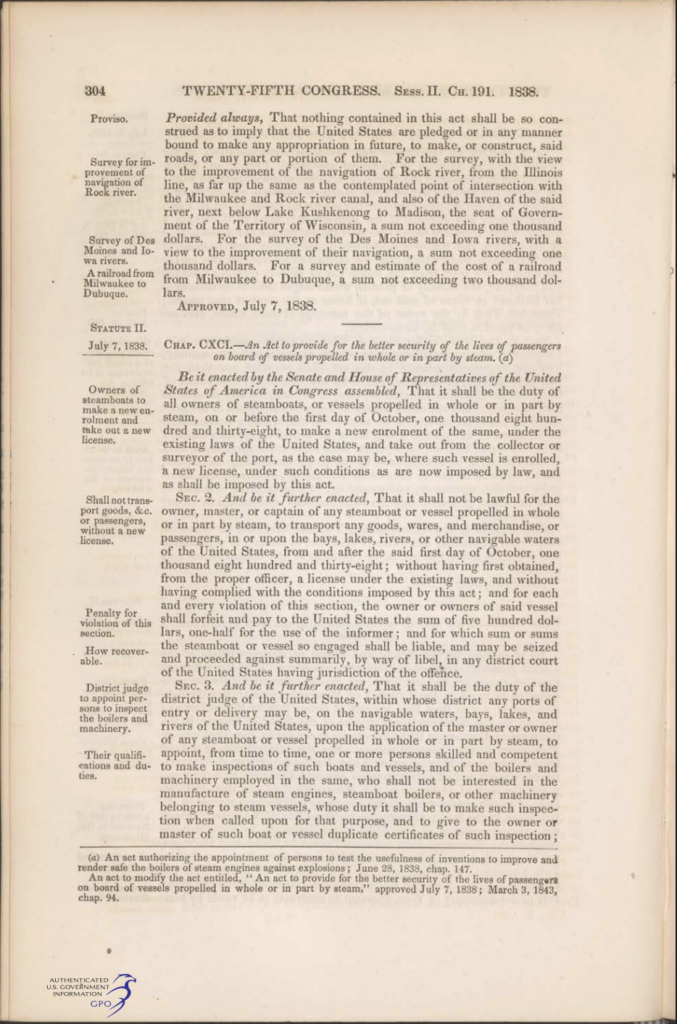
This law relied on the local inspectors to hold steamboat captains accountable, meaning that it varied drastically depending on the region. This was also the era of political patronage, so many of these inspectors were appointed in exchange for a favor. This led to many inspectors not being qualified or even being corrupt. 12
The intent of this bill is good, however the enforcement is very careless. The lack of unified standards and even enforcement led to many ships not being up to par and caused this law’s impact to be diminished greatly.
The Technology of the SS Sultana
The Sultana had 4 high-pressure tubular boilers. In each boiler there were twenty four five inch tubes. These boilers were efficient but very hard to clean and maintain. The steam from these boilers went to an engine that was used to power two paddle wheels, one of each side of the boat. Notably the boilers were positioned in the center of the steamboat, as this was the most convenient location for powering the paddlewheels.14
The construction of the hull of the Sultana was shallow draft to be able to traverse the Mississippi river. The Sultana had three decks, the main deck(the lowest of the three), the cabin deck(the middle deck), and the hurricane deck(the upper deck), of which the pilot house sat on top of.15 The materials used for the Sultana were primarily wood, as was typical for steamboats at the time, however different types of wood were used for different parts of the ship. More study woods such as oak were used for the frame and the hull. However, the upper decks were built using much lighter wood, such as pine or poplar. The interior of the ship was coated in paint that included solvents such as turpentine and benzene.16
What Caused the Explosion
There were many factors that led to the explosion occurring, as well as exacerbated it. Among these, the lack of adequate repairs on an already weak boiler, the lack of thorough cleaning on the complex boilers, the water levels in the boilers not being kept to an acceptable level, the overcrowding present on the boat, and the existing construction of the boat. Although all of these factors played a role in the disaster it is difficult to say if the outcome would be different based on only one or two factors changing. What we can say for sure is that the combination of all of these resulted in the worst maritime disaster in the history of the United States.
The water in the Mississippi river contains a lot of sediment. When this water is used in the boilers the sediment would result in the sediment condensing around the interior of the boiler, especially around the flues that carried the hot gas from the furnace. These spots would act as insulators and would prevent the water from regulating the temperature of the metal.17 Because of this boilers had to be cleaned often, however the type of boiler that the Sultana was using was much harder to clean, with its 24 separate flues. This meant that there was a significant build up of sediment around the flues.18
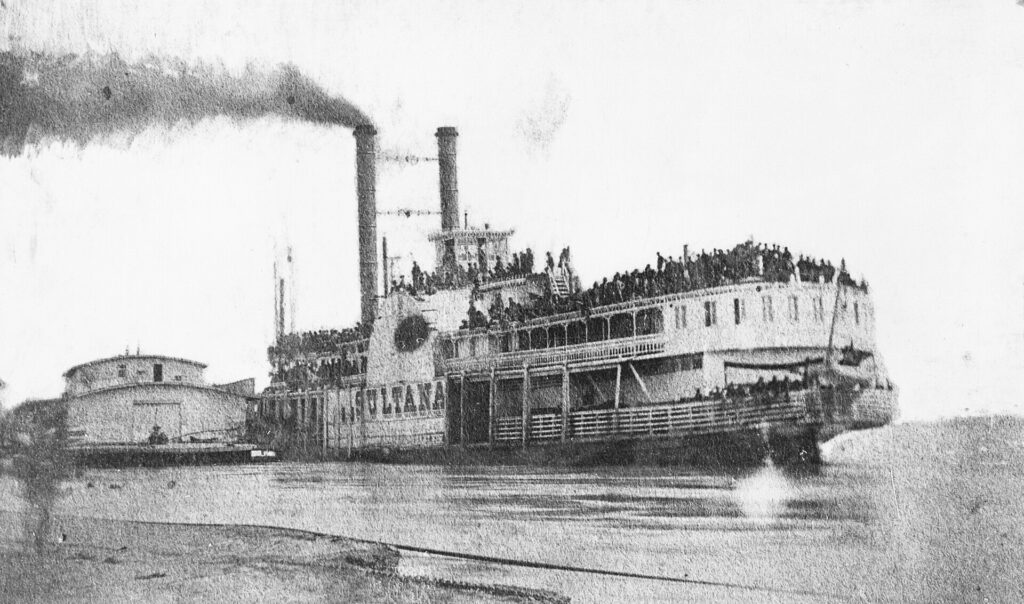
The overcrowding on the ship played a large role in the disaster. It impacted the disaster in a few different ways, first the sheer number of people on the ship greatly increased the casualties, strained the boilers, and caused the ship to be unstable. The unnatural amount of people on the top deck caused the ship to be top heavy. This resulted in the ship careening back and forth. The result of this was the water in the boilers sloshing back and forth.20
Had the water in the boilers been at a reasonable level this would not have been that big of an issue. However the workers on the Sultana had carelessly allowed the water level in the boilers to reach a critical level.
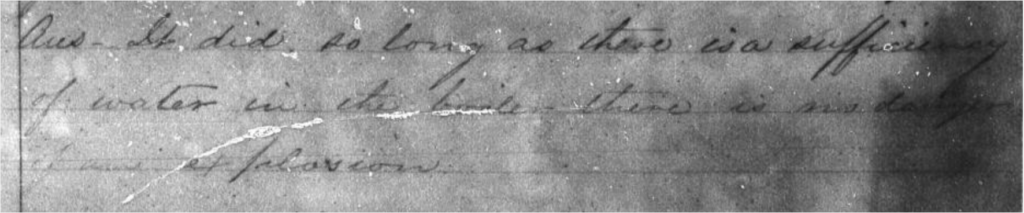
“So long as there is a sufficiency of water in the boiler, there is no danger of an
explosion”
–RG Taylor, Boilermaker
This meant that when the Sultana careened back and forth, because of the top-heavy nature of the ship, the water in the boilers would slosh about. The low water levels would expose the flues with the built up sediment to the air, taking away their heat regulator and actually insulating the tubes with hot gas in them. This could cause the metal to get red hot and much more brittle. When the water would come back it would create an instant change in pressure as it was superheated into steam nearly instantaneously.
Because of the extreme pressure and temperature that boilers go through it is necessary to keep them in good working order to prevent failure. However in their greed the people in charge of the Sultana tried to capitalize on the army needing transportation and rushing the repairs to a leaking boiler.22 This meant that when the boiler experienced this change in pressure it failed. Resulting in the massive explosion and ensuing fire aboard the ship.
Explosion Simulator
This simulator lets you control each of the major factors in the explosion to visually see how they had an impact.
The Fire
A key factor in the disaster was how fast the fire was able to spread throughout the ship. This resulted in the casualties from the disaster to be much more extreme. Because the boiler was placed in the center of the ship when they exploded they blew apart that entire section of the boat. Which included the pilot house, leaving the Sultana without controls. This would have been much less catastrophic if it wasn’t for the fire that swept through the steamboat within the next twenty minutes.23
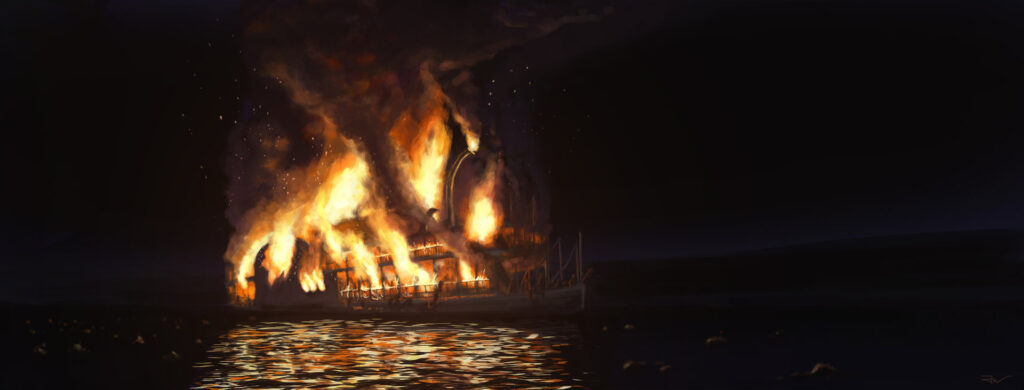
The Sultana’s wooden construction left little defense against a fire, although the frame was built out of hardy oak, the pine upper decks caught fire much more easily. This was only exacerbated by the highly volatile ingredients of turpentine and benzene used in the paint. This was the typical construction and materials used in steamboats of the age.25 However, given that steamboat explosions were not unheard of, the lack of care associated with not adapting the design of the steamboat also had an impact on this disaster. The owners of the boats were much more concerned with their speed and weight, factors that directly correlate with profit, than with safety.
Greed and Carelessness with the SS Sultana
Throughout the events leading up to the disaster with the SS Sultana there were many careless or greedy choices that collectively led to the ultimate disaster. Although this was the result of a compilation of such choices across the board, many of them did pertain to the technology on the steamboat.
The most obvious of all of these is the decision not to undergo a full boiler repair in Vicksburg, opting instead to take on the Soldiers with a weakened boiler. Given how common boiler explosions were around this time and the well over capacited Sultana this was purely a greedy decision made in order to get the commission for transporting the troops. Although this was the most impactful decision that was made, it is not the only one. The Sultana’s boilers needed to be cleaned often in order to minimize the mineral build up around the flues. However because of the nature of the boiler they were very difficult to clear and were often overlooked. This type of careless behavior led to one of the factors in the eventual explosion. The last careless act that led to the explosion of the Sultana is the water levels inside the boiler. Water level had to be maintained throughout the voyage in order to minimize risk, and the engineers let the water level get too low, leading to increased risk.
Footnotes
- Burton, “The Golden Age of the Steamboat, 1851-1900.” ↩︎
- Tweet, “History of Transportation on the Upper Mississippi & Illinois Rivers.”
↩︎ - Biscontini, “Steamboat | Engineering | Research Starters | EBSCO Research.” ↩︎
- Spitzner, “History of the Steam Engine.” ↩︎
- Spitzner, “History of the Steam Engine.” ↩︎
- Talha, “LANCASHIRE BOILER Parts, Working, Application, Advantages and Disadvantages.” ↩︎
- Talha, “LANCASHIRE BOILER Parts, Working, Application, Advantages and Disadvantages.” ↩︎
- File:Scotch Marine Boiler Side Section (Stokers Manual 1912).Jpg – Wikimedia Commons. ↩︎
- Spitzner, “History of the Steam Engine.” ↩︎
- Spitzner, “History of the Steam Engine.” ↩︎
- Bennett, “A Case of Calculated Mischief.” ↩︎
- Lockwood, John. “The Steamboat Act of 1852 and the Death of Henry Clemens.” ↩︎
- United States of America. 1838. “An Act to Provide for the Better Security of the Lives of Passengers on Board of Vessels Propelled in Whole or in Part by Steam.” ↩︎
- The Sultana Association of Descendants and Friends. “The Disaster | Sultana Association.” ↩︎
- The Sultana Association of Descendants and Friends. “The Disaster | Sultana Association.” ↩︎
- Yager, Wilson M. “The Sultana Disaster.” ↩︎
- Spitzner, “History of the Steam Engine.” ↩︎
- Jennings, “What Happened to the Sultana?” ↩︎
- File:Ill-fated Sultana, Helena, Arkansas, April 27, 1865.jpg – Wikimedia Commons. ↩︎
- Sniderman, Debbie. “The Greatest Maritime Disaster in U.S. History.” ↩︎
- Jennings, “What Happened to the Sultana?” ↩︎
- Mikesell, “Understanding the Sultana Tragedy: The Long Way Home – as Much as the Water: How Steamboats Shaped Arkansas.” ↩︎
- Yager, Wilson M. “The Sultana Disaster.” ↩︎
- File:Johan-windh-sultana-fire-3500.jpg – Wikimedia Commons. ↩︎
- Yager, Wilson M. “The Sultana Disaster.” ↩︎
References for Timeline
- Blethen Adams, “New Orleans, Louisiana Maritime Heritage, International Harbors, Sea Captains, Merchants, Merchandise. 1800-1899.”
- Burns, “Illinois Central Railroad: Map, Logo, History.”
- File:Drawing – Original Steam Vessel Invented by William Symington in 1787.jpg
- File:Explosion of the Steamer SULTANA, April 28, 1865 LCCN2002699583.jpg
- File:NouvelleOrleansTHMillerBirdsView.Gif – Wikimedia Commons.
- National Inventors Hall of Fame. “NIHF Inductee John Fitch and Steam-Powered Water Travel,”
- Przybylek, Leslie. “The Incredible Journey of the Steamboat New Orleans.”
- Sniderman, Debbie. “The Greatest Maritime Disaster in U.S. History.”
- Wikipedia contributors. “New Orleans (Steamboat).”
References for Explosion Simulator
- Anthropic. Claude. AI language model. Accessed March 1, 2026. https://claude.ai.