
The Role of Inuit Oral History in the Discovery of HMS Erebus
The 2014 discovery of HMS Erebus, the flagship of Sir John Franklin’s doomed 1845 Northwest Passage expedition, was not the product of modern technology alone. Rather, it was the culmination of over 160 years of Inuit oral tradition that finally guided researchers to the resting place of one of history’s most celebrated lost ships.
Inuit Knowledge System (Qaujimajatuqangit)
Qaujimajatuqangit represents the Inuit framework of traditional knowledge encompassing environmental observation, lived experience, and intergenerational storytelling6. Because Inuit communities had no written language, history was preserved through carefully maintained oral accounts.
“Inuit had no written system of language… History was passed down through oral history, which meant telling and retelling stories. During the long winter days and nights it was usually the elders who would tell stories.”
— Louie Kamookak, Inuit historian
Inuit Verbal Accounts
John Rae
The first Europeans to document Inuit knowledge of the Franklin disaster were mid-nineteenth-century searchers who, in most cases, only partially appreciated the information being offered to them. In 1854, Hudson’s Bay Company explorer Dr. John Rae learned from Inuit at Pelly Bay and Repulse Bay that around 1848 approximately 40 white men had been seen on the western shore of King William Island heading southward after their ships had become trapped in ice2,3. Rae carefully recorded these accounts and bartered for Franklin expedition objects the Inuit had collected, relaying the findings back to England. However, upon relaying the information to England, Rae received major backlash for suggesting possible cannabalism at the wreck site.
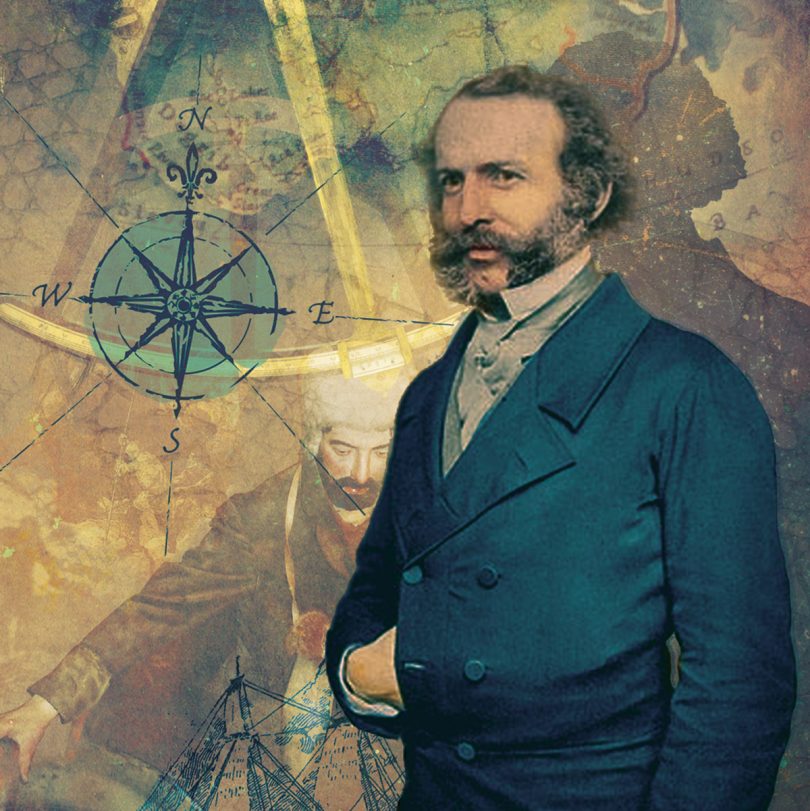
McClintock and Hobson
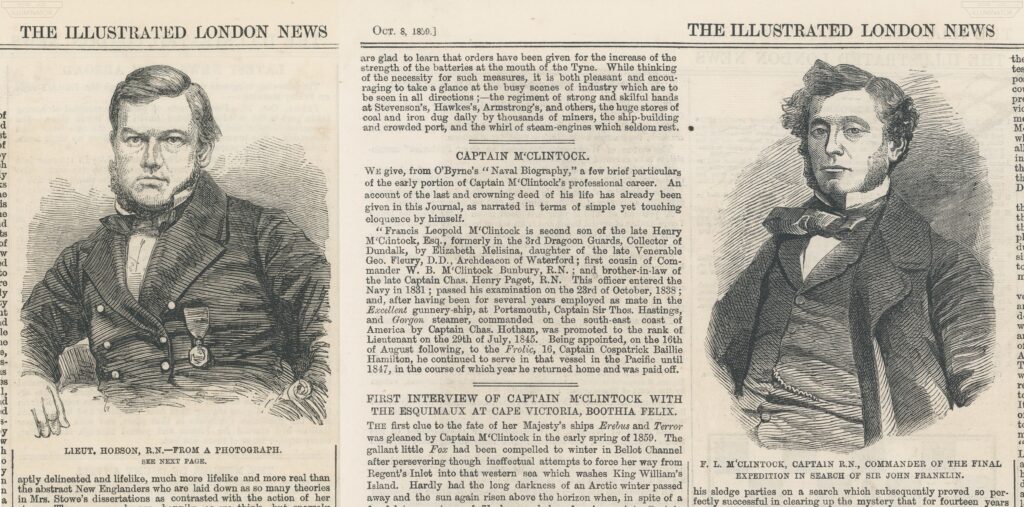
Five years later, in 1859, Lieutenant William Hobson sailed under Captain Francis Leopold McClintock on an expedition specifically aimed at recovering physical evidence of the Franklin disaster. Hobson traversed the treacherous coastline of King William Island, recording critical observations about the physical terrain, ice conditions, and wildlife of the region1. Hobson’s most pivotal find was a written note in a cairn at Victory Point, a document confirming that the ships had become beset in ice in 1846, that Franklin had died in June 1847, and that the surviving 105 crew members had abandoned the vessels and set off overland. In fact, Inuit in the region recalled sightings of both Hobson and McClintock during these search activities, demonstrating the degree to which Inuit observers were actively present and aware of European search efforts underway in their territories. Again, upon finding suspicious bone fragments and cuts, there was opposition to the belief that cannabilism was a possibility by McClintock and Hobson. However, there is no evidence to believe that evidence of cannibalism was purposely left out, as Hobson and McClintock only took a brief look at the remains left in the area7.
Charles Francis Hall’s collection of Accounts
The most organizes nineteenth-century effort to gather Inuit testimony came from American journalist Charles Francis Hall, who spent years living among the Inuit in the 1860s and 1870s. Hall’s work was distinguished by his use of Inuit interpreters, such as Taqulittuq and Ipiivik, who enabled genuine interpretation rather than distorted translation3. Through these conversations, Hall learned that the reported wreck was located off the western shore of the Adelaide Peninsula. One Inuit informant, Inukpujijuk (In-nook-poo-zhe-jook), not only described the location in verbal detail but also drew his own map indicating the wreck’s position on an Admiralty chart. Hall also recorded that Inuit had boarded the still-floating vessel, salvaged numerous items, and discovered the body of a crew member inside. These accounts were remarkable in their precision and would eventually prove to be accurate.
Applying Inuit History to the 2014 Search
When Parks Canada established its formal shipwreck search program in the 1990s, the research framework was intentionally designed to incorporate Inuit knowledge from its inception. A central figure in this collaboration was Louie Kamookak, a self-taught Inuit historian. Over the course of three decades, Kamookak documented oral histories from community elders regarding the Franklin expedition and the specific geography of King William Island. Parks Canada integrated Kamookak’s expertise into its archaeological operations. To ensure success, the search team was intentionally structured to include Inuit Knowledge Holders as essential partners, working alongside representatives from Parks Canada and the government. Success Later came in 2014 when an unnamed Inuit found archaeological artifacts at the Ugjulik area, focusing the search to the nearby area. Shortly after, the HMS Erebus was found northeast of O’Reilly Island, almost precisely where the Inuit informant Inukpujijuk had indicated to Charles Francis Hall over 140 years earlier. Erebus was found in the shallow waters of Utjulik, exactly as Inuit oral accounts had consistently maintained4,5.
“For us Inuit it means that oral history is very strong in knowledge, not only for searching for Franklin’s ships but also for environment and other issues.” – Louie Kamookak
The HMS Terror was found later in 2016 as a citizen of Gjoa Haven found timber protruding from the ice six-years earlier. Once again, Inuit guidance proved vital to discovery.
- STENTON, DOUGLAS R. “A Most Inhospitable Coast: The Report of Lieutenant William Hobson’s 1859 Search for the Franklin Expedition on King William Island.” Arctic 67, no. 4 (2014): 511–22. http://www.jstor.org/stable/24363813.
- Houston, C. Stuart. “John Rae (1813-1893).” Arctic 40, no. 1 (1987): 78–79. http://www.jstor.org/stable/40510567.
- BLUM, HESTER. “INUIT KNOWLEDGE AND CHARLES FRANCIS HALL.” In The News at the Ends of the Earth: The Print Culture of Polar Exploration. Duke University Press, 2019. https://doi.org/10.2307/j.ctv11cw6qx.12.
- “Franklin Find Proves ‘Inuit Oral History Is Strong’ | CBC News.” CBCnews, September 10, 2014. https://www.cbc.ca/news/canada/north/franklin-find-proves-inuit-oral-history-is-strong-louie-kamookak-1.2761362.
- McCorristine, Shane. “Afterword: The Discoveries of the Erebus and Terror.” In The Spectral Arctic: A History of Dreams and Ghosts in Polar Exploration. UCL Press, 2018. https://doi.org/10.2307/j.ctvqhsrj.11.
- Parks Canada Agency, Government of Canada. “Inuit Traditional Knowledge.” Wrecks of HMS Erebus and HMS Terror National Historic Site, June 27, 2024. https://parks.canada.ca/lhn-nhs/nu/epaveswrecks/culture/inuit/qaujimajatuqangit.
- Stenton, Douglas R., Anne Keenleyside, and Robert W. Park. “The ‘Boat Place’ Burial: New Skeletal Evidence from the 1845 Franklin Expedition.” Arctic 68, no. 1 (2015): 32–44. http://www.jstor.org/stable/24363886.