
Introduction
The sinking of the RMS Titanic is one of the most influential events on maritime safety regulations. There were many causes behind the disaster, some related to lack of or quality of regulations and others related to the general mindset surrounding the Titanic and the Olympic (the Titanic’s sister ship). The public and White Star Line placed their confidence on the technology behind the ship, but White Star Line put pressure on the crew to prioritize the profitability of the journey over its safety. When it sank, sailors immediately directed their focus to sufficient lifeboats. Questions regarding the size of the ship arose as well. Over time, two prominent organizations evolved: the International Convention of Safety of Life at Sea1 and the U.S. Coast Guard: International Ice Patrol.2
Causes
Understanding the catalysts behind the loss of life related to the Titanic can help explain the reasoning behind the development in safety regulations and policies. The causes behind the Titanic, though likely not entirely exhaustive, are detailed in the U.S. Senate Titanic Disaster Hearings report on the causes published in 1912.3
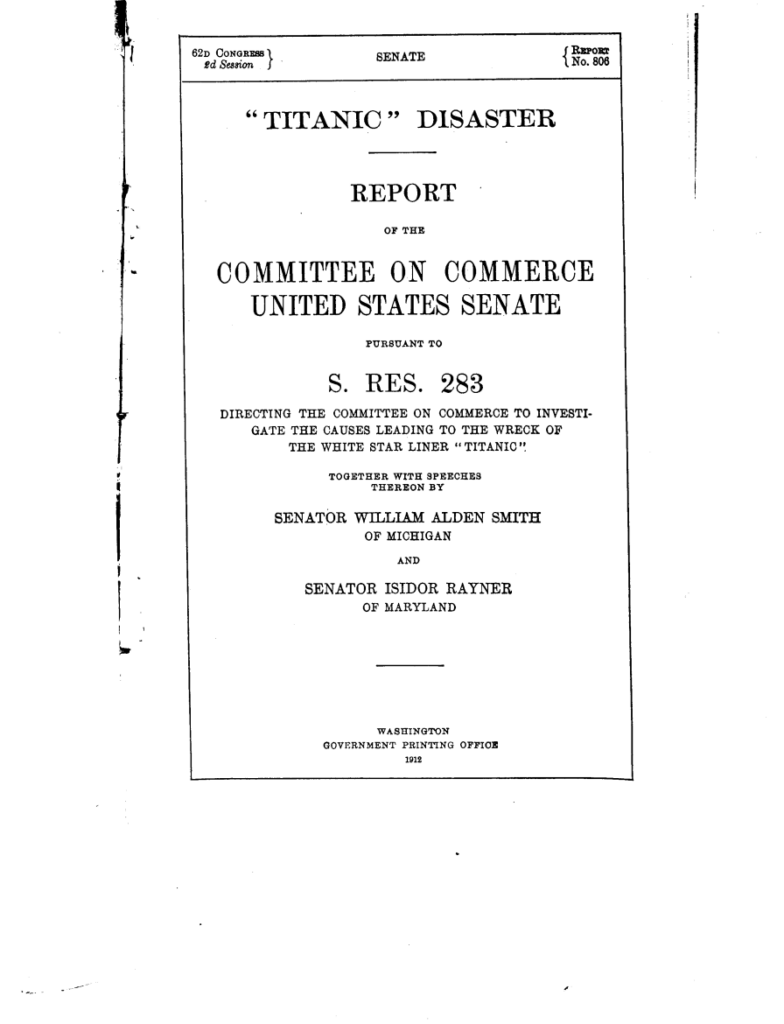
Some of the cited causes were lack of watertight compartments, contributing to the speed at which the Titanic sank,5 as well as improper utilization of lifeboats (not all were filled),6 and the lack of change in speed upon learning about the presence of icebergs in the Titanic’s path.7 Moreover, not only were there not enough lifeboats for all passengers, the training of the crew on how to use and deploy the lifeboats was insufficient.8 These are all important factors related to the loss of life. The speed of the sinking combined with unpreparedness proved to be an exceptionally deadly combination. It does not, however, tell the full story.
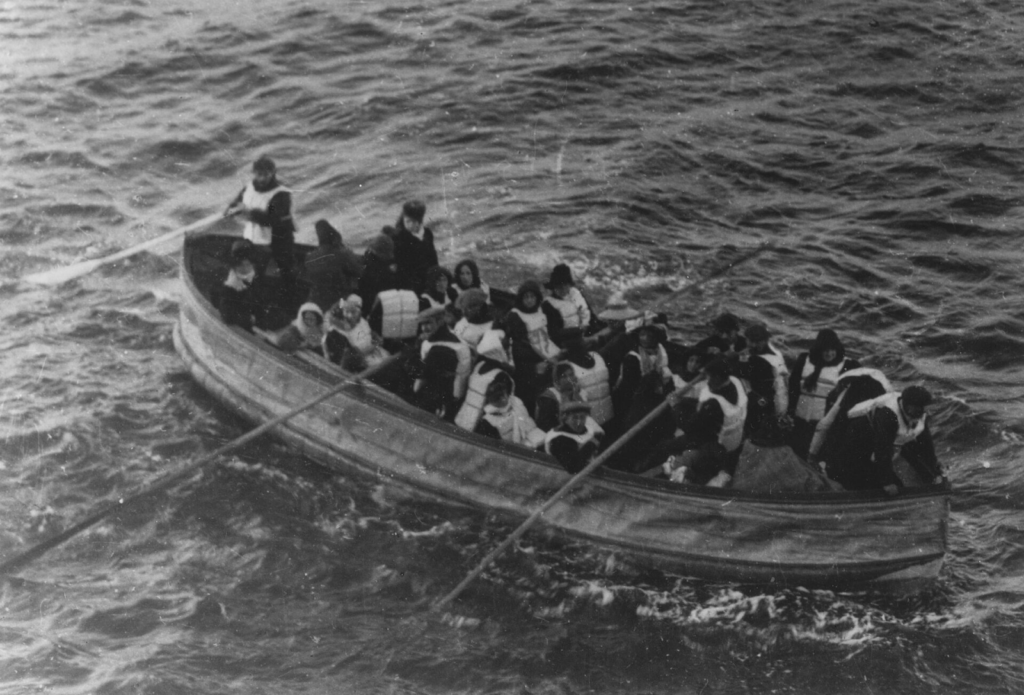
The Disaster Report from the Senate focuses on more tangible causes: it is harder to quantify an atmosphere. Therefore, the mindset regarding the Titanic and the Olympic must be considered with the use of other sources. Schröder-Hinrichs et. al. discusses how the Titanic crew prioritized the speed and profitability of the voyage over the safety—the possibility of disaster was considered to be low.10
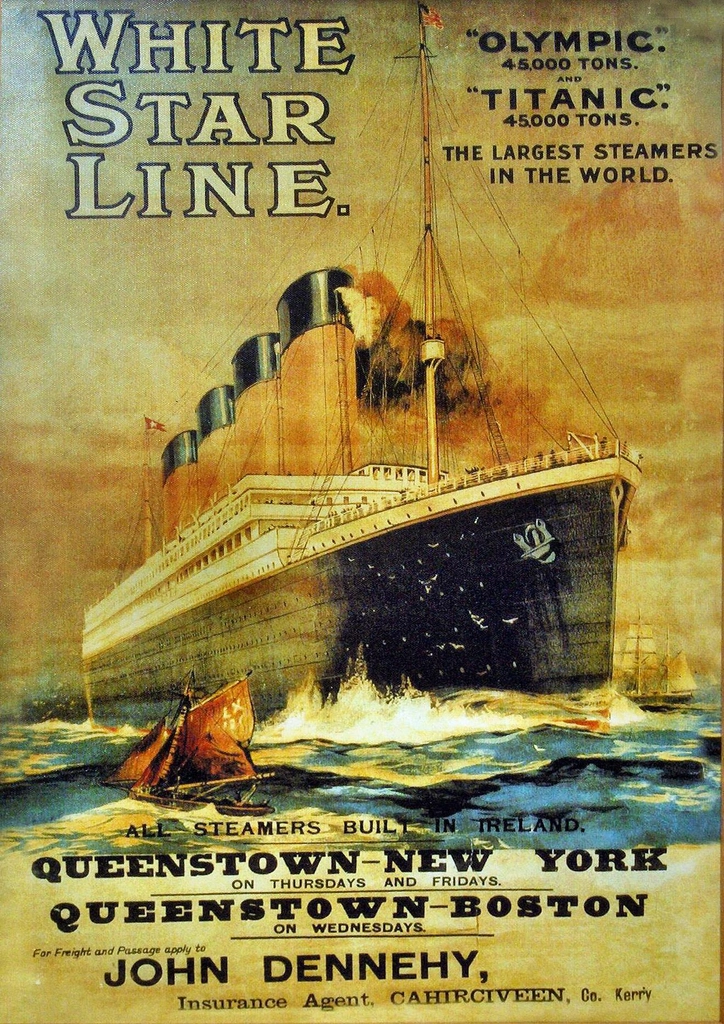
Advertisements like this one demonstrate the mindset behind the Titanic: the size is the important takeaway. If listing the weight was not prominent enough, the phrase, “The Largest Steamers in the World,”12 should drive the point home. The inclusion of smaller boats next to the White Star Line ship (either the Titanic or the Olympic) demonstrates the belief in technological superiority of these two ships compared to all previous ships—and therefore a low likelihood of disaster.13 More generally, White Star Line preferred success over safety.14 Despite learning about the iceberg, speed was maintained to try to keep time with the expected arrival time.
The causes behind the loss of life were not, however, unique to the Titanic. Lifeboats were frequently insufficient. Maritime technology, though quickly developing, was largely unregulated and not reliable enough to omit now-standard safety practices.15 The lack of provisions before the disaster means that the scene was set for the Titanic to have as large of an impact as it did.
Short-Term Reaction
With the standards set unreasonably high with regards to technology and performance—and preparations limited—a quick and severe public backlash upon disaster is not unexpected. Many of the causes leading to the sinking of the Titanic were quickly identified and brought to public attention, especially through newspapers.
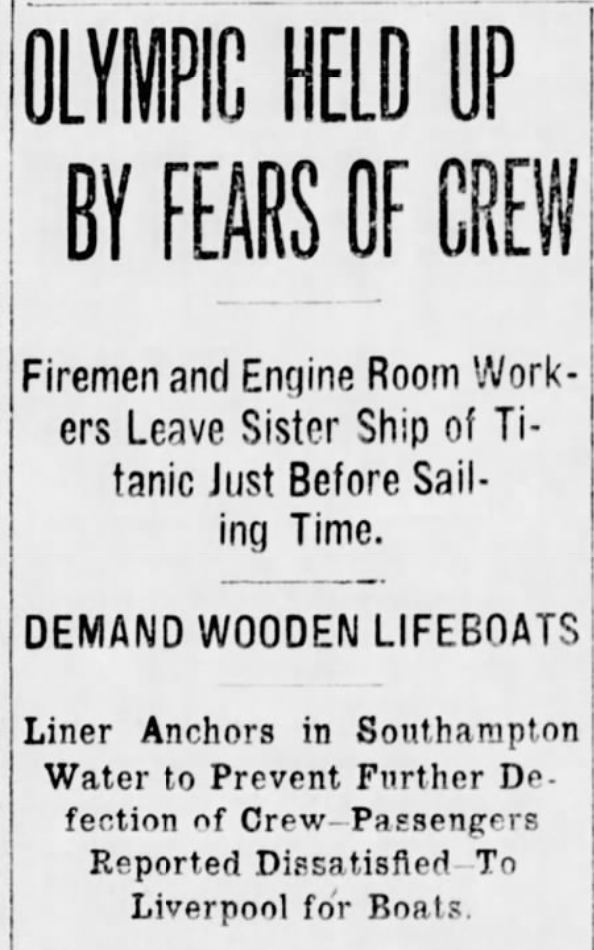
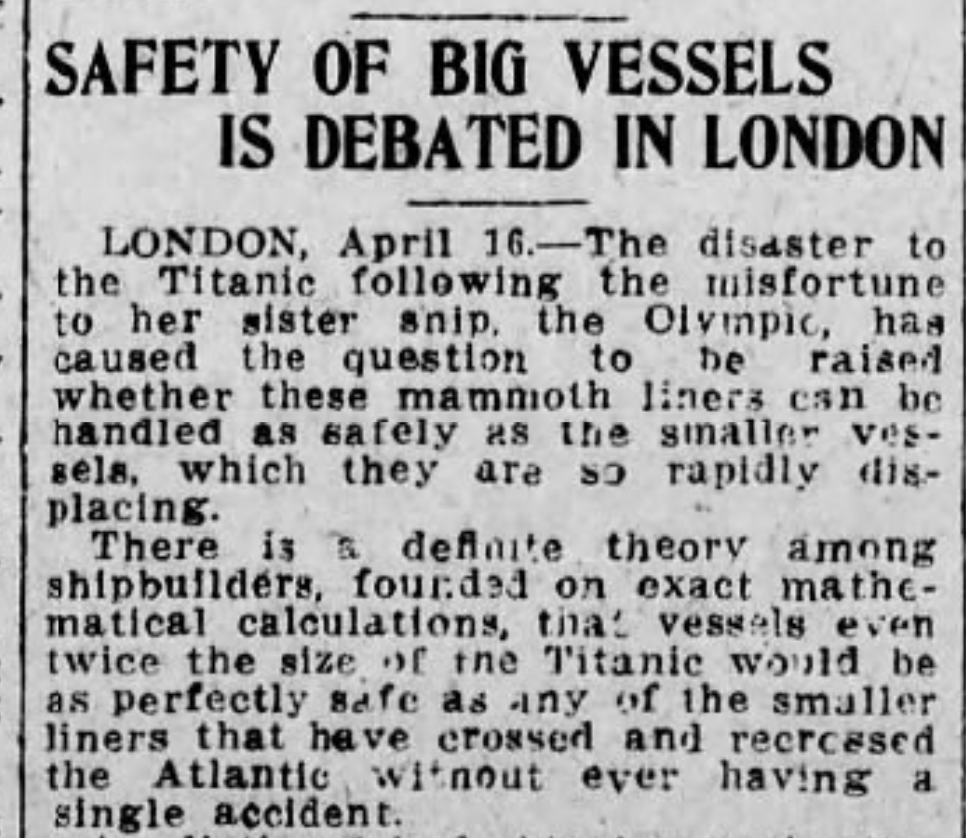
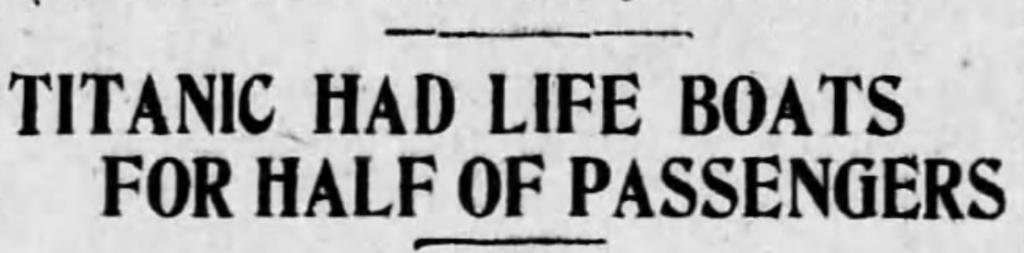
The attention in newspapers was placed on the lack of lifeboats and the size of the Titanic. Unsurprisingly, shipbuilders defended the size of the Titanic, claiming that a smaller ship would have sunk significantly faster, providing even less time for evacuation.19 The questioning of the technology at all, however, demonstrates some degree of lost confidence in technology.
Strikes were another immediate outcome of the sinking of the Titanic.20 Many sailors from the Olympic went on strike as they wanted wooden life boats compared to collapsible ones. Though these incidents in themselves may not have had a huge influence on regulations, they are representative of changing mindset and a shift towards the prioritization of safety.
Long-Term Response
The International Convention of Safety of Life at Sea: “The most important of all international treaties concerning the safety of merchant ships.”21

The long-term response to the Titanic was more organized than strikes and newspaper outcry, though it did not take long for permanent moves towards change to occur. The International Convention of Safety of Life at Sea (SOLAS) is one of the most prominent direct outcomes of the Titanic disaster. Started in 1914, it established regulations such as increased number of lifeboats22 as well as policies requiring other ships to help those in distress, shifting the general maritime mindset towards the safety of others.23 SOLAS is still active today, with consistent amendments to ensure up-to-date technological requirements. The impact of the Titanic on maritime safety can be seen in two ways through the lens of SOLAS: it was quickly established (only 2 years after the sinking) and it is still prevalent today.
The International Ice Patrol (part of the United States Coast Guard) is another lasting outcome of the sinking of the Titanic. Directly attributed to the sinking of the Titanic, the International Ice Patrol records the location of icebergs and alerts any nearby ships of these locations.24 Though Ice Patrol initially used ships, as aviation became more common, planes became another important method of alerting nearby ships.25
These two organizations are effective at solving the problems brought up in the Senate Disaster Report. Addressing the human component, however, is an ongoing issue and lacks an easy solution. The Costa Concordia is an example of how prioritization of financial success over safety and general overconfidence can still lead to disaster, despite modern safety regulations.26 The number of deaths, however, would have been significantly higher without them. It is hard to quantify the impact the Titanic had on safety regulations. That said, there were close to none prior to the disaster and now there are many full-fledged organizations with the sole purpose of preventing further disasters.
Conclusion
Despite the influential moves towards a safer, more regulated ocean space, not all factors that led to the sinking of the Titanic and the subsequent loss of life are equally addressable through organizations like SOLAS and the International Ice Patrol. As can be seen with the sinking of the Costa Concordia,27 the human factor related to the sinking of the Titanic is still prominent even a century after. Though the Titanic disaster did not permanently change the human possibility for error, it certainly dissuaded beliefs of invincibility28 and was the catalyst for key maritime organizations.
References
- “International Convention for the Safety of Life at Sea (SOLAS), 1974.” Accessed February 28, 2026. https://www.imo.org/en/about/conventions/pages/international-convention-for-the-safety-of-life-at-sea-(solas),-1974.aspx. ↩︎
- “International Ice Patrol – About Us | Navigation Center.” Accessed March 10, 2026. https://www.navcen.uscg.gov/international-ice-patrol-about-us. ↩︎
- “‘Titanic’ Disaster Report of the Committee on Commerce United States Senate.” Washington Government Printing Office, n.d. https://www.senate.gov/artandhistory/history/resources/pdf/TitanicReport.pdf. ↩︎
- “‘Titanic’ Disaster Report of the Committee on Commerce United States Senate.” 1912. 1.
↩︎ - “‘Titanic’ Disaster Report of the Committee on Commerce United States Senate.” 1912. 9.
↩︎ - “‘Titanic’ Disaster Report of the Committee on Commerce United States Senate.” 1912. 12.
↩︎ - “‘Titanic’ Disaster Report of the Committee on Commerce United States Senate.” 1912. 7.
↩︎ - “‘Titanic’ Disaster Report of the Committee on Commerce United States Senate.” 1912. 4.
↩︎ - Barker, J. W. Titanic Lifeboat. April 15, 1912. Photograph. https://commons.wikimedia.org/wiki/File:Titanic_lifeboat.jpg.
↩︎ - Schröder-Hinrichs, Jens-Uwe, Erik Hollnagel, and Michael Baldauf. 2012. “From Titanic to Costa Concordia—a Century of Lessons Not Learned.” WMU Journal of Maritime Affairs 11 (2): 151–67. https://doi.org/10.1007/s13437-012-0032-3. 155.
↩︎ - Poster White Star Line Showing RMS Titanic. Circa 1912. Photograph. https://openverse.org/image/d3cfc4b8-51ae-4921-bfe1-3b682794e4ba?q=titanic+advertisement&p=66.
↩︎ - Poster White Star Line Showing RMS Titanic. Circa 1912.
↩︎ - Battles, James B. 2001. “Disaster Prevention: Lessons Learned from the Titanic.” Baylor University Medical Center Proceedings 14 (2): 150–53. https://doi.org/10.1080/08998280.2001.11927752. 151.
↩︎ - Schröder-Hinrichs et. al. 2012. 155.
↩︎ - Andreadakis, Antonios, and Dimitrios Dalaklis. “Evacuation of Ships: Discovering the Mishaps behind the Casualties.” Journal of International Maritime Safety, Environmental Affairs, and Shipping 6, nos. 2–3 (2022): 135–40. https://doi.org/10.1080/25725084.2022.2129200. 135.
↩︎ - New York Tribune (New York City, New York). “Olympic Held Up By Fears of Crew.” April 25, 1912. 1.
↩︎ - The Tribune (Scranton, Pennsylvania). “Safety of Big Vessels Is Debated in London.” April 17, 1912. 2.
↩︎ - The Tribune (Scranton, Pennsylvania). “Titanic Had Life Boats For Half of Passengers.” April 17, 1912. 2.
↩︎ - The Tribune (Scranton, Pennsylvania). “Safety of Big Vessels Is Debated in London.” April 17, 1912. 2.
↩︎ - New York Tribune (New York City, New York). “Olympic Held Up By Fears of Crew.” April 25, 1912. 1.
↩︎ - “International Convention for the Safety of Life at Sea (SOLAS), 1974.” n.d. Accessed February 28, 2026.
↩︎ - Paulsen, Gard. “‘Proceed to the Assistance of the Persons in Distress’: The Sinking of the Titanic and the International Regulation of Safety of Life at Sea.” International Journal of Maritime History 38, no. 1 (2026): 116–29. https://doi.org/10.1177/08438714251412652. 117.
↩︎ - Paulsen, Gard. 2026. 117.
↩︎ - “International Ice Patrol History | Navigation Center.” Accessed March 12, 2026.
↩︎ - “International Ice Patrol History | Navigation Center.” Accessed March 12, 2026.
↩︎ - J.-U. Schröder-Hinrichs et al. 2012. 155.
↩︎ - J.-U. Schröder-Hinrichs et al. 2012. 152.
↩︎ - J.-U. Schröder-Hinrichs et al. 2012. 159.
↩︎