
The Wreck:

The CSS Virginia was scuttled on May 11th, 1862, just three months after construction was complete. The Confederacy had just lost Norfolk and the Gosport Navy Yard days prior to the Union, the port that had supported the CSS Virginia for the entirety of its career.2 In hopes of fleeing, the crew aboard the Virginia attempted to take the ironclad through the James River, a shallow and narrow river that connects Norfolk and Richmond, to where the Confederates had reinforcements.3 However, due to the Virginia‘s deep draft and the high winds, the ironclad proved to be too big to maneuver through the river. It is important to note that the Union ship fleet was very strong despite the Confederacy having the CSS Virginia. The crew knew that the CSS Virginia did not stand a chance against the rapidly approaching Union fleet that had just taken over Norfolk, which included the USS Monitor. In order to prevent capture by the Union, the Virginia’s crew placed flammable materials aboard the ship and set the ironclad on fire.4 The fire subsequently led to a massive explosion that sank the CSS Virginia, completely destroying the ship.5
Legacy of the CSS Virginia:
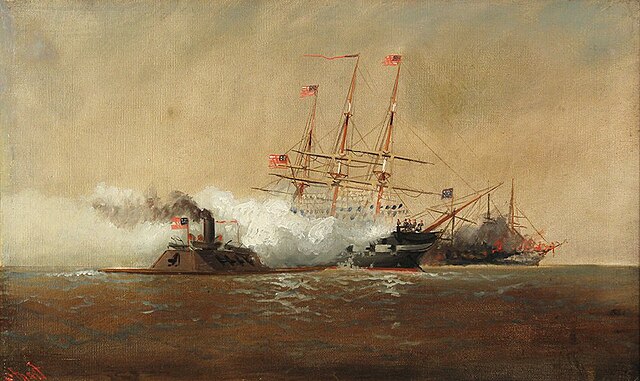
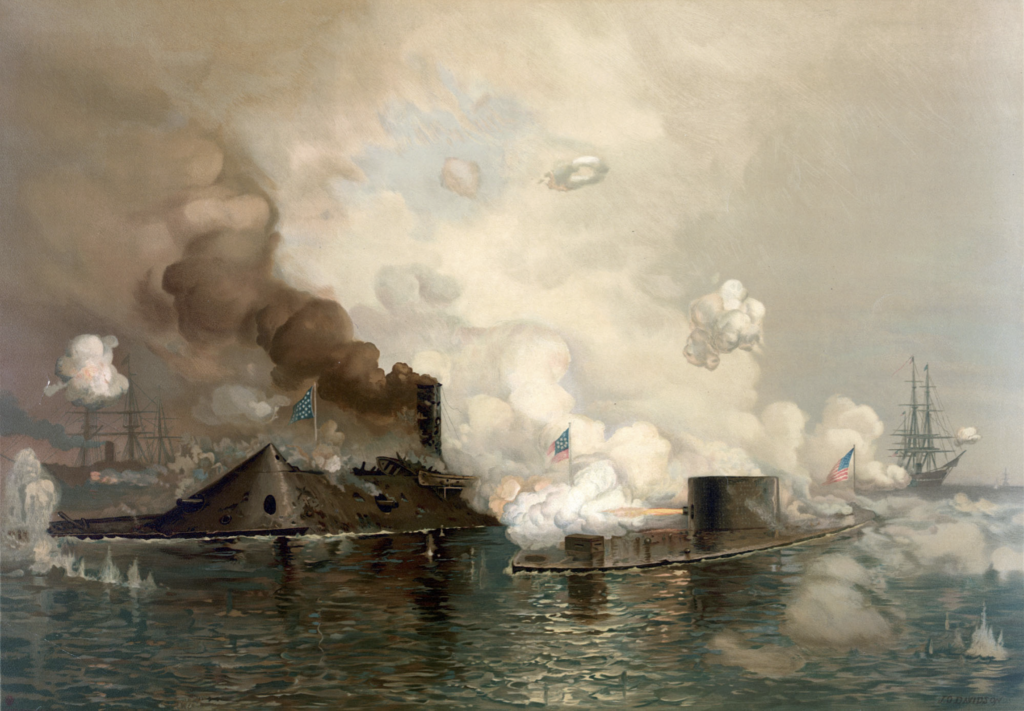
The Battle of Hampton Roads was a turning point in the way in which ironclad ships were viewed. The sheer power both the CSS Virginia and the USS Monitor displayed on March 8-9, 1862, changed opinions on the need for wooden ships, confirming the viability of ironclads.6 However, the idea of an ironclad ship was not new; in fact, the British and French navies had already constructed their own ironclads prior to the battle between the Virginia and the Monitor. In November of 1859, the French Navy constructed the first ever ironclad ship, the Gloire.7 The British would do the same in December of 1860 by building their own ironclad, the Warrior.8 The British ship, the Warrior, would be the first completely iron-hulled warship, ultimately updating the French Navy’s design into the classic ironclad seen today.9
What set apart the meeting between the CSS Virginia and the USS Monitor and prior attempts to construct ironclad ships was that the Battle of Hampton Roads was the first time an ironclad was used in major combat, and more significantly, the first time that two ironclad ships had come into conflict with one another. Both ships would come out of battle relatively unharmed, showing that ironclads were worth investing in and thus, the future of naval ships.10
Evidence of its Legacy:
Newspaper Article:
On March 8th, 1974, an article called Monitors Fight With Merrimack Began the Age of Iron Ships, was published by the New York Times. In it, author Lawrence Van Gelder articulated the insignificance of wooden ships as proven by the power displayed by the CSS Virginia and the USS Monitor. Gelder wrote “[The battle between the CSS Virginia and the USS Monitor] had sounded the death knell of wooden men of war and the solid shot that belched from their guns…”12 Ironclads were effectively upgraded wooden ships that were encased in metal plating to strengthen their defensive ability, and could be fitted with bigger guns due to the hardiness of the ship’s hull. Lawrence Van Gelder goes on to say, “The age of iron ships and explosive shells had begun.”13 As the media continued to cover the Battle of Hampton Roads, it emphasized the strength of ironclad ships, becoming clear to navies around the world that wooden ships were outdated, and ironclads were the only way forward in naval warfare.
“The age of iron ships and explosive shells had begun.”14
-Lawrence Van Gelder
Written Accounts:
During the Civil War, many Navy sailors wrote letters describing the wonders of ironclads. After the CSS Virginia’s debut, many letters were sent home or to higher ranking officials describing first hand accounts of its success. These letters provide evidence of the CSS Virginia’s popularity and how it shocked seamen around the US.
Letter written by Major General Benj. Huger:
In a letter from Major General Benj. Huger to General S. Cooper, General Huger wrote, “This action shows the power and endurance of ironclad vessels.”15 By “this action,” General Huger meant the Battle of Hampton Roads, thus articulating the influence it had on the use of ironclads in naval warfare. General Huger went on to write, “Cannon shots do not harm them, and they can pass batteries or destroy large ships…How these powerful machines are to be stopped is a problem I can not solve.”16 It is clear from General Huger’s letter that he is in awe at the strength of the ironclad ship, as they pose a problem to typical wooden ships used in the Civil War that have no way to stop ironclads.
“Cannon shots do not harm them, and they can pass batteries or destroy large ships…How these powerful machines are to be stopped is a problem I can not solve.”17 – General Benj. Huger
Letter written by Lieutenant Samuel Dana Green:
The USS Monitor, the Union ironclad ship that the CSS Virginia fought during the Battle of Hampton Roads, also played a huge part in the ultimate success of ironclad ships. Although it does not get as much recognition for the part it played in ironclad history, Lieutenant Samuel Dana Green’s account of the Battle of Hampton Roads was written from aboard the USS Monitor, a letter which he later sent to his parents. His report gave a detailed account of the encounter between the USS Monitor and the CSS Virginia, sharing details that show the pure strength of ironclads.18 Lieutenant Green writes, “The shot, shell, grape, canister, musket, and rifle balls flew about us in every direction but did us no damage,” illustrating how cannons and guns had no effect on ironclads.19 Furthermore, he expresses what it was like to face another ironclad ship. In his letter, Lieutenant Samuel Dana Green writes, “We literally hold all the property, ashore and afloat in these regions, as the wooden vessels are useless against the Merrimac,” by which he means the Union did not store any important property aboard wooden ships when they came into battle with the CSS Virginia.20 The Union knew that wooden ships did not stand a chance against an ironclad. Both skepticism and admiration at the power of the CSS Virginia were common, solidifying the power it held as a technological phenomenon.
Conclusion – International Influence:
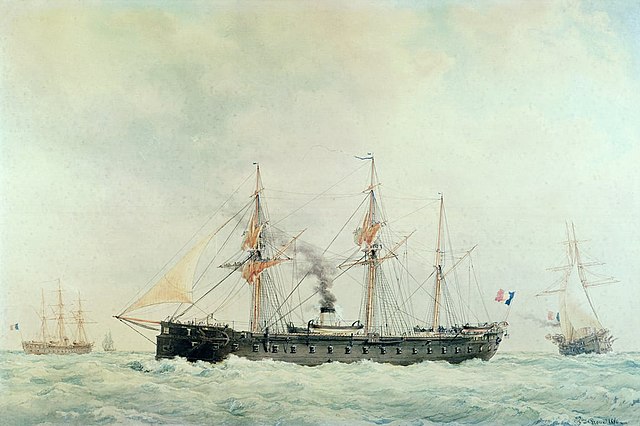
The influence the CSS Virginia had on the technological advancement of ships is undeniable. The Battle of Hampton Roads showcased the power of ironclads and thus forced out old wooden ships in hopes of modernizing naval warfare. Ironclads were stronger and could hold bigger guns, making them superior to other warships.22 Although the US was not the first country to construct an ironclad, they were the first to use one in a major battle. After the Battle of Hampton Roads, countries around the world got to work building their own ironclads, as they hoped to reinforce their navies.23 France immediately built 16 more ironclads, dreaming of dominating the sea.24 Russia, Italy, and Austria would quickly do the same.25 In 1866, Italian and Austrian ironclads would face each other in the Battle of Lissa, in what was the largest sea battle of the ironclad age, further solidifying ironclad ships as the future of naval warfare.26
Recovered Artifacts: Remains of the CSS Virginia’s Legacy:
On May 11th, 1862, the CSS Virginia was scuttled right off Carney Island and sank to the harbor’s floor. For twenty years, its broken parts lay in the shallow water of the Elizabeth River before it was salvaged for its metal in the early 1880s.27 Very few artifacts from the CSS Virginia remain today due to the harsh conditions in which it was sunk. If artifacts were not burned during the fire right before the ship sank, the twenty years the ship spent in shallow water, being battered by tides and sediment, did little to preserve its remaining artifacts.28 There was no true excavation done of the CSS Virginia wreck site; however, over the years, a few remaining artifacts have been brought to the surface by various excavators and placed in museums around the US. Today, the artifacts remaining are displayed in maritime history museums around the country, carrying on the CSS Virginia’s legacy.
Metal Fragment:
This metal plate is one of the few pieces of armor still remaining from the CSS Virginia’s metal plating. Excavated in 1867, this piece is a reminder of the strength ironclads had, showing that even under gunfire, metal plating would stay intact, as this plate was able to withstand a bullet.29 Metal fragments salvaged from the CSS Virginia are rare, as a majority of its parts were used as scrap metal in the late 1880s. The Old Dominion Iron and Nail Works Company was the first known excavator of the CSS Virginia and the finder of these metal remains.30 Much of the iron that they salvaged was repurposed into nails, horseshoes, and small commemorative hearts by the Old Dominion Iron & Nail Works Company. Today, this remaining piece of metal sits on display at The Mariners Museum and Park as a reminder of the CSS Virginia’s involvement in naval warfare.31
Anchor:
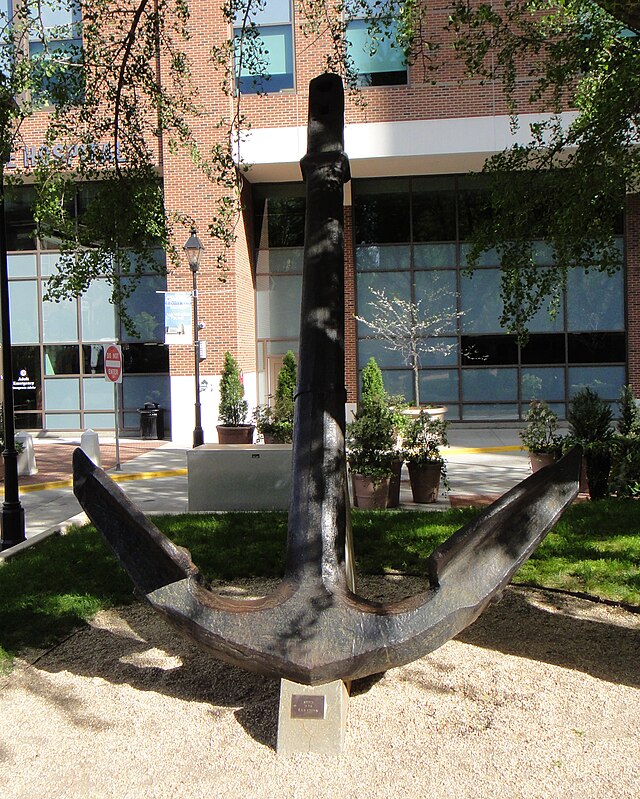
Another of the few artifacts salvaged from the CSS Virginia was its anchor, which now sits out front of The American Civil War Museum. The anchor was dredged from the James River in 1907 by the Lamberts Point Tow Boat Company, which dredged the Virginia’s wreck site in hopes of finding any artifacts signifying that the CSS Virginia existed.33 It was subsequently identified by Mr. Curtis, a member of the Lamberts Point Coal Piers Company, who had worked as a ship carpenter in the Confederate Navy Yard at the time of the Virginia’s construction.34 He recognized it and correctly identified it as the CSS Virginia’s anchor. It is now displayed in front of the American Civil War Museum, commemorating the crucial role the CSS Virginia played during and after the Civil War.
Brass Bell:
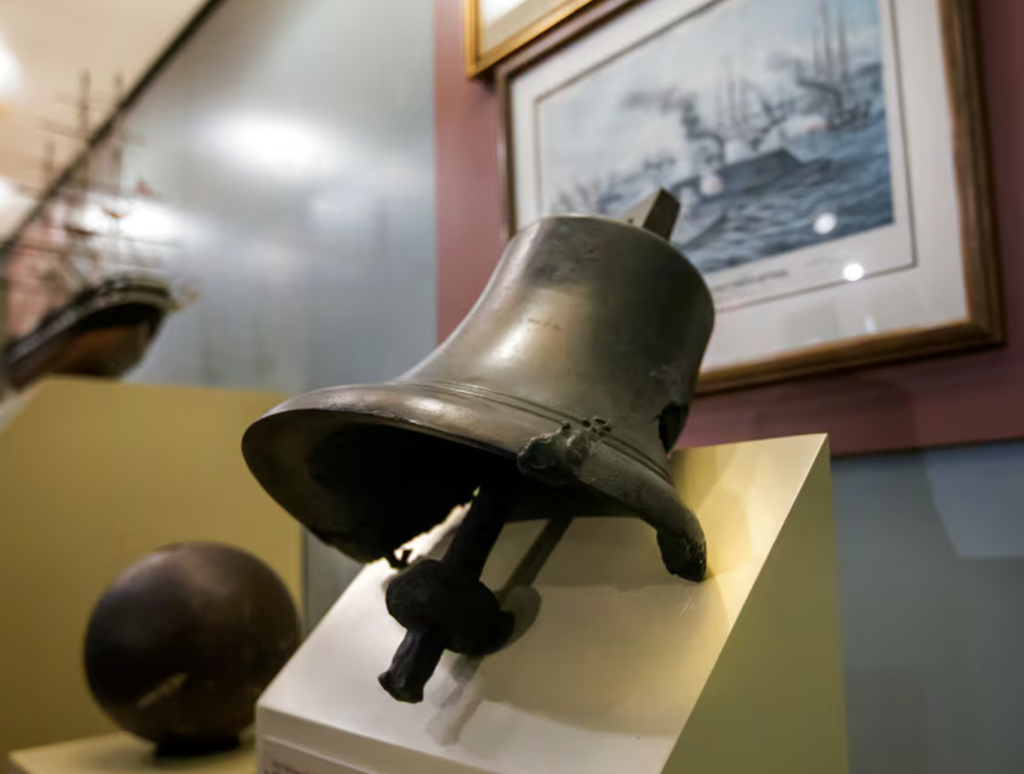
The CSS Virginia’s brass bell was also salvaged from the wreck and is now on display at the Hampton’s Naval Museum. The bell was originally salvaged in 1875 by a diver who received government permission to go and excavate what was left at the CSS Virginia’s wreck site.36 The diver successfully recovered very little; however, he did recover the brass bell that had a very symbolic meaning in the Confederacy and served as the “heart and soul” of the CSS Virginia.37 For Navies around the world, bells act as a method of timekeeping, alarms in times of distress, and honoring personnel who pass away, all aspects that are sacred to Navy men while out at sea. The bell was unfortunately broken in half during a fire in 1907, while it was on display at St. Paul’s Catholic Church in Portsmouth.38 In hopes of preserving some of its importance, the bell was not reconstructed, but instead, what was left of it was put on display at the Hamptons Roads Naval Museum to showcase its original significance to the crew aboard the CSS Virginia.
Brooke Cannon:
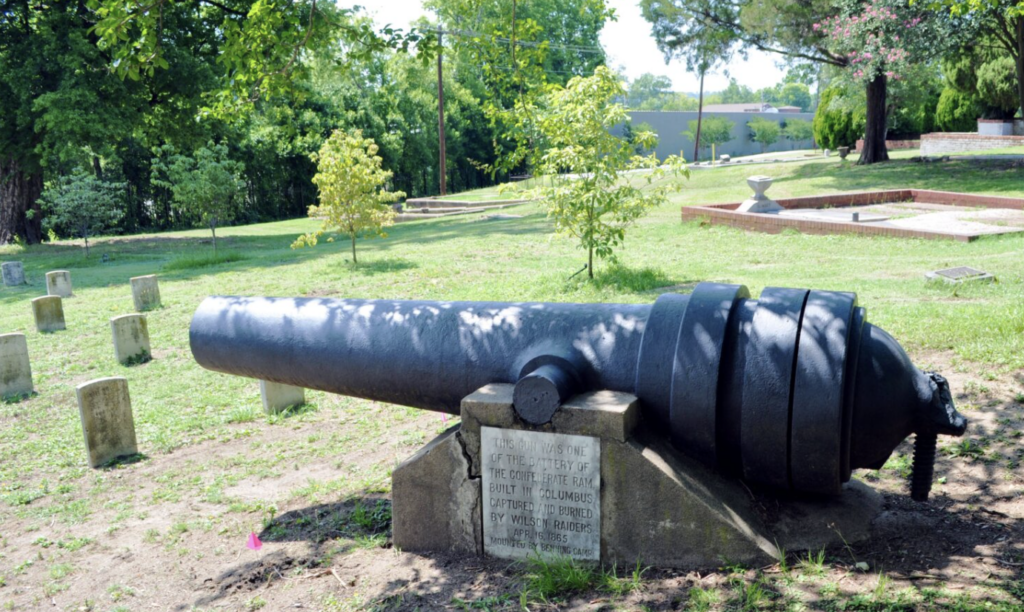
The Brooke cannon, also salvaged from the CSS Virginia, was a technological phenomenon when it was built. Built by Lt. Brooke in the 1840’s, this cannon was designed to shoot explosive shells, a civil war time invention meant to inflict more damage on opposing ships.40 The model of Brooke cannon that was salvaged was the 6.4-inch Brooke rifle, developed to be a broadside gun for the CSS Virginia, and weighing in at 10,675 pounds.41 It would accompany the CSS Virginia as one of its main operational guns until it sank in 1862. Today, the cannon sits on display at the Linwood Cemetery, above graves commemorating Confederate soldiers who fought during the Civil War.
Conclusion:
These artifacts are what remain of the CSS Virginia, symbolizing the influence it had on naval warfare. Although not much was recovered, what was found at the CSS Virginia wreck site provides a somewhat full picture of how the ship operated and what made it unique for its time. To answer our proposed question, the CSS Virginia, with help from the USS Monitor, was able to have a lasting impact on naval warfare, as it proved that wooden ships were no longer a match for advancing technology. It is clear by reading the reports of those who witnessed the Battle of Hampton Roads, as well as reports describing what happened during and after the battle, that the CSS Virginia influenced the construction of ironclads worldwide after its debut during the Civil War. The construction of ironclads around the world in the late 1860s and early 1870s proves that naval warfare would not be the same today without the Battle of Hampton Roads. Although there have been a lot of technological advancements even since the age of the ironclad, the CSS Virginia and ironclads hold a special place in history as some of the earliest modern warships.
Footnotes:
- Library Company of Philadelphia. 1862. Destruction of the Rebel Monster “Merrimac” off Craney Island, May 11th, 1862. Lithograph. Wikimedia Commons. ↩︎
- Rafuse, “‘CSS Virginia’ Encyclopedia Virginia.” ↩︎
- Rafuse, “‘CSS Virginia’ Encyclopedia Virginia.” ↩︎
- Rafuse, “‘CSS Virginia’ Encyclopedia Virginia.” ↩︎
- Rafuse, “‘CSS Virginia’ Encyclopedia Virginia.” ↩︎
- Holloway and White, “Our Little Monitor: The Greatest Invention of the Civil War,” 102 ↩︎
- Konstam, “European Ironclads 1860-75,” 4 ↩︎
- Konstam, “European Ironclads 1860-75,” 4 ↩︎
- Konstam, “European Ironclads 1860-75,” 4 ↩︎
- Holloway and White, “Our Little Monitor: The Greatest Invention of the Civil War,” 103 ↩︎
- Stuart, Alexander Charles, Merrimac Sinking the Cumberland, 1862-1866, oil on canvas, Wikimedia Commons ↩︎
- Lawrence Van Gelder, “Monitor’s Fight With Merrimack Began Age of Iron Ships,” The New York Times, March 8, 1974. ↩︎
- Lawrence Van Gelder, “Monitor’s Fight With Merrimack Began Age of Iron Ships,” The New York Times, March 8, 1974. ↩︎
- Lawrence Van Gelder, “Monitor’s Fight With Merrimack Began Age of Iron Ships,” The New York Times, March 8, 1974. ↩︎
- General Huger, Benj. 1862. General S. Cooper, March 10th. Naval History and Heritage Command. ↩︎
- General Huger, Benj. 1862. General S. Cooper, March 10th. Naval History and Heritage Command. ↩︎
- General Huger, Benj. 1862. General S. Cooper, March 10th. Naval History and Heritage Command. ↩︎
- Lieutenant Samuel Dana Green, 1862. Mother and Father, March 14th. Naval History and Heritage Command, 3 ↩︎
- Lieutenant Samuel Dana Green, 1862. Mother and Father, March 14th. Naval History and Heritage Command, 4 ↩︎
- Lieutenant Samuel Dana Green, 1862. Mother and Father, March 14th. Naval History and Heritage Command, 4 ↩︎
- Geoffroi, François, The French Battleship La Gloire, 1859, painting, Wikimedia Commons ↩︎
- Holloway and White, “Our Little Monitor: The Greatest Invention of the Civil War,” 103 ↩︎
- Konstam, “European Ironclads 1860-75,” 13 ↩︎
- Konstam, “European Ironclads 1860-75,” 19 ↩︎
- Konstam, “European Ironclads 1860-75,” 14 ↩︎
- Konstam, “European Ironclads 1860-75,” 6 ↩︎
- “Merrimack (U.S.S.) | National Underwater and Marine Agency,” n.d. ↩︎
- “Merrimack (U.S.S.) | National Underwater and Marine Agency,” n.d. ↩︎
- “SECTION OF ARMOR PLATE, CSS VIRGINIA – The Mariners’ Museum Online Catalog,” n.d. ↩︎
- “SECTION OF ARMOR PLATE, CSS VIRGINIA – The Mariners’ Museum Online Catalog,” n.d. ↩︎
- “SECTION OF ARMOR PLATE, CSS VIRGINIA – The Mariners’ Museum Online Catalog,” n.d. ↩︎
- Object Record, The American Civil War Museum ↩︎
- Object Record, The American Civil War Museum ↩︎
- Object Record, The American Civil War Museum ↩︎
- Hafner, “Whatever happened to the Merrimack’s brass bell?” ↩︎
- Hafner, “Whatever happened to the Merrimack’s brass bell?” ↩︎
- Hafner, “Whatever happened to the Merrimack’s brass bell?” ↩︎
- Hafner, “Whatever happened to the Merrimack’s brass bell?” ↩︎
- Quarstein, “Guns of the CSS Virginia” ↩︎
- Quarstein, “Guns of the CSS Virginia” ↩︎
- Quarstein, “Guns of the CSS Virginia” ↩︎