
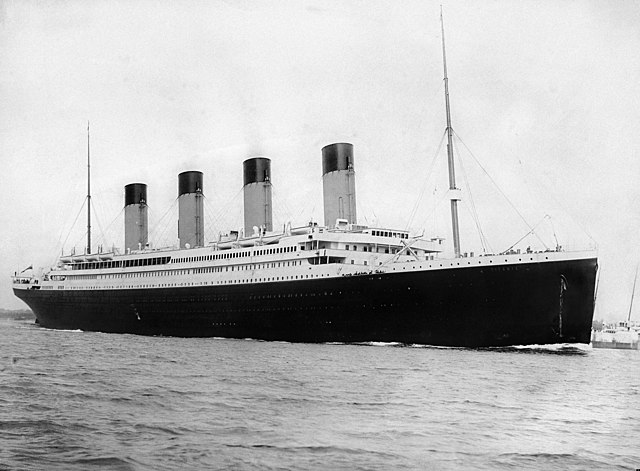
The Titanic was a British ocean liner that departed from Southampton on April 10, 1912 for New York. It sank on April 15, 1912 at 2:20 am in the North Atlantic ocean, around 400 miles south of Newfoundland, Canada.1 The luxury steamship had struck an iceberg and out of the 2,240 passengers and crew on board, over 1,500 lost their lives in the tragedy. The Titanic to this day remains a cultural legend. The question that led us through our research tries to grasp the full extent of the aftermath of the Titanic sinking: What were the effects of the Titanic sinking on the maritime world and the greater cultural conscience? We dissected the question by looking at different aspects of the maritime world and beyond that the Titanic affected, such as ship technology, maritime regulation, and culture as a whole.
Why the Titanic?
The RMS Titanic is still one of the most important case studies for shipwrecks because it represents the catastrophic intersection of industrial hubris and social hierarchy. As a new ship of the White Star Line, the Titanic was designed to be the largest and most luxurious ship of its time, symbolizing the height of Edwardian era technology3. As it was widely advertised as “practically unsinkable” in the publications of the time, such as The Shipbuilder, its sinking became a cultural shock. It is this perceived invincibility that makes the Titanic such an interesting case study in how a dependence on modern technology can lead to a systemic ignorance and disregard for other factors such as the environment, and for the Titanic, the ice fields of the North Atlantic.
The disaster also served as one of the most important triggers for the reformation of international maritime law and safety regulations. The lifeboat regulations of the British Board of Trade at the time of the sinking were based on the gross tonnage of the ship, not its passenger capacity, which created a loophole that allowed the Titanic to set sail with enough lifeboats for only half of the people on board. Even more alarmingly, the absence of a standardized 24-hour radio watch meant that ships in the nearby area were not aware of the distress calls from the Titanic. Analyzing the Titanic shipwreck from this perspective highlights how the sinking directly led to the 1914 International Convention for the Safety of Life at Sea (SOLAS), which established a law that mandated enough lifeboats for every person on board and created the International Ice Patrol.
The tragic end of the Titanic’s first voyage on April 14, 1912, also serves as a critical look into the flaws and resulting failure of operational communication. Despite receiving several wireless telegraph warnings from other ships about heavy ice, the Titanic continued to move at a fast speed of 22 knots. The collision with the iceberg and the desperate distress calls made by operators Jack Phillips and Harold Bride illustrate the disparity between information and decision-making. Through the use of the Titanic, we can successfully examine how the failure of communication systems and a lack of emergency planning can turn a local event into a global disaster.
About the Authors
Martin Moshfeghi
Martin is a first year student at Carleton College from Palo Alto, California. He is interested in Chemistry and English. In this project, his work is focused on the impact that the sinking of the Titanic had on maritime safety.
Iris Noren
Iris is a first year student at Carleton College from Minneapolis, Minnesota. She is interested in majoring in Geology. In this project, her work focused on the broader cultural and societal impacts of the sinking of the Titanic.
Anujin Purevtseren
Anujin is a first year student at Carleton College from Charlotte, North Carolina. She is a prospective Economics major. In the project she focuses on the effects of the sinking of the Titanic on maritime technology and architecture.
- “R.M.S Titanic – History and Significance | National Oceanic and Atmospheric Administration.” 2024. Www.noaa.gov. July 18, 2024. https://www.noaa.gov/office-of-general-counsel/gc-international-section/rms-titanic-history-and-significance. ↩︎
- Stuart, F. G. O. 1912. “English: RMS Titanic Departing Southampton on April 10, 1912.” Wikimedia Commons. 1912. https://commons.wikimedia.org/wiki/File:RMS_Titanic_3.jpg.
↩︎ - Battles, James B. 2001. “Disaster Prevention: Lessons Learned from the Titanic.” Baylor University Medical Center Proceedings 14 (2): 150–53. https://doi.org/10.1080/08998280.2001.11927752.
↩︎